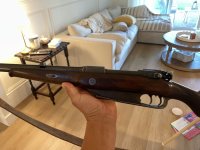
Need help identifying great Grandpa’s rifle!

BeauB

New member
Rating - 0%
0   0   0
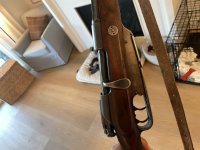
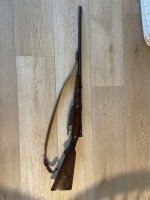
Hey all, recently my Grandpa gave me his father’s old 7mm Mauser*
It looks and feels like a very neat gun.
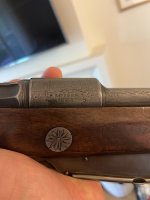
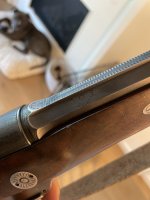
The only words engraved on it are “Bohler Special”
Appreciate any help!
 

Attachments

  • IMG_5301.jpeg
    IMG_5301.jpeg
    99 KB · Views: 151
  • IMG_5299.jpeg
    IMG_5299.jpeg
    79.4 KB · Views: 146
  • IMG_5298.jpeg
    IMG_5298.jpeg
    139.9 KB · Views: 140
  • IMG_5302.jpeg
    IMG_5302.jpeg
    83 KB · Views: 139
  • IMG_5297.jpeg
    IMG_5297.jpeg
    94.4 KB · Views: 148
For the curiousity of it I tossed a copy of the STG image to Grok to look for information (AI's make pretty good search engines IF you tell them blunt and honest answers only) and this is what it came up with.... the stupid thing still might be hallucinating but it looks like a start.

"
blunt honest answer, what can you tell me about a 7mm Mauser rifle with Bohler special on the barrel and the above image on the other side
Thought for 16s

It's a pre-1913 German commercial/sporter Mauser (most likely a 98 action or similar) in 7×57mm Mauser (the classic “7mm Mauser”), with a high-grade Böhler barrel steel and the standard old-style German nitro proof marks from that era.The markings in the photo
  • “7,67 g G.B.P.” = 7.67 grams of Gewehr Blättchen Pulver (military-style flake rifle powder).
  • “St.m.G.” = Stahlmantel Geschoss (steel-jacketed bullet).
This exact format (powder charge weight + bullet type, no separate “Nitro” or crown-N yet) was the German commercial/military-style proof load marking used until about 1912. After 1912 they switched to just the bullet weight + type (e.g., “St.m.G. 12 g”) plus a Nitro mark. So the rifle (or at least the barrel/proof) dates to 1912 or earlier.

germanhuntingguns.com
These marks are almost always on the left side of the receiver ring on German sporting rifles of the period.“Bohler Special” on the barrelBöhler (Gebrüder Böhler / Böhler Edelstahl, Austrian) made premium barrel steels that German and Austrian gunmakers loved for high-end sporters. “Böhler Special,” “Böhler Stahl,” “Bö,” or similar markings indicate the barrel blank is from their better grades of steel — a quality feature, not a maker. It was common on better commercial Mausers, Suhl/Zella-Mehlis guild guns, and custom work from that era.What the rifle actually is

  • Commercial/sporter built on a Mauser action (almost certainly Model 98 or a commercial variant), not a military Gew 98 that was later sporterized (though some of those exist).
  • Chambered for the original 7×57 Mauser cartridge (7 mm Mauser).
  • Typical of the German/Austrian sporting rifle trade before WWI: often half-stocked or full-stocked hunting rifles with nicer wood, sometimes express sights, claw mounts, etc. The decorative flower/star washer or inlay on the stock in the photo is consistent with period commercial work.
  • Proofed under the 1891 German proof law system (crowns over B/U/G etc. would normally also be present somewhere).
Bottom line (blunt)It’s a nice early German commercial 7×57 Mauser sporter with good steel (Böhler) and the classic pre-1913 powder/bullet proof marks. These are solid, well-made hunting rifles from the golden age of German gunmaking. Value depends heavily on condition, originality of the stock/barrel, any maker’s name (Suhl, Zella-Mehlis, or a specific retailer), engraving, and whether the bore is still good. Many were imported or brought back over the years and are still perfectly shootable with modern 7×57 ammo (just stick to standard pressures). If there’s a maker’s name, serial number, or other marks on the barrel or receiver, those would pin it down further.

 
For the curiousity of it I tossed a copy of the STG image to Grok to look for information (AI's make pretty good search engines IF you tell them blunt and honest answers only) and this is what it came up with.... the stupid thing still might be hallucinating but it looks like a start.

"
blunt honest answer, what can you tell me about a 7mm Mauser rifle with Bohler special on the barrel and the above image on the other side
Thought for 16s

It's a pre-1913 German commercial/sporter Mauser (most likely a 98 action or similar) in 7×57mm Mauser (the classic “7mm Mauser”), with a high-grade Böhler barrel steel and the standard old-style German nitro proof marks from that era.The markings in the photo
  • “7,67 g G.B.P.” = 7.67 grams of Gewehr Blättchen Pulver (military-style flake rifle powder).
  • “St.m.G.” = Stahlmantel Geschoss (steel-jacketed bullet).
This exact format (powder charge weight + bullet type, no separate “Nitro” or crown-N yet) was the German commercial/military-style proof load marking used until about 1912. After 1912 they switched to just the bullet weight + type (e.g., “St.m.G. 12 g”) plus a Nitro mark. So the rifle (or at least the barrel/proof) dates to 1912 or earlier.

germanhuntingguns.com
These marks are almost always on the left side of the receiver ring on German sporting rifles of the period.“Bohler Special” on the barrelBöhler (Gebrüder Böhler / Böhler Edelstahl, Austrian) made premium barrel steels that German and Austrian gunmakers loved for high-end sporters. “Böhler Special,” “Böhler Stahl,” “Bö,” or similar markings indicate the barrel blank is from their better grades of steel — a quality feature, not a maker. It was common on better commercial Mausers, Suhl/Zella-Mehlis guild guns, and custom work from that era.What the rifle actually is

  • Commercial/sporter built on a Mauser action (almost certainly Model 98 or a commercial variant), not a military Gew 98 that was later sporterized (though some of those exist).
  • Chambered for the original 7×57 Mauser cartridge (7 mm Mauser).
  • Typical of the German/Austrian sporting rifle trade before WWI: often half-stocked or full-stocked hunting rifles with nicer wood, sometimes express sights, claw mounts, etc. The decorative flower/star washer or inlay on the stock in the photo is consistent with period commercial work.
  • Proofed under the 1891 German proof law system (crowns over B/U/G etc. would normally also be present somewhere).
Bottom line (blunt)It’s a nice early German commercial 7×57 Mauser sporter with good steel (Böhler) and the classic pre-1913 powder/bullet proof marks. These are solid, well-made hunting rifles from the golden age of German gunmaking. Value depends heavily on condition, originality of the stock/barrel, any maker’s name (Suhl, Zella-Mehlis, or a specific retailer), engraving, and whether the bore is still good. Many were imported or brought back over the years and are still perfectly shootable with modern 7×57 ammo (just stick to standard pressures). If there’s a maker’s name, serial number, or other marks on the barrel or receiver, those would pin it down further.

That’s some good info, thank you!
 
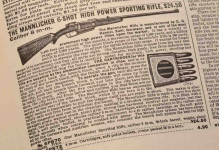
Wow! At $24.50, I'll take two please, and a case of 8mm Mauser ammo.......:);)
I've looked at what $24.50 would be today, and it looks, if we apply today's standards, this would be considered a budget gun today, not that im advocating this is a cheap gun, it is a magnificent heirloom, I would never consider selling it myself

had a closer look at the pix; damn thats a fine looking steel
 
Last edited:
You have a factory built sporting rifle built on the Gewehr 1888 Mannlicher style action.
Very nice gun.

Böhler Special, stands for Böhler Special Laufstahl, = special barrel steel
You are likely correct that it's a factory built sporter, but back in the day, many "cottage" smiths produced almost identical copies of those firearms.

OP, there should be a factory or maker stamp on the top of the barrel, along with bullet diameter.

Those rifles are very nice. The actions are smooth and well finished.

The only drawback is they require "enbloc" bullet carriers, unless your rifle has the internal side spring conversion inside the mag well.

I just went back and looked at your pics, your rifle appears to have a release system on the mag well. It may very well have the conversion, or the release system is for the enbloc.
 
Back
Top Bottom