What the! 40 shot string one POA hot barrel

WhelanLad

CGN Ultra frequent flyer
Rating - 0%
0   0   0
Location
Australia AU
check this out an lend ya thoughts.
i found interesting that a poster mentioned to me it doesnt matter if my FWT barrel gets hot , as it doesnt effect accuracy etc.....

an i felt like it did, somehow.... an like the video guy says, you would suspect the gun is a 1/2 moa gun...... until ya shot it more and he knew its a 1.5 inch gun..... an this was the results

 
His results in his gun with his ammo, and you have to take that all that is on the up and up.
Lots of YouTube videos are less than honest in the narrative they portray, I don’t think this guy is doing that but take it into consideration.
Next is the cartridge he is using, a 223 which is basically a military cartridge that was originally designed for semi automatic high volume fire and still provide good barrel life.
Next, we do not know anything about his gun; how free floated the barrel is (or not) or what type of manufacture it is.
In my experience, not that I do it anymore, is on longer strings (nowhere close to 40…) group sizes either open up or shift.
I’m likely wrong and will be corrected shortly but my thoughts on the causes are likely:
-increasing anxiety and/or fatigue shooting a larger recoiling cartridge works against keeping a long string group size really small…
In all but the smaller cartridges or super thin pencil barrels I would think this is the largest culprit.
-the barrel warps from the increasing heat probably from internal stresses created when manufactured and how it was manufactured.
I think this would show a gradual walking of the group.
-if the barrel isn’t sufficiently free floated and contacts something while heated or if it’s pressure bedded the point and pressure of its contact changes which changes the harmonics.
I think this more displays groups opening or increased fliers within a group.

I think the effect of heat on barrels is more than real as are the steps to mitigate it but in the context of a pure hunting rifle/cartridge I think it’s pretty much irrelevant.
For a hunting rifle I need the cold bore shot to go where I want it to go, and be able to repeat that cold bore shot time and again.
I’ll also need the second shot to land in the same place and a third going to the POI is preferable but not a show stopper if it would shift marginally.
Just throwing it out there but most of the time one or two are all that’s needed and of the very few times I’ve witnessed higher volumes of fire to harvest the shooters form has been thrown out the window and the resulting meat damage is a true waste…heat opening the group is the least of the contributing factors.
Just my opinion, YMMV.
 
I’m not too worried about how a hot barrel may affect precision in a properly assembled rifle. I only worry about destroying a throat from long strings of fire in a rifle I never intended to do frequent barrel changes on.

Oddly, that was a satisfying video to watch. Thanks for sharing!
 
In about 60 years of shooting, hunting and backwoods 'smithing I played with a good number of different rifles. Because the areas I hunted whitetail deer, black bear etc. are fairly rough terrain, heavily wooded, a 'featherweight' rifle can make life a lot easier. Because of the nature of the terrain, long range shots are few and far between making bench-rest accuracy a secondary consideration.
I've owned a good number of 'featherweights' in various calibers, mostly things like post '82 Win. mod. 70s and old BSAs in 30-06, 7X57 or .257 Roberts. Virtually all of those were quite accurate for 3 rounds, 4 if you were lucky, and after that they all started stringing vertically. Somewhat frustrating if you wanted to punch neat little holes 5 at a time, but all more than adequate for any hunting situation I ever encountered.

If a game animal isn't down after 3 rounds, you probably had no business shooting at it under the circumstances. ;-)
 
His results in his gun with his ammo, and you have to take that all that is on the up and up.
Lots of YouTube videos are less than honest in the narrative they portray, I don’t think this guy is doing that but take it into consideration.
Next is the cartridge he is using, a 223 which is basically a military cartridge that was originally designed for semi automatic high volume fire and still provide good barrel life.
Next, we do not know anything about his gun; how free floated the barrel is (or not) or what type of manufacture it is.
In my experience, not that I do it anymore, is on longer strings (nowhere close to 40…) group sizes either open up or shift.
I’m likely wrong and will be corrected shortly but my thoughts on the causes are likely:
-increasing anxiety and/or fatigue shooting a larger recoiling cartridge works against keeping a long string group size really small…
In all but the smaller cartridges or super thin pencil barrels I would think this is the largest culprit.
-the barrel warps from the increasing heat probably from internal stresses created when manufactured and how it was manufactured.
I think this would show a gradual walking of the group.
-if the barrel isn’t sufficiently free floated and contacts something while heated or if it’s pressure bedded the point and pressure of its contact changes which changes the harmonics.
I think this more displays groups opening or increased fliers within a group.

I think the effect of heat on barrels is more than real as are the steps to mitigate it but in the context of a pure hunting rifle/cartridge I think it’s pretty much irrelevant.
For a hunting rifle I need the cold bore shot to go where I want it to go, and be able to repeat that cold bore shot time and again.
I’ll also need the second shot to land in the same place and a third going to the POI is preferable but not a show stopper if it would shift marginally.
Just throwing it out there but most of the time one or two are all that’s needed and of the very few times I’ve witnessed higher volumes of fire to harvest the shooters form has been thrown out the window and the resulting meat damage is a true waste…heat opening the group is the least of the contributing factors.
Just my opinion, YMMV.
you raise many valid points
That said, groups opening up from a hot barrel is a real thing. I'm experiencing it with a rifle I've owned for many years that has been exceptionally reliable and accurate until this year when I started to notice fliers as she heated up. This a factory rifle that was blueprinted , freefloated and trigger worked by a highly respected smithy. I've done many 10shot groups in past sessions and never noticed what I'm experiencing this year. This year during range sessions , 5 round groups, deliberate fire with maybe 30 seconds between shots, she puts 4 right where i want them and then launches the 5th way outside the group and high. Basically she has become a scatter gun after the 4rth shot. The result was repeatable from a cold barrel several times. In my case, the rifle has seen a lot of use both in the field and on the bench so I figure it's the barrel telling me I need to replace it LOL Still has excellent cold bore accuracy and though it happens, I rarely need a follow up shot in the field. I can still hunt with it but her target shooting days are over with that barrel
 
I've sat down and fired a box of rounds from a pencil barrel 308. So far, accuracy doesn't go downhill when it heats up

More testing needed

And it won't, with a properly made gun :)

check this out an lend ya thoughts.
i found interesting that a poster mentioned to me it doesnt matter if my FWT barrel gets hot , as it doesnt effect accuracy etc.....

an i felt like it did, somehow.... an like the video guy says, you would suspect the gun is a 1/2 moa gun...... until ya shot it more and he knew its a 1.5 inch gun..... an this was the results


Ahhh but what you COULD do....is just shoot 3 shot groups, call it a sub MOA rifle, and don't worry about how one group lands far enough away from the last one that its actually still a 1.5 MOA gun.
 
40 shots in 17 minutes that's 1 shot every 25.5 seconds not exactly rapid fire some cooling happens between shots.

Hypothetically try 1 shot every 3 seconds and see what happens? Gemini AI says -

55589255452_b038b04357_z.jpg

55589255892_6cc60e4984.jpg
 
Last edited:
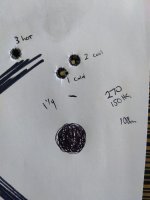
I did some "testing" today 😂😂

3 shots but cold, cool and then basically hot straight after the second...results
IMG_20261015_183009~2.jpg


That's the winchester- thin barrel.
FRANCHI is considerably thicker- standard sporter spec.... An it shoots 3 back to back No worries and accurately..... Model 70 not so. Kimber not really so either.


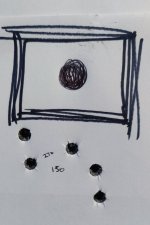
Here's a 5 shot combo of 270 model 70,
It's 2 MOA .

Similiar sequence. But I left it cool right down and fired a cold #4 and cool #5.

**Adjusted POI between groups-

I'll take that as a Hunter rifle... But It's not a super target gun for sure but I just enjoy shooting it.

IMG_20261015_182251~2.jpg
 
There are special ways to heat treat barrels to solve the wandering poi as a barrel warms up, there is also a "cryogenic stabilizing treatment" which IMHO isn't quite as good as proper heat treatment. Both are expensive, some factory rifles have said barrel treatments, but they're also expensive.

Most of us just don't require that type of performance, unless we're at the range working up loads.

Then there are the "unicorn" firearms that just shoot very well, cold or hot. I've yet to come across one in chambered in a cartridge I would hunt big game with.

I'm showing my age here, but when I first started shooting in the sixties, a 4moa rifle was considered to be an accurate rifle. Mind you, back then most hunters used "common sense" and didn't shoot at game animals beyond 2-300 yds.

Today, a 4moa rifle is scoffed at.

The thing is, most of those older 4moa rifles responded very well to modern powders, bullets, and primers that we can get reliably today.

The advent of the "Juenke" gauge, that measured birefringence differences between jacket thicknesses, opened up a lot of eyes, now bullet jackets are extremely consistent in thickness.

WL, most rifles will shoot well for the first 3-5 shots, then they start to open the group, but as the barrel reaches a certain point of temperature, harmonics settle down, and the rifle starts shooting well again, and will keep shooting well as long as the temp is kept consistent.

Most of us here have shot extended strings at one time or another, either because we didn't know any better or in some cases had the impression that the "sweet" spot, shooting from a barrel hot enough to burn your fingers would still be the same when the barrel cooled again.

It was a learning curve.

One spot we used to shoot a lot of gophers on, was a great learning experience. The population of the critters was likely a few hundred thousand, on a clear cut, which was going to become a hay field, but the farmer didn't have time to complete the job.

We would shoot anywhere from 500 - 1000 222rem or 223rem every day. Those barrels weren't heavy match barrels, because we had to move around a lot. As mentioned above, the average groups soon opened up from a half inch to 1.5 inches and stayed there, until the jacket fouling became extreme, and we just had to stop for cleaning.

Most people couldn't afford to shoot that much for a couple of days in a row. We didn't use surplus ammo, because it just wasn't accurate enough.

 
I know that at 1,000 yards as the barrel warms up, the longer you leave the cartridge in the chamber the higher it’s going to hit the target. But that’s more about the powder heating up than the barrel.


I’m sure there’s some point where heat hurts accuracy or precision but that’s a matter of degree

 
This is a good thread.
I don't necessarily agree on all points but that's not important is it? It's a polite discussion on differing points of view. A refreshing departure from the norm.
 
Back
Top Bottom