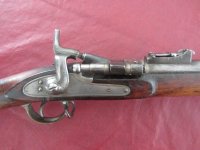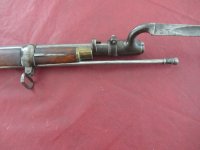












































Canadian Sniders with their matching bayonet

Pelcat

Member
Rating - 100%
27   0   0
I'm curious if anyone here has been able to pair up a Canadian Militia Snider with it's matching bayonet?

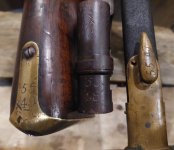
I almost did, this scabbard, bayonet and 3-bander are all one rack number off from each other. They are from the 55th Megantic Battalion, headquartered in my home town. Rack number 49 for the rifle, 48 for the bayonet and 47 for the scabbard.

I got the bayonet and scabbard first from a friend's grandfather, also from my town. It was hidden away in his barn. According to him the bayonet belonged to his grandfather. It also has another ground off rack number on the socket, 55/205.

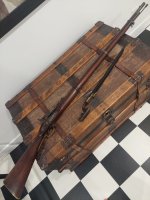
The rifle I came across at auction. It was a sporter, cut right in front of the rear band and crudely shaped to a point with a knife. It was missing a lot of small parts, all three bands, the lock screw for the action pin, cleaning rod, firing pin protector, rear sight slider, rear sight but the sight ladder was present and matching. The forend came from a rough stripped stock and was spliced onto the original stock. Bit of time and money expended but to me it was worth it to put them back together in their original configuration.

I know rifle 55/46 is out there as well, it sold in 2017 for a ridiculous amount of money at a non-firearms auction.

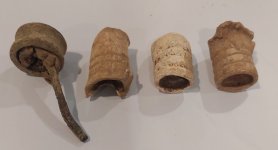
Also pictured some bullets and a tompion I found not 200 meters away from my family home.


1000003490-jpg.1226057

1000003486.jpg
1000003491.jpg
 

Attachments

  • 1000003490.jpg
    1000003490.jpg
    108.3 KB · Views: 150
Very cool, a DC marked Snider is on my "wanted" list - I don't hold out a lot of hope of finding one with even a closely matched bayo tho!
Great job bringing that old gal back from the dead!
 
Last edited:
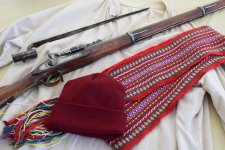
Yes, good job saving another one. I'm in the middle of building a "parts" Snider from spares I had assembled over the years and it's proving surprisingly easy. There certainly was some "interchangeability" with these guns. Personally, I've never managed to find a matching bayonet, but I have managed to get three rifles marked to units that participated in the Riel Rebellion- another collecting direction for Canuck Sniders.

milsurpo
 
….., but I have managed to get three rifles marked to units that participated in the Riel Rebellion- another collecting direction for Canuck Sniders.

milsurpo
This is what I would like to add to my collection as it was likely what my great,great (great?) would have carried when he served in the rebellion
 
Last edited:
Nice find it's those small towns in Quebec and Ontario that seem to hide all kind of treasures. One of my Sniders is from the Montmagny and L'islet battalion but I had no luck and it came without a bayonet.

There are so many things like this all over the place, they get stored in a barn, attic or in a shack and then the owners die and it's still there 100 years later.

I have another Snider from the 55th that I loaned for a local exhibit. A guy from my town saw it and came by to my place with a red box of Dominion Snider catridges to give me. He told me that he never knew what rifle they were for but when he saw my rifle it reminded him of them, they'd been sitting on his basement windowsill since he bought the place!

Another person decently close by apparently found a cache of all sorts of old rifles in a small cave on his land, all rusted out. I was told there were some Sniders in there but unfortunately, I was never able to see them before he moved away and did god knows what with them.

I wager a lot of interesting Sniders were probably left to sit and rot. They got surplussed in the early 1900s and only 20 years later a metric ton of much more modern Lee Enfields were hitting the market. I had to clean out mud dauber nests from the cleaning rod channel of the very rifle pictured here, clearly it had been sitting in a not too insulated place for a good while.
 
With your permission....
End of the 70's, I had a call at the house of an old lady and, on the wall, there was a rack with two Snider-Enfields, a 3 bands and a 2 bands , both BRAND NEW.
She told me they belonged to a member of the family that was at the battle of Batoche.
The wood was yellowish, with matching bayonets in their sheats.
On the sides, above the triggers, a name was inscribed, like with a hot branding iron : Capt W.Pearce.
There is a Capt W.Pearce who was a surveyor as per the note on Wikipedia :

William Pearce was not a combat captain in the Battle of Batoche (May 9–12, 1885), but rather a prominent Dominion Land Surveyor and federal public servant whose pre-war actions directly contributed to the tensions that caused the North-West Resistance. [1, 2, 3]

Was it him ? Probably.
Were the rifle a presentation to him ? also probably.
At those times, there was no Internet to make a research.
I asked the lady if, by any chance, the rifles might be for sale....guess the answer ?
 
Was it him ? Probably.
Were the rifle a presentation to him ? also probably.
At those times, there was no Internet to make a research.
I asked the lady if, by any chance, the rifles might be for sale....guess the answer ?

I'm guessing you got the same answer as when an unliscenced friend pulled out a Long Branch No.4T sniper (that belonged to her father that allegedely used to be an FLQ member) wrapped in a bedsheet and tape from her broom closet and asked me what it was.

"NO"
 
Do you know what unit he served with?
I do not, still trying to find that info.
There is also some thought that he may have been involved in the Fenian incursions as well - so hard to find history of this time period.
I have found out however that his father was a Lt in the 42nd Reg of Foot - still trying to figure out where he would have served to but we believe it was likely the Napoleonic wars in France.
He was given a land grant in Inverness County QC for his service and moved to Canada - my dad always said the king just wanted rid of him :D
 
Last edited:
He was given a land grant in Inverness County QC for his service and moved to Canada - my dad always said the king just wanted rid of him :D

Small world!

Inverness County was the old name of Megantic county, where this very Snider is from. My hometown, Inverness, was the county "capital". It was mostly settled by Scots from Arran Isle early on, they would've have arrived in the 1820s. Lots of Irish during the famines later on. They subdivided the land in the early 1810s, I was able to find the map for that in the Quebec archives.

Were you to PM me some details I may be able to tell you more or at least put you in contact with a local historian who does. I'll just point out that the timeline of him serving in both the Napoleonic wars and the 1885 rebelion does not really add up to me. If he did he would have been really old at that point, especially at that time. That's even if they did employ him as a child soldier initially, lol.

I'm into our local history so that's very cool to hear!
 
Last edited:
These Sniders, they would kick like a mule, yes? What type of charge would these have shot?

The long rifles aren't all that bad due to their weight. I have a Snider cavalry carbine (marked to the Quebec Cavalry, B troop) though and that one hurts. After the third shot I had to force myself to finish the group.

Depending what mark of cartridge, original loads were a 530gr or 480gr bullet in front of 65gr or 60gr of RFG2 powder (about equivalent to 1.5Fg).
 
Last edited:
Small world!

Inverness County was the old name of Megantic county, where this very Snider is from. My hometown, Inverness, was the county "capital". It was mostly settled by Scots from Arran Isle early on, they would've have arrived in the 1820s. Lots of Irish during the famines later on. They subdivided the land in the early 1810s, I was able to find the map for that in the Quebec archives.

Were you to PM me some details I may be able to tell you more or at least put you in contact with a local historian who does. I'll just point out that the timeline of him serving in both the Napoleonic wars and the 1885 rebelion does not add up, if he did he would have been really old at that point. Even if they did employ him as a child soldier, lol.

I'm into our local history so that's very cool to hear!
That certainly is cool!
Im only starting into my research as the firearms of that period have suddenly caught my intrest.
So, the father (George) supposably fought in France in the early 1800s - his son John in the Riel rebellion (and Fenion raids possibly)
The family apparently donated land and had a church named after them in the Inverness area (Wilton surname)

So I went through the index of the book "Annals of Megantic County" (rare book, not in print anymore) and John Wilton appears on pages 43 and 139. No George Wilton was mentionned in the book.

Pg.43: On 11th range Inverness, the first settlers were three Johns, viz.: "Jack Campell" (founder afterwards of Campbell's Corners), John Glass and John Wilton, who were on the field as early as 1830. Fifteen years later St. Stephen's church was erected, meetings previous to that time having been held in houses. Lambie's Mill was the nearest to these settlers, and before roads were opened up the settlers carried grain and flour on their backs.

Nothing much on page 139 unfortunately, just a passing mention of the Wiltons being one of the families on 11th range. The book was published in 1902, the author interviewed people living at the time. There is a lot more info on other families, my guess is the Wiltons had long moved on by that point.

I do not know of any church being named Wilton but there were two Anglican churches on range road 11. The first burned down in the 1800s and was at the site of the Anglican cemetary, near Rectory Hill. This may be the one they donated the land for. I know the current landowner and have metal detected the field around it, I'm actually going back tomorrow. The second church was on Rectory Hill proper, it also burnt in the second half of the 20th century, the exact date escapes me.

I can check for headstones with the Wilton surname when I go back. I can also ask the historian if she knows any more. A 1796 token was found on the land they may have been on, and I have found a Half Penny token there as well as a fragment of nicely engraved crotal bell.
 
Last edited:
Back
Top Bottom