










































7mm Rem mag fail to fire

This is long winded so hang with me.

I loaded some 120gr v-max in the 7mm RM to get the newly mounted scope on paper. I bore sighted at the range and first shot went off without a problem. The second shot was click and no bang. Sat there for a couple minutes before I ejected the shell and put it in the 'bomb' disposal can. The second round had a normal firing pin dent in the primer so figured it was a dud primer. Fired the third shot and I physically heard a click, then the bang. Point of impact was maybe 1.5" lower than the other shot at 100 yards. I thought that was off as well. Tried one more and it only went click, no bang. I packed the gun up after that round sat for a few minutes and was disposed of in the safe place.

I resized the brass according to the RCBS die sheet. I can't remember what primer I had put in there as I don't have the box anymore, but I do know that they are just regular large rifle primers, not magnums. Primers were all seated all the way down in the pocket and were flush with the case head. The charge was 61 grains of H414 that was leftover from doing some Mauser loads years ago. The powder has always been kept in a cool dry place in a sealed container.

The case measurements are just a shade bigger than a factory load from the same case manufacture. The reloads chamber and eject without problems.

I came home and pulled the bullets from the remaining 10 rounds and put that powder into a separate container until I figure out what's wrong. I then took the empty primed cases and cycled them through the gun and fired them off, each one fired right off! The primer dents in these shells looked identical to the ones that didn't fire at the range.

I also took the bolt out of the gun and cleaned the bolt internally with some solvent the best I could, some crud did come out but nothing of any worry.

So my question is: Is there a possibility that the primer is not strong enough to ignite 61 grains of H414 effectively that I had 2 fail to fire rounds? The cases are obviously not full and the powder can slosh around in there and could have been in any orientation, just depending on how I loaded them in one at a time.

Thanks for staying with me through to the end, I've been scratching my head a long time over this one. I am going to get some magnum primers this weekend, but don't want to waste them on powder that isn't good anymore if that's the case

Josh
One of a couple things likely are causing this.

Defective or contaminated primers.

Over sized brass and a bit generous of headspace causing the case to take its headspace off the belt, and the case is sitting a bit depressed to the bolt face, and you aren’t getting a sold enough impact on the primer. I had this exact issue with my sons .264 WM, and I resorted to using COW fire forming with LP primers, utilizing orthodontic elastics in front of the belt to hold things against the bolt face. I now partial size the cases with zero shoulder bump, and haven’t had a fail to fire since changing my process.
1793468163065.jpeg
1793468214163.jpeg
 
If the same box of primers work fine in another rifle than id be looking at the rifle. You mention thinking they were federal primers, same as you use in your 7mm Mauser without issue. But then you confirm that they're actually CCI primers. Are you using these CCI primers in your 7mm Mauser without issue?


I've got a rifle that didn't like CCI primers. Very inconsistent ignition. Primers were good though, after dismantling the ammo I hit a few with a hammer to make sure they weren't defective. My solution was to only use Federal primers in that gun, they have a reputation for being easier to ignite and they work flawlessly in the gun that doesn't like Cci primers. I've since finished the box of primers in a different rifle and had no issues with the primers themselves.

OP what kind of rifle in the 7 rem mag?

Yes, Suther. I was incorrect on the brand of primer and they are both using CCI in the Mauser and my 7mm RM.

My reloading steps are to tumble the fired brass then resize. I will then clean the primer pocket and flash hole with a deburring tool. Trim to length, deburr and prime. Fill with powder and seat bullet.

I will only deburr the flash hole only the first time, which these were. I always check to make sure the flash hole isn't blocked with my bore light. I am not a high precision reloader but I try my best to get the most accuracy I can with what I have.

I could only find 200 Remington Magnum primers within a 1.5 hour drive of my place. I need to get more powder soon too so will make a trip further soon I guess.

I didn't know that the primers had different hardness, if that's even a word, I thought they would have been a standard density.

I will load some up tomorrow with the old 414 and some with the 4831 and I will see what happens. With the time change it makes it harder to get to the range and bow hunting needs to start sooner than later.

When I go hunting I can swing by and grab the misfires if they are still in there as it's only a couple blocks from where I hunt

Thanks for all the ideas, well get to the bottom of this and find out the culprit(s).
 
Federal primers are the most sensitive... to the point where some pistol ammo slam fired.

Federal 215's were designed for the .300 Weatherby case and slow powders.


Oil residue or a little solvent residue can kill a primer quite easily after a bit of time.

I once used Hoppes # 9 as a lubricant when turning some necks... just a little. I wiped the case necks dry. Primed and loaded a few rounds. Went to shoot them two weeks later... none fired. Powder was fine... damn Hoppes seeped down as the cases were all standing in a loading tray. That was a long time ago.
I never have encountered bad powder. Most of the 4831 on the market into the 1980's was surplus from the 1940's. It worked just fine.
 
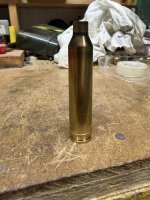
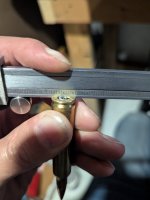
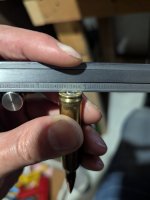
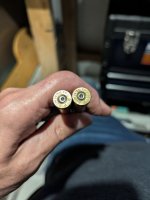
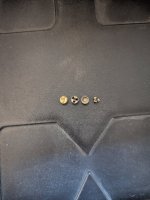
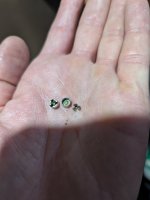
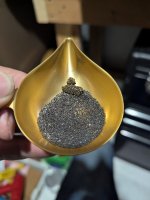
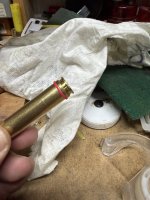
Grabbed the misfires from the range this morning and here are pictures. First of the misfires has one primer strike, the second I think I let it have 4 before deeming it a dud. The single punch primer sits flush with the case head and the quad punch primer sits proud, likely from the multiple hits mushrooming the material out. Bullets have been pulled and will inspect primers once decapped. Dumped powder out in my balance cup and seen the powder right at the flash hole was discoloured and clumped up. It's crispy and takes a bit of a push to break it up.

Popped the primers out and one had the anvil fall out with the primer, the other one came out whole. Both primers had gone off, you can tell because the one on the left is a new primer of the same make and type.
 

Attachments

  • PXL_20261101_205627762.MP.jpg
    PXL_20261101_205627762.MP.jpg
    64.8 KB · Views: 8
  • PXL_20261101_205659301.MP.jpg
    PXL_20261101_205659301.MP.jpg
    66 KB · Views: 8
  • PXL_20261101_210000102.MP.jpg
    PXL_20261101_210000102.MP.jpg
    63.9 KB · Views: 9
  • PXL_20261101_212340301.jpg
    PXL_20261101_212340301.jpg
    119.9 KB · Views: 9
  • PXL_20261101_212011010.MP.jpg
    PXL_20261101_212011010.MP.jpg
    66.2 KB · Views: 9
  • PXL_20261101_210903431.MP.jpg
    PXL_20261101_210903431.MP.jpg
    77.9 KB · Views: 8
Last edited:
H414 is a notoriously hard to ignite ball power. It has also has been a few years since it's been discontinued, so it is possible it has taken on a bit of moisture as well. Not necessarily, but it could have.

Even with lower charge rates in smaller cartridges with H414 a magnum primer is almost always recommended or used in reloading manuals. For your charge weight, it definitely requires a magnum rifle primer for it to get proper ignition. You might have other factors giving you issues as well. But starting off with a magnum primer is going to be the first step.
 
One of a couple things likely are causing this.

Defective or contaminated primers.
So you read the part where the OP pulled all the remaining rounds and ALL of the remaining primers fired normally and then you came to the conclusion that the primers are defective? :rolleyes:


Dumped powder out in my balance cup and seen the powder right at the flash hole was discoloured and clumped up. It's crispy and takes a bit of a push to break it up.
This is quite similar to the problem I had with some old powder. Unless that powder is dear to you, I would not use it again.


H414 is a notoriously hard to ignite ball power.

Even with lower charge rates in smaller cartridges with H414 a magnum primer is almost always recommended or used in reloading manuals.
This is something I have not experienced. It has been a long time since I have used H414. I remember it being quite dirty.

Potentially this could be the cause of the misfires. He could maybe try that powder in a smaller case, to see if it works in that. Personally I don't want to bugger around with potentially bad powder.
 
Primers are a lot more durable than most people think.

I once found a primed 9mm case in my pocket that had gone through the clothes washer. The primer had thus been soaked in water and soap and then gone through the heat of the drier. I dropped that case into the gun and the primer fired as normal.

The idea of soaking a primer in water or oil to inactivate it is both wrong and dangerous because in my experience, that won't inactivate a primer.
I wil add my own experience to this - I had mis-done some reloads - perhaps 6 or 7 Fed 210 primers were placed in a couple ounces of motor oil to "de-activate" them. The container sat on a shelf and I eventually forgot about them - perhaps a year or so later I "found" them again. I decanted the motor oil - the primers "dried" perhaps a week - then I placed the primers one by one on my shop bench vice - hit them with a ball peen hammer - all went "bang" - the year long soak in the motor oil had not "killed" the primers, although I do not know if a firing pin strike would have set them off or not. After that, I did a much shorter test - several Fed 210 primers were put in tap water for a week or so - then an abbreviated "drying" time - perhaps two or three days - all went "bang" when hit with the ball peen hammer - I still do not know if a firing pin strike would set them off, but I am satisfied that neither soaking in motor oil for a year or so, nor soaking in water for a week or so, will permanently "kill" the pellet in Fed 210 primer.
 
Back
Top Bottom