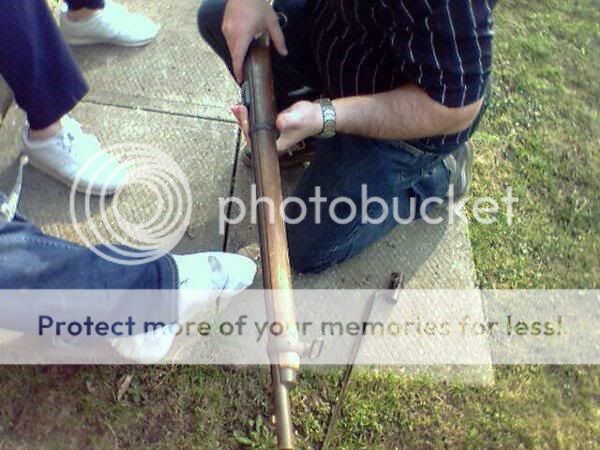
Basement find 1873 Martini Henry

shortandlong

BANNED
BANNED
BANNED
EE Expired
Rating - 100%
36   0   0
Pics are up .........lousy ones but better than nothing :D

An Acquaintance of mine asked me to come by and take a look at an old rifle he found behind a freezer in his basement, and i came find 1873 Martini Henry with the bayonet attached

It apparently belonged to a distant uncle who served in the Boer War.

the condition of the rifle .......i real light haze of rust ......the action works and is not rusted shut by no means .......no cleaning rod but the stock has a small crack, very dry but looks ok..........no water damage (it might have been a basement but it was very dry.
and the rifling is very strong. ........but there was filled with dust bunnies

There is light rust on the crown but its not as bad as it looks

there are two stock markings on the side and bottom

:eek:

going on this what can you tell me ?

comments?

martin4.jpg


martin3.jpg
martin2.jpg
 
Last edited:

right now its on the wifes phone.........he wanted to give it to me becuase he knows I collect a bit but i basically told him .......no, I can't in good honesty as its likely worth something. (i can't fig if i am honest or stupid) :D
 
Well...not what you'll want to hear, but, in all likelyhood it is a Mark1 which makes it quite collectable and valuable. All dependant on condition but Denner sells Mk.1 M/H's for $2,500.00. They are rare as most were upgraded to Mk.2's. "IF" all is original and in VG condition it is a real find! I have one with the 1873 date. The Regimental markings are also important. There should'may be a number or latters stamped into the butt stock somewhere. If you desire you can e-mail me with that info and I will check the history. It should have a stock which goes nearly to the muzzle. Anyway....great find. Dave
 
Dave...... Nice rifle. Some guys have all the luck. Here is a quote from Grandpa Barnes on distinguishing a MK 1 Martini from other models. "The three characteristics that make the Mk1 stand out from others are: 1 - the 'hinge pin (or axis) quite noticeably made of BRASS. The other Mk's are steel. 2 - the 'large cocking indicator extends into the crown design. Even at a distance or without looking at the date, you can pick out a Mk 1 from the others by this pin and the brass axis. 3 - the other is the button shaped ramrod head. Again a one-only design for the MK 1. The plate clearly shows the VR for Queen Victoria, Enfield for Enfield production, the date 1873 (these were introduced in 1871) and below this the numeral 1. for the Mk."
 
It's not stupid by being honest. Stuff isn't worth losing a friend over.

your totally right .........I couldn't do something like that and live with myself. I actually feel good about helping the guy out.. I could never feel like i owned it even if i bought it (it says something about our society when we feel stupid doing the right thing eh?........then again .....CGN is good company)

now .....back to the rifle ....This seems to be a MK1, brass? yes marked 1873,
and all the above.

now the wood is loose due to it being dried out and it will not dry fire..or will itÉ...and no ramrod.

Dave gave me some advice now I am looking for more. ..............Is there pics of regimental markings?

also should i just be taking this to an authority

I will get the guy to send me more pics as well ......I think i have sparked his interest in subject.
 
Last edited:

Any markings would be helpful even a list of what they say and descriptions of where the markings are is good... but pictures are even better.

Also, keep it away from "the authorities" until you've sorted out what it's worth. Perhaps show it to "an authority" on martinis - but none that will try to remove the gun for their profit or to melt it ;)

Other enthusiasts will differ on how to do this, but cleaning the wood of dirt, even with a dry cloth (wet cloth may raise the grain of the wood) could expose some good markings on the stock itself.
 
Don't need to worry about turning it in, or even telling the "authorities"! It's an antique, no registration required!

What a find! I'm excited for you, that's a mighty awesome treasure you've got there:)
 
I know its an antique :D CGN has educated me well :D

I am going to wait for some pics on the proof marks the stock ones are readable
the one odd thing about the one on the right side is a vertical bar stamp underneath the "proof mark" or regimental mark maybe ? which reads 54(if i recall rightly )

now if you look in the pics .......there appears to be a bayonet stud type device on the right ..........WTF is that ? :D thanks

i did not see any N.W.M.P. markings
 
Last edited:

Offa hucks ake.

If it were my basement I might find an old thermos or some National Geographic magazines. Your friend isn't even interested in shooting and he finds a Martini Henry probably carried by a relative in the Boer War. It's just not right. :mad:
 
now if you look in the pics .......there appears to be a bayonet stud type device on the right ..........WTF is that ? :D thanks

Just like you said, it is a bayonet stud. M-H's can accent the socket bayonet (like the one you found with it) and also a "sword" bayonet. Originally the "yataghan (Not sure I spelled that right!) style modified from one used on the snider, and later, a straight bladed one designed specifically for the M-H. Sword bayonets were for rifle regiments and some NCOs.
 
I bet everyone going to check behind their freezers now. Nice find regardless of value.

or better yet .........buy a freezer to check behind it .......you never know ......maybe it crawled there after it escaped a "gun amnesty" to hide ......because all guns have a mind of their own and are all evil :evil:
 
Mk.I Martini Henrys were not issued to Canadian first line troops.

Most Mk.I rifles found in North America come from a batch of about 2000 rifles that were shipped to Canada in 1874 and are sometimes refered to as 'The Canadian cache'. These 2000 were dispersed on loan to DCRA ranges and turn up in canada quite often, many in very shootable condition.

The rifle's serial number will be stamped on the front face of the receiver body and the underside of the barrel reinforce. Not visible until you take the forewood off. The serial will help identify.
 
Back
Top Bottom