












































You are using an out of date browser. It may not display this or other websites correctly.
You should upgrade or use an alternative browser.
You should upgrade or use an alternative browser.
Old artillery shell
- Thread starter Timberlord
- Start date
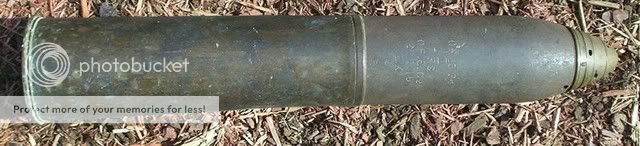


I'm not sure myself (looks like an arty shell) , but all the markings are covered in this "out of print" War Department publication (592 pages plus plates, (115 in colour) in the Technical Articles for Milsurp Collectors and Re-loaders (click here)http://www.milsurps.com/forumdisplay.php?f=25.
1915 Treatise on Ammunition (click here)http://www.milsurps.com/showthread.php?t=3291
This Treatise on Ammunition contains details of all ammunition in use by the British Army at the end of 1914. With few exceptions, it covers ammunition, explosives and propellants in service to the end of the First World War. This volume covers explosives, propellants, fuses and igniters, together with details of all QF and QFC ammunition for field guns. It also covers military pyrotechnics and signal flares, together with the sole British hand grenade. Other sections deal with small arms ammunition, and there is a section on the manufacture of the items covered in this important volume. The volume includes many colour plates and black and white drawings, so I bet you'll find pictures and technical data on on it in this publication.
There's also an earlier 1905 version of the same publication on-line.
Hope that helps ...
Regards,
Badger
1915 Treatise on Ammunition (click here)http://www.milsurps.com/showthread.php?t=3291
This Treatise on Ammunition contains details of all ammunition in use by the British Army at the end of 1914. With few exceptions, it covers ammunition, explosives and propellants in service to the end of the First World War. This volume covers explosives, propellants, fuses and igniters, together with details of all QF and QFC ammunition for field guns. It also covers military pyrotechnics and signal flares, together with the sole British hand grenade. Other sections deal with small arms ammunition, and there is a section on the manufacture of the items covered in this important volume. The volume includes many colour plates and black and white drawings, so I bet you'll find pictures and technical data on on it in this publication.
There's also an earlier 1905 version of the same publication on-line.
Hope that helps ...
Regards,
Badger

My guess would be for a Quick Firing 18 Pounder, a la
http://en.wikipedia.org/wiki/Ordnance_QF_18_pounder
http://en.wikipedia.org/wiki/Ordnance_QF_18_pounder

My guess would be for a Quick Firing 18 Pounder, a la
http://en.wikipedia.org/wiki/Ordnance_QF_18_pounder
Judging by the fact that it is stamped on there, I would agree as well.

Old Shell.
.
British 18 pounder...Standard light artillery gun of WWI.
The brass nose on the fuse has bands that rotate on it. The holes in these rings are for a spanner to set the fuse. Inside the fuse was a "powder train" and when you set the fuse, it moved the vertical part of the train to give shorter or longer time of flight before it burst. The graduated markings are a guide for setting the fuse. This way, you could get an airburst over the enemy trenches, infantry in the open, or other exposed targets. Usually there was also a percussion detonator so the shell would go off it it hit something or the time fuse failed.
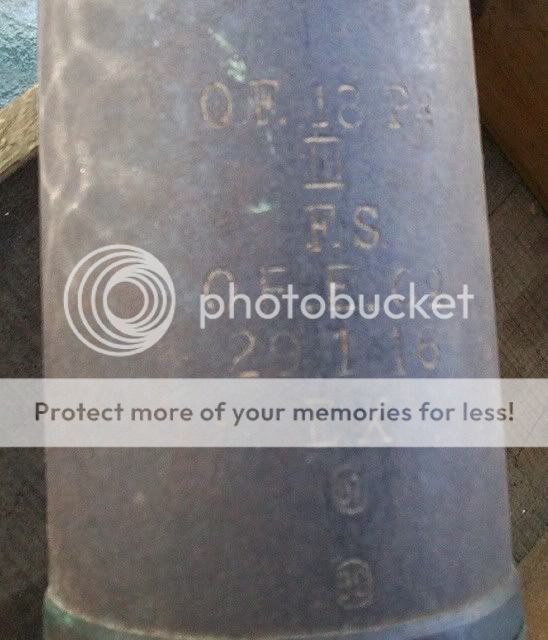
QF 18pr III..............Quick Firing 18 pounder (shell weight) Mark 3
F.S.........................Forged Steel
O.F.E. Co................Manufacturer - Otis Fensom Elevator
29-1-16..................Made 29 January 1916
EX..........................Explosive shell
The brass case is a Mark II case. The various marks are inspector's marks.
These guns were originally pulled by horses. There was an ammunition limber behind the horses that carried a supply of ready ammunition, with the gun behind the limber. Gun carriages were later modified to use rubber tires.
There are still 18 pounder Guns on strength of the British Army today. They are with the demonstration troop of the Royal Horse Artillery, and give shows and demonstrations to the public.
The 18 pounder was still in use during WWII but was replaced by the 25 pounder Gun-Howitzer.
.
.
.
British 18 pounder...Standard light artillery gun of WWI.
The brass nose on the fuse has bands that rotate on it. The holes in these rings are for a spanner to set the fuse. Inside the fuse was a "powder train" and when you set the fuse, it moved the vertical part of the train to give shorter or longer time of flight before it burst. The graduated markings are a guide for setting the fuse. This way, you could get an airburst over the enemy trenches, infantry in the open, or other exposed targets. Usually there was also a percussion detonator so the shell would go off it it hit something or the time fuse failed.
QF 18pr III..............Quick Firing 18 pounder (shell weight) Mark 3
F.S.........................Forged Steel
O.F.E. Co................Manufacturer - Otis Fensom Elevator
29-1-16..................Made 29 January 1916
EX..........................Explosive shell
The brass case is a Mark II case. The various marks are inspector's marks.
These guns were originally pulled by horses. There was an ammunition limber behind the horses that carried a supply of ready ammunition, with the gun behind the limber. Gun carriages were later modified to use rubber tires.
There are still 18 pounder Guns on strength of the British Army today. They are with the demonstration troop of the Royal Horse Artillery, and give shows and demonstrations to the public.
The 18 pounder was still in use during WWII but was replaced by the 25 pounder Gun-Howitzer.
.
.
Last edited:

stencollector
CGN Ultra frequent flyer
- Location
- shilo MB, the armpit of Canada
I have one of those bullets sitting here in the office as well. Mine was made in Winnipeg, and is dated 1916 like yours. Yours appears to be made by Otis elevator company (Otis Fensom Elevator Co back in those days), the same guys who built my WWII Bofors.


Let’s be careful playing with our toys folks…..
Re-posted from milsurps,.com ....
Regards,
Badger
Re-posted from milsurps,.com ....
Casualty of Hobby (click here) http://www.nationalpost.com/news/story.html?id=517839
U. S. Civil War enthusiast killed cleaning artillery shell
Mary Vallis, National Post
Published: Friday, May 16, 2008
Sam White loved researching history so much he used to joke he wanted to be blasted from an American Civil War cannon when he died.
Instead, the passionate relic hunter was cremated and remembered at a simple ceremony near his Virginia home.
Mr. White, 53, was working on a Civil War artillery shell the size of a beach ball in Chester, Va., on Feb. 18 when it exploded.
Shrapnel flew across the street, crashing through a neighbour's porch roof. The blast left a crater in Mr. White's driveway and prompted a two-day evacuation of his suburban neighbourhood.
"When we got to the entrance of the subdivision, it looked like something out of a sci-fimovie, with police, fire trucks, ambulances, bomb squad," his widow, Brenda White, recalled in an interview yesterday.
Three months later, she is still finding shards of safety glass in the driveway.
Officials from the Bureau of Alcohol, Tobacco, Firearms and Explosives (ATF) are soon expected to complete an investigation into Mr. White's death.
Mrs. White hopes it will answer many unanswered questions, including what type of shell caused the blast and what happened to his shoes.
In the meantime, scores of relic hunters who spend their weekends searching for Civil War memorabilia with metal detectors fear Mr. White's death may make their hobby more difficult to enjoy -- and lead to the destruction of artifacts, instead of preservation.
When officials at the nearby Petersburg National Battlefield recently unearthed a 20-kilogram mortar shell while building a road, they immediately called the local bomb squad.
The shell was blown up at a dump rather than being disarmed and preserved.
Surrounding counties are also contemplating new regulations that would govern what happens when live shells are uncovered.
"It's created somewhat of a hysterical response," said Ben Greenbaum, a friend of Mr. White's and president of the Central Virginia Civil War Collectors Association.
Collectors say active shells from the Civil War are relatively safe to handle, in part because the black powder has deteriorated in the 140 years since the conflict.
Only a handful of injuries and deaths from the shells have been reported in the past 50 years.
While most of the thousands of U. S. relic hunters get permission to search on private property, some cross the line by sneaking onto protected federal sites or digging up graves.
A Virginia man was recently charged with stealing an intact shell from a brick building in Petersburg, Va.; police later destroyed it.
Friends and family say Mr. White, a retired UPS deliveryman, was one of the most honest and diligent collectors around.
His expertise and passion for Civil War relics were even known overseas.
He simply loved history and loved to share it with others.
Having grown up near Petersburg, where a famous Civil War siege began in 1864, Mr. White spent weekends roaming Virginia hunting for artifacts. He and son Travis plunged into the James River near Hopewell, Va., to look for century-old ammunition and weapons buried in the muck.
Mr. White also ran a Web site, Sam White Relics, through which he sold cannonballs, bullets and other artifacts.
He also offered his services disarming and preserving Civil War ordnance for $35 each.
"I've done approx. 500 artillery projectiles and still have all my fingers (I must be doing something right, knock on wood)!" said the site, which has since been taken offline.
Mrs. White said her husband also did work for the National Park Service--proof to her that he knew what he was doing.
According to friends and family, he had successfully unloaded 1,500 to 2,000 artillery shells over the years.
Mr. Greenbaum considers Mr. White's death a "quirk of fate." His wife calls it a "freakish accident."
While the ATF's findings have not yet been released, Mrs. White said officials have suggested her husband was not doing anything wrong.
"It was something in the shell itself. They called it a manufacturing defect," she said.
There may have been a pocket of black powder in the bottom of the shell that was not visible, she explained.
While she was not home at the time of the explosion, Mrs. White was told her husband had deactivated the shell and was cleaning its exterior, possibly with a small hammer or hand grinder.
Rumors are also flying through Mr. White's community of collectors.
Mr. Greenbaum said he believes the exploding artifact was a spherical naval shell brought by another collector, which would have been manufactured with extra precautions to make sure it could explode under water.
"I think it was totally a tragic accident," he said.
"I'd like people to learn something from this. Learn that you need to know what you're doing, and take all sorts of precautions so you or others don't get hurt."
mvallis@nationalpost.com
Regards,
Badger
- Location
- Tucson, Arizona
Patina. I suppose I would be called a heretic by the antique collectors. I polished the case, and laquered it , then repainted the projectile, adding the double red filling rings. I would guess that is a shrapnel round rather than H.E.
And it looks to be unfired by the lack of engraving on the driving band,
I would certainly unscrew the fuze and look inside to verify that there is no filling.
And it looks to be unfired by the lack of engraving on the driving band,
I would certainly unscrew the fuze and look inside to verify that there is no filling.
Last edited:





















