
My Model 94, 30-30cal is my favorite gun. I have presently 8 rifles and my 30-30 is great. I have killed many deers with it, and before it got handed down to me by my father...well he got a few deer with it also. 160gr,180gr in the bush it dosent really matter, its close range anyway. I have so many good stories with that rifle. People that would critize the power of a 30-30 for deer are pretty much the same people that would used a 12ga for grouse hunting will a 410 is good enough. I guess sometimes people need to compensate for lack of marksmanship....













































You are using an out of date browser. It may not display this or other websites correctly.
You should upgrade or use an alternative browser.
You should upgrade or use an alternative browser.
30-30 For Deer....Thumbs Up or Down?
- Thread starter 50calshooter
- Start date
mudgunner49
CGN Ultra frequent flyer
Man do I have a pic from home that reflects this statement. Have to scan it tonight.
Nice to see Craig actually said some useful for a change. I quit buying mags for the simple reason every product the man touched was absolute gold. I wish he'd tell it Colonel style like it should be.
I'm not a great fan of some of his stuff but he does have a wealth of experience. When he wrote the original "Safari Rifles" he'd been to Africa over 20 times - not a lot of non-PH's can say that. I do find that his books are far better than most of his articles for the periodicals...

Brutus
CGN Ultra frequent flyer

I know, I've posted this pic a thousand times before.QUOTE]
I too have seen this photo many times before......and I never tire of it.
You John, have ultimately, the most 'fuel efficient' big game rifle.
All this return, from a good bullet, over 30 grains of gunpowder, sensible practice & sharpened hunting skills.
The 30-30 can do the job. Question is" Can you?


For the record I'm taking one of my SKS's out this year for Van Island deer.
And no I'm not talking about the ones that hang out in my Victoria driveway eating our roses.
Last edited:


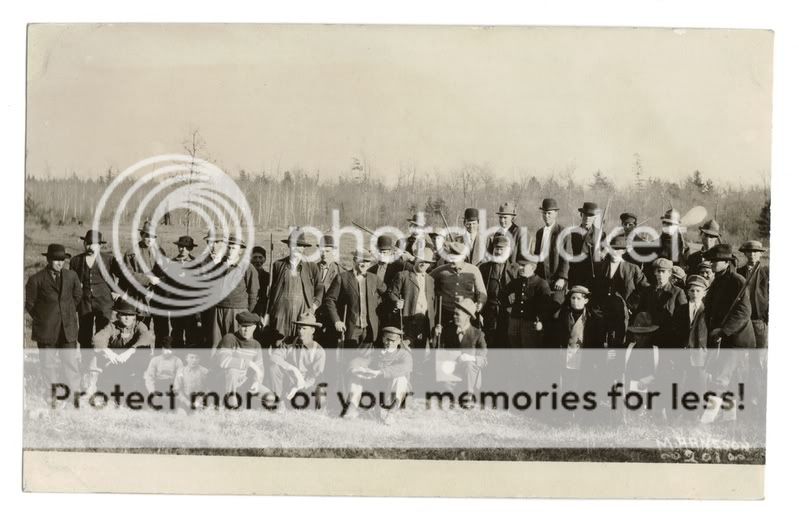
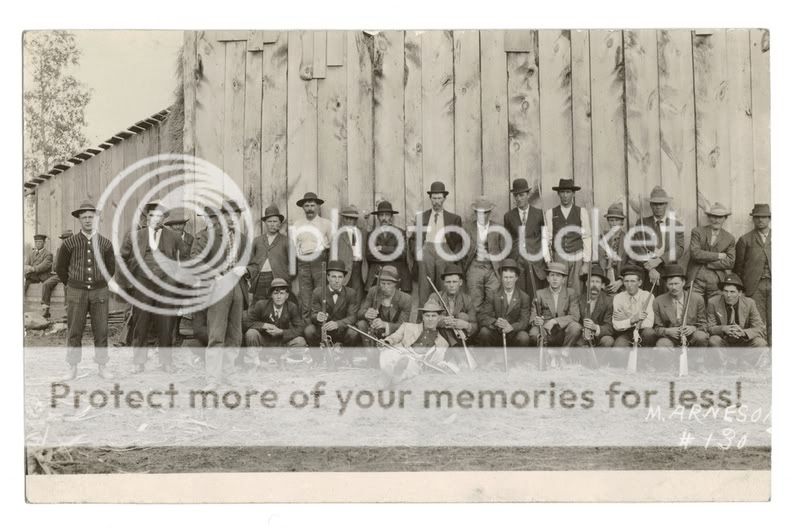
I can't give you an exact date for this pic but it is before 1911. It is in Wisconsin, taken by a trapper who moved up here at the mentioned date. I have just finished scanning close to 60 of his pictures. I think my heads gonna explode.
Here are a couple for you to enjoy, relevant to the subject anyway.
Check this out, even an 1893 Marlin and an 1899 Savage could at one time kill Deer!
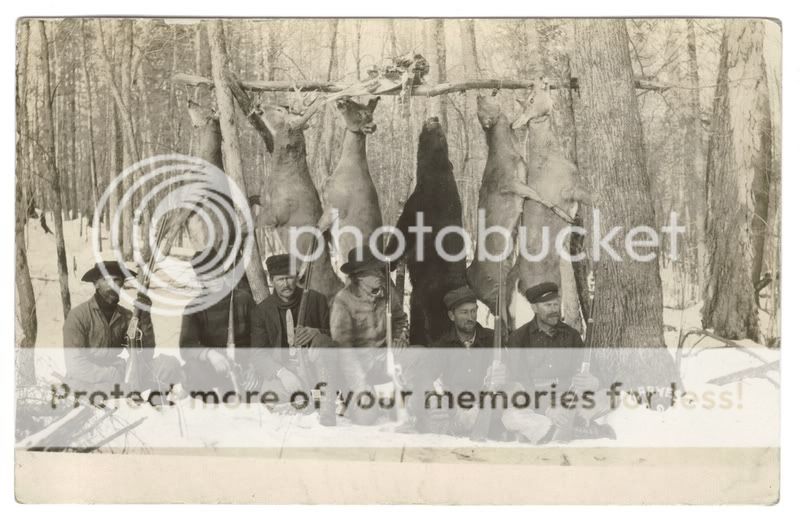
That is Martin Arneson on the far right. He had a 32-40 and a 40-60 Winchester. Cannot say for sure which he has there. His brother Carl is second from the left. That is one stiff little buck.
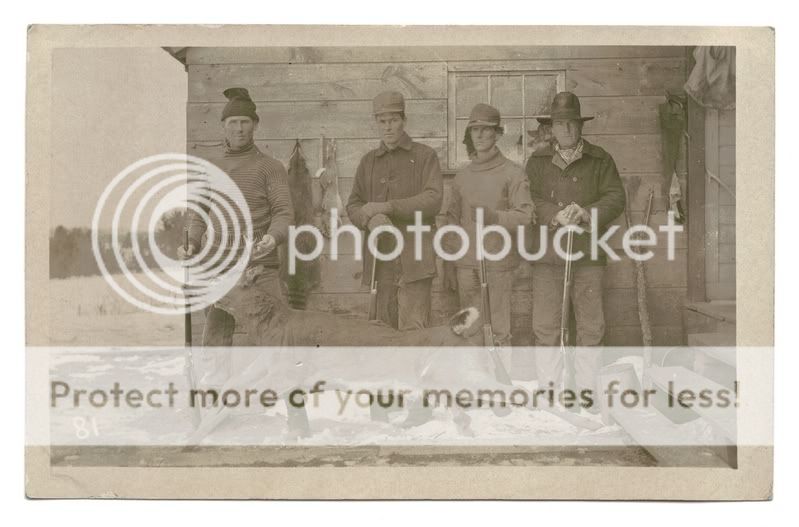
And just think in the off season you can go dust off a Fox caught in your trap.
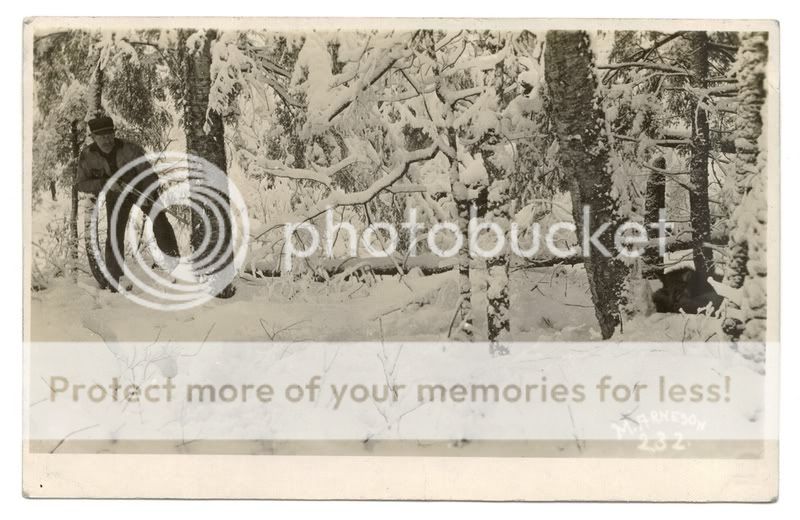
Here are a couple for you to enjoy, relevant to the subject anyway.
Check this out, even an 1893 Marlin and an 1899 Savage could at one time kill Deer!
That is Martin Arneson on the far right. He had a 32-40 and a 40-60 Winchester. Cannot say for sure which he has there. His brother Carl is second from the left. That is one stiff little buck.
And just think in the off season you can go dust off a Fox caught in your trap.


- Location
- Brant County, Ontario
WOW those are great pics, thanks for sharing!! I guess that answers the original question pretty good I think
Makes me want a couple more win94's
Makes me want a couple more win94's

Look! No camo either!
Last fall was a great example of how well non camo can work. My BIL head to toe in camo is sitting right beside me, ball cap was my only piece of camo, other than that just drab colored clothing. We had deer pass within 20 feet, stop to look at us for only a second and then start grazing right there.
I think the biggest thing is not making eye contact that close and also being pretty darn still.
If you guys want, I will post all the pics I have, in another thread of course. It would shift this one totally sideways.

If you could zoom in on those fellows bandoliers I bet there isn't a single partition or TSX to be found either.
Noel
- Location
- 54°52'56"N 112°10'7"W Alpha Bravo
Great pictures, I think that pretty much sums up this thread......Last fall was a great example of how well non camo can work. My BIL head to toe in camo is sitting right beside me, ball cap was my only piece of camo, other than that just drab colored clothing. We had deer pass within 20 feet, stop to look at us for only a second and then start grazing right there.
I think the biggest thing is not making eye contact that close and also being pretty darn still.
If you guys want, I will post all the pics I have, in another thread of course. It would shift this one totally sideways.
If you could zoom in on those fellows bandoliers I bet there isn't a single partition or TSX to be found either.
Noel


Boy that one deer in the old pic sure is dark. Must be some weird hybrid or something
Kinda looks like a bear....Can't be though, you need a .362 Remchestuger Super Consumer for those.

- Location
- Somewhere on the Hudson Bay Coast
This turned out to be a bit longer than I intended, but I hope some out there are able to benefit from it. I'm taken by one thing in Noel's pics, and that is the number of peep sight equipped rifles. Those boys knew a thing or two about shooting. In those days folks didn't often spend money on stuff that didn't matter.
The .30/30 and the rifles that are most commonly chambered for that cartridge have much to offer. Lots of old timers cast 180 gr bullets and loaded them to what we know today would of been about 1800 fps and killed truck loads of stuff, large and small. The rifles are light and handy, but they are also surprisingly accurate. I have seen more than one 336 or M-94 shoot MOA at 100 yards. That's pretty good considering these rifles don't do much that the accuracy gurus say you have to do to achieve those results. Consider how much time effort and money has been invested over the years to bring about a bolt gun that is light and handy, yet all along the Winchester and Marlin carbines already had those attributes. Those rifles today continue to have the same advantages that they did at the beginning of the 20th Century; they are light to carry, they hold lots of ammo, they are accurate, and they are powerful enough.
Let's consider the powerful rounds that are commonly used for back-up against African dangerous game. Almost universally these rounds fire bullets at about 2100 fps. Regardless of caliber which begins at .45 or bullet weight that begins at 500 grs, the velocity sought was 2100. The magic of 2100 fps is that the bullets penetrate deeply in a straight line and are not likely to fail. The .30/30 shares that magic velocity. It was not designed to kill animals whose weight was measured in tons, but that was never it's job. It will handle game up to 1000 pounds quite well though. That 2100 fps velocity ensures that the bullet will penetrate deeply without failure. What happened when the .270 and later the belted magnums appeared? Bullets began to fail due to the high velocity. This was never an issue with the .30/30. It just continued to kill game with boring regularity, and without blowing 20 pounds of meat to mush. When bullet manufacturers began to produce tougher bullets to withstand the higher velocities of modern rounds, failures with the .30/30 began to come to light. It seems that when tougher bullets were loaded to only 2000 fps that they would sometimes not expand, and what was advertised as a better bullet, proved to be a poor choice for the .30/30. For a time, say from the '50's through the '70's the .30/30 caught a lot of bad press, and many of the "experts" disassociated themselves from it. There is a lesson to be learned here. If it ain't broke, don't fix it. The .30/30 loaded with traditional jacketed bullets with lots of exposed lead killed well, as did the cast bullets. They will today.
If you want to hunt with the .30/30, it is no different than any other big game rifle. It has a reasonable expectation of killing a big game animal with a single shot, from any angle, within it's appropriate range. The size of the game determines the range any given shot should be taken from, but in the case of deer and small bears, your ability determines what that range is. There are guys that should never shoot beyond 25 yards, there are other guys who can extend that 10 times.
You have to make the investment in time and ammunition in order to determine what you can do with your rifle on demand. What you did from a bench rest once doesn't matter. How far can you hit an 8.5"X11" piece of paper off hand, from kneeling, sitting , and prone? When holding the rifle in both hands, from 25 yards, how close can you snap shoot a pair of shots at a target with no distinct aiming point? Don't worry about shooting groups, worry about how far your bullet holes appears from the intended point of impact. Once it has exceeded 4", (meaning that it could be 8" between bullet holes) you are shooting at a range that is beyond your ability given the conditions present on that day.
If you are unimpressed with your performance, how can you improve it? If you are relying on the factory sights, the first step might be to exchange them for a sight that covers up less of the target. A ghost ring and post, a low powered scope, or even an electronic sight are better choices than the semi-buckhorn and bead factory sight.
The second step is more difficult. You must master the basics of field marksmanship before you will shoot well, regardless of the rifle you choose. This can be accomplished with weekly visits to the range supported with an hour of dry firing each day for a month prior to the season. Dry firing must be done with a goal in mind and in a way that will benefit you. When the hammer falls, how far have the sights moved off target? Learn to call your shot. Can you balance a quarter on the barrel near the muzzle and dry fire without dropping the coin? Keep records of your training and of your strengths and weaknesses. Don't ignore working the areas in which you are strong, but spend time on the areas that need work. If you can, work with a coach to prevent reinforcing bad habits.
Learn how to attain and check your natural point of aim, and get used to what that should feel like. If you close your eyes, relax and upon opening your eyes find that the sights have swung of target, you need to adjust your position relative to the target. Ensure you have a good cheek weld. If shooting with irons, focus on the front sight to the exclusion of anything else. Press the trigger, don't jerk, slap, or snap it regardless of slow fire or rapid. Breath between shots. Concentrate on the shot you are making, not the previous or the subsequent shot. Follow through, which means to remain focused on the front sight after the hammer has fallen. After the shot, work the action without getting out of position or removing the butt from your shoulder, and quickly reacquire your sight picture. In the field, conditions are in a constant state of change, so you are always shooting against the clock, train accordingly.
The .30/30 and the rifles that are most commonly chambered for that cartridge have much to offer. Lots of old timers cast 180 gr bullets and loaded them to what we know today would of been about 1800 fps and killed truck loads of stuff, large and small. The rifles are light and handy, but they are also surprisingly accurate. I have seen more than one 336 or M-94 shoot MOA at 100 yards. That's pretty good considering these rifles don't do much that the accuracy gurus say you have to do to achieve those results. Consider how much time effort and money has been invested over the years to bring about a bolt gun that is light and handy, yet all along the Winchester and Marlin carbines already had those attributes. Those rifles today continue to have the same advantages that they did at the beginning of the 20th Century; they are light to carry, they hold lots of ammo, they are accurate, and they are powerful enough.
Let's consider the powerful rounds that are commonly used for back-up against African dangerous game. Almost universally these rounds fire bullets at about 2100 fps. Regardless of caliber which begins at .45 or bullet weight that begins at 500 grs, the velocity sought was 2100. The magic of 2100 fps is that the bullets penetrate deeply in a straight line and are not likely to fail. The .30/30 shares that magic velocity. It was not designed to kill animals whose weight was measured in tons, but that was never it's job. It will handle game up to 1000 pounds quite well though. That 2100 fps velocity ensures that the bullet will penetrate deeply without failure. What happened when the .270 and later the belted magnums appeared? Bullets began to fail due to the high velocity. This was never an issue with the .30/30. It just continued to kill game with boring regularity, and without blowing 20 pounds of meat to mush. When bullet manufacturers began to produce tougher bullets to withstand the higher velocities of modern rounds, failures with the .30/30 began to come to light. It seems that when tougher bullets were loaded to only 2000 fps that they would sometimes not expand, and what was advertised as a better bullet, proved to be a poor choice for the .30/30. For a time, say from the '50's through the '70's the .30/30 caught a lot of bad press, and many of the "experts" disassociated themselves from it. There is a lesson to be learned here. If it ain't broke, don't fix it. The .30/30 loaded with traditional jacketed bullets with lots of exposed lead killed well, as did the cast bullets. They will today.
If you want to hunt with the .30/30, it is no different than any other big game rifle. It has a reasonable expectation of killing a big game animal with a single shot, from any angle, within it's appropriate range. The size of the game determines the range any given shot should be taken from, but in the case of deer and small bears, your ability determines what that range is. There are guys that should never shoot beyond 25 yards, there are other guys who can extend that 10 times.
You have to make the investment in time and ammunition in order to determine what you can do with your rifle on demand. What you did from a bench rest once doesn't matter. How far can you hit an 8.5"X11" piece of paper off hand, from kneeling, sitting , and prone? When holding the rifle in both hands, from 25 yards, how close can you snap shoot a pair of shots at a target with no distinct aiming point? Don't worry about shooting groups, worry about how far your bullet holes appears from the intended point of impact. Once it has exceeded 4", (meaning that it could be 8" between bullet holes) you are shooting at a range that is beyond your ability given the conditions present on that day.
If you are unimpressed with your performance, how can you improve it? If you are relying on the factory sights, the first step might be to exchange them for a sight that covers up less of the target. A ghost ring and post, a low powered scope, or even an electronic sight are better choices than the semi-buckhorn and bead factory sight.
The second step is more difficult. You must master the basics of field marksmanship before you will shoot well, regardless of the rifle you choose. This can be accomplished with weekly visits to the range supported with an hour of dry firing each day for a month prior to the season. Dry firing must be done with a goal in mind and in a way that will benefit you. When the hammer falls, how far have the sights moved off target? Learn to call your shot. Can you balance a quarter on the barrel near the muzzle and dry fire without dropping the coin? Keep records of your training and of your strengths and weaknesses. Don't ignore working the areas in which you are strong, but spend time on the areas that need work. If you can, work with a coach to prevent reinforcing bad habits.
Learn how to attain and check your natural point of aim, and get used to what that should feel like. If you close your eyes, relax and upon opening your eyes find that the sights have swung of target, you need to adjust your position relative to the target. Ensure you have a good cheek weld. If shooting with irons, focus on the front sight to the exclusion of anything else. Press the trigger, don't jerk, slap, or snap it regardless of slow fire or rapid. Breath between shots. Concentrate on the shot you are making, not the previous or the subsequent shot. Follow through, which means to remain focused on the front sight after the hammer has fallen. After the shot, work the action without getting out of position or removing the butt from your shoulder, and quickly reacquire your sight picture. In the field, conditions are in a constant state of change, so you are always shooting against the clock, train accordingly.
This turned out to be a bit longer than I intended, but I hope some out there are able to benefit from it. I'm taken by one thing in Noel's pics, and that is the number of peep sight equipped rifles. Those boys knew a thing or two about shooting. In those days folks didn't often spend money on stuff that didn't matter.
.
This shooting was was real serious, they even had a club! This is pre 1911.
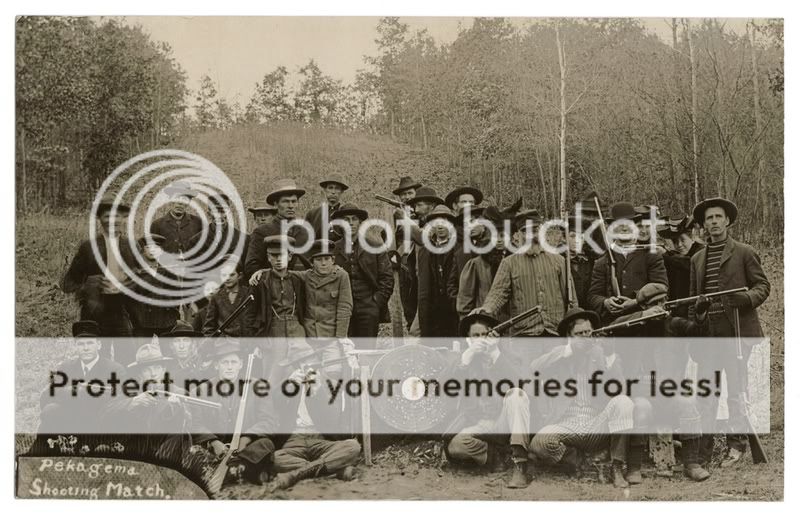

I could give a bit of confirmation to what Boomer wrote. As a kid in the 1930s I lived through an age in the bushcountry boondocks where society lived on wild game, year 'round. As a boy attending a log schoolhouse, it was common to have the boys in deep conversation about the rifle their family owned. And the hours we spent extolling the virtues of a 32 W Special over a 30-30, or how deadly a 38-55 was on moose, and on and on. It would be hard to think of a calibre that wasn't on the list of a rifle owned by one of the bush homesteaders. The 30-30 was the most common, but they all killed game.
A Winchester 351 self loader is considered on the really weak side today, for deer. But in homestead days one fellow killed 9 moose with one box of 20 shells for his 351!
On bullet speed I witnessed a convincing demonstration. A mountain goat is considered a hard animal to kill. I have many times seen rifles in the 300 magnum class recommended for them. I took a young son goat hunting with his .243, because this was his rifle and he could shoot it well. We bought a box of Imperial IVI, with 100 grain bullets for the hunt.
I sat with him as he took a good rest and squeezed one off at the nice billy about 100 yards away and sideways to us. At the shot the goat rolled down the mountain. On skinning it the bullet was retrieved on the far side, a picture perfect example of what a bullet hitting game should look like.
Shortly after that I had a Oehler 33 chronograph and tested five rounds from the box of .243 Imperial IVI ammunition he had used to kill the goat.
The 100 grain bullets averaged 2560 feet per second! A bit less than the 3100 fps stated on the box. However, had they been going that fast the bullet may easily have blown up on impact and only wounded the goat.
I often think about this whenever I hear those endless arguments based on ballistic figures and just what firearms are so superior.
A Winchester 351 self loader is considered on the really weak side today, for deer. But in homestead days one fellow killed 9 moose with one box of 20 shells for his 351!
On bullet speed I witnessed a convincing demonstration. A mountain goat is considered a hard animal to kill. I have many times seen rifles in the 300 magnum class recommended for them. I took a young son goat hunting with his .243, because this was his rifle and he could shoot it well. We bought a box of Imperial IVI, with 100 grain bullets for the hunt.
I sat with him as he took a good rest and squeezed one off at the nice billy about 100 yards away and sideways to us. At the shot the goat rolled down the mountain. On skinning it the bullet was retrieved on the far side, a picture perfect example of what a bullet hitting game should look like.
Shortly after that I had a Oehler 33 chronograph and tested five rounds from the box of .243 Imperial IVI ammunition he had used to kill the goat.
The 100 grain bullets averaged 2560 feet per second! A bit less than the 3100 fps stated on the box. However, had they been going that fast the bullet may easily have blown up on impact and only wounded the goat.
I often think about this whenever I hear those endless arguments based on ballistic figures and just what firearms are so superior.


- Location
- 54°52'56"N 112°10'7"W Alpha Bravo
Thank-you Noel, H4831 & Boomer very helpful and interesting......






















