













































You are using an out of date browser. It may not display this or other websites correctly.
You should upgrade or use an alternative browser.
You should upgrade or use an alternative browser.
Sig P210
- Thread starter UncleWalther
- Start date


Paulinator
Regular
- Location
- Southwestern Ontario
Go and shoot one, then you'll know why.
Here is mine in Hard chrome.
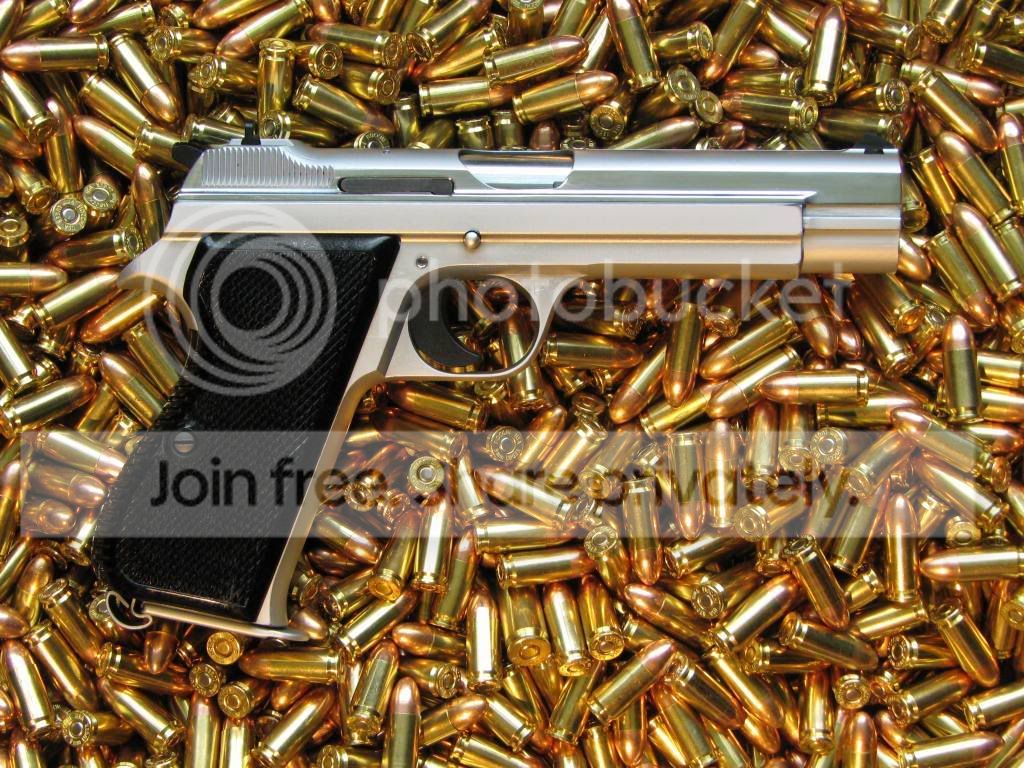
Here is mine in Hard chrome.

I own one, & it's a keeper.
It would be the last on my list to sell in my handgun collection, if I do deside to sell any of my guns.
If i needed money the (car,boat,cottage,house) would be sold first.
The fit & finish on SIG-P210 are A+
Not to mention that it's accurate and has almost no felt recoil. I'd really like one myself but it's priced beyond my means.


Nice, but why did you go for non-matching finish on the slide and frame?Go and shoot one, then you'll know why.
Here is mine in Hard chrome.


Steve David
CGN Ultra frequent flyer
- Location
- Oshawa, Ontario
Simply the single most accurate and well build pistol I have ever shot. I would love to have one.
Paulinator
Regular
- Location
- Southwestern Ontario
Nice said:It's the same finish on the slide and the frame. I had the flat on the slide polished to add some contrast.

Sig P210?
Nine posts & no one yet has actually explained WHY the P210 is "better than the rest".
The cool factor?
The fact you will pay 3 - 4 times what a "lesser" 9mm pistola's will cost you?
The Euro style heel mag release?
No one has mentioned the secret to it's legendary accuracy has to do with the slide rails being inside the frame as opposed to outside as in 97% of other designs.
Don't own one, never owned one. But dang, one day I'd love to own one!
Nine posts & no one yet has actually explained WHY the P210 is "better than the rest".
The cool factor?
The fact you will pay 3 - 4 times what a "lesser" 9mm pistola's will cost you?
The Euro style heel mag release?
No one has mentioned the secret to it's legendary accuracy has to do with the slide rails being inside the frame as opposed to outside as in 97% of other designs.
Don't own one, never owned one. But dang, one day I'd love to own one!

I don't own one, but have used them in the military here. I think that they're good pistols, but are somewhat dated now.
I can't argue about their accuracy, as they're very precise, but the magazine release is a pain, and the magazine is annoying to load if you're shooting a lot (very stiff spring, and low capacity).
I suppose the 'cool factor' is somewhat lower here where they're government issue, but even so they are still popular among civilian shooters (I suspect that it's mostly due to the 'nostalgia factor') among former soldiers.
Regards
Jeff
I can't argue about their accuracy, as they're very precise, but the magazine release is a pain, and the magazine is annoying to load if you're shooting a lot (very stiff spring, and low capacity).
I suppose the 'cool factor' is somewhat lower here where they're government issue, but even so they are still popular among civilian shooters (I suspect that it's mostly due to the 'nostalgia factor') among former soldiers.
Regards
Jeff
Nine posts & no one yet has actually explained WHY the P210 is "better than the rest".
The cool factor?
The fact you will pay 3 - 4 times what a "lesser" 9mm pistola's will cost you?
The Euro style heel mag release?
No one has mentioned the secret to it's legendary accuracy has to do with the slide rails being inside the frame as opposed to outside as in 97% of other designs.
Don't own one, never owned one. But dang, one day I'd love to own one!
Well I can't tell you why they are more accurate, but I can tell you that they are more accurate than most SA target guns and really their price is pretty comparable (or was when they were available).
The new guns we imported several years ago came with 9rd test targets shot at 50m. Groups were consistantly about 30mm. If you look at the new X5s that are now shipping, they come with a 25m test target and a 5 shot group that often measures about 30mm.
CZ-75 also has slide rails inside the frame, yet it's hardly the most accurate pistol out there. Slide to frame fit has little to do with accuracy in any event. The P210 is so accurate because of precise tolerances and superior quality control (which is also the reason why it's so expensive).Nine posts & no one yet has actually explained WHY the P210 is "better than the rest".
The cool factor?
The fact you will pay 3 - 4 times what a "lesser" 9mm pistola's will cost you?
The Euro style heel mag release?
No one has mentioned the secret to it's legendary accuracy has to do with the slide rails being inside the frame as opposed to outside as in 97% of other designs.
Don't own one, never owned one. But dang, one day I'd love to own one!
No one has explained becaues it is an experience thing.
Try a Les Baer or a S@W preformance Center for the same experience
I dont think the rails being inside has anything to do with the accuracy.It just makes it harder to rack the slide.
Mine is thirty years old,looks like new,shoots great,good gun.
NAA I think you missed the other big selling point. The high cap 8 round mag.
Try a Les Baer or a S@W preformance Center for the same experience
I dont think the rails being inside has anything to do with the accuracy.It just makes it harder to rack the slide.
Mine is thirty years old,looks like new,shoots great,good gun.
NAA I think you missed the other big selling point. The high cap 8 round mag.

The SIG P210 design is a licensed evolution of the 1935 S Petter pistol, in turn inspired by the Tokarev TT30, which at first was faithfully scaled up to 9x19mm Luger from the French chambering in 7.65x22mm Longue. Its additional design influence came from the Radom Vis wz. 1935, developed by Piotr Wilniewczyc and Jan Skrzypinski. Its main competitor was the Browning-Saive GP35 derivative, W+F 43 and W+F 47.
On 19 May 1942, SIG tested five contemporaneous service handguns for accuracy in preparation for the development of their candidate for the next Swiss service sidearm, eventually adopted as the Pistole 49 and designated commercially as the P210. This is what they got in 8 shots fired at 50 meters:
Walther P38:
12.0cm from rest/14.5 cm offhand
Radom ViS35:
18.5cm from rest/17.0 cm offhand
Colt M1911:
30.0cm from rest/42.0 cm offhand
9mm Luger 06/29:
5.5cm from rest/11.5 cm offhand
7.65 Luger 06/29:
5.8cm from rest/9.0 cm offhand
The test Colt was a 1919 commercial Government Model, SN C113936. (See Armbruster, p. 15.)
In developing their improved version of the tilting barrel, short recoil locked breech autopistol design pioneered by Browning, Tokarev, and Petter, SIG engineers aimed at improving the performance of the M1911 at 50 meters sixfold, shrinking its 30.0cm 8 shot groups obtained in their machine rest tests, to less than 5cm, without compromising its ruggedness or reliability. To that end, they reversed the customary rail interface between the slide and frame from its prototype designed by Browning and patented by him as U.S. Patent 580924. Whereas previous slides incorporated rails that aimed inward, towards each other, and reciprocated on tracks cut into the frame, the slide of the P210 mimicked the arrangement of the Luger receiver that reciprocated within the frame. As with the Luger, the P210 frame tracks were located on the inside, whereas its slide rails faced outwards, away from each other. SIG designers also dispensed with the barrel bushing, as used by all three of their predecessors, Browning, Tokarev, and Petter. In its stead they used a solid slide with a differentially bored opening at the business end, allowing the barrel to drop down at the breech while minimizing play at the muzzle.
References:
Erwin Armbruster & Werner Kessler, Begegnungen mit einer Legende — SIG SP 47/8 / P 210, Kessler Waffen AG, 2007
Lorenz Vetter, Das grosse Buch der SIG-Pistolen, Motorbuch Verlag/Verlag Stocker-Schmid, 1995, ISBN 3-7276-7123-8
H.P. Doebeli, Die SIG Pistolen, Motorbuch Verlag, 1981, ISBN 3-87943-739-4
On 19 May 1942, SIG tested five contemporaneous service handguns for accuracy in preparation for the development of their candidate for the next Swiss service sidearm, eventually adopted as the Pistole 49 and designated commercially as the P210. This is what they got in 8 shots fired at 50 meters:
Walther P38:
12.0cm from rest/14.5 cm offhand
Radom ViS35:
18.5cm from rest/17.0 cm offhand
Colt M1911:
30.0cm from rest/42.0 cm offhand
9mm Luger 06/29:
5.5cm from rest/11.5 cm offhand
7.65 Luger 06/29:
5.8cm from rest/9.0 cm offhand
The test Colt was a 1919 commercial Government Model, SN C113936. (See Armbruster, p. 15.)
In developing their improved version of the tilting barrel, short recoil locked breech autopistol design pioneered by Browning, Tokarev, and Petter, SIG engineers aimed at improving the performance of the M1911 at 50 meters sixfold, shrinking its 30.0cm 8 shot groups obtained in their machine rest tests, to less than 5cm, without compromising its ruggedness or reliability. To that end, they reversed the customary rail interface between the slide and frame from its prototype designed by Browning and patented by him as U.S. Patent 580924. Whereas previous slides incorporated rails that aimed inward, towards each other, and reciprocated on tracks cut into the frame, the slide of the P210 mimicked the arrangement of the Luger receiver that reciprocated within the frame. As with the Luger, the P210 frame tracks were located on the inside, whereas its slide rails faced outwards, away from each other. SIG designers also dispensed with the barrel bushing, as used by all three of their predecessors, Browning, Tokarev, and Petter. In its stead they used a solid slide with a differentially bored opening at the business end, allowing the barrel to drop down at the breech while minimizing play at the muzzle.
References:
Erwin Armbruster & Werner Kessler, Begegnungen mit einer Legende — SIG SP 47/8 / P 210, Kessler Waffen AG, 2007
Lorenz Vetter, Das grosse Buch der SIG-Pistolen, Motorbuch Verlag/Verlag Stocker-Schmid, 1995, ISBN 3-7276-7123-8
H.P. Doebeli, Die SIG Pistolen, Motorbuch Verlag, 1981, ISBN 3-87943-739-4
Last edited:


- Location
- Southeastern Michigan
I have never owned a P210 but they are reported to be very accurate to 100 yards. Regards, Richard
I own 2 210-2 SIGS and 1 210-5 SIG.....the trigger is as smooth as an old model S&W Model 27 and the sights are great. It is a gun showing its age, but so are Colt 1911's and Browning High Powers. They are big pistols that have served the military/police units well and civilian shooters as well. The fit and finish on a SIG 210-5 is second to none.
So the old Nazi Lugers are roughly as accurate as a Sig 210?
Yes, but vice versa
That was Swiss army requirement for the next service pistol to be as accurate as P08. Back in those days P210 was the only pistol that past following test. They took batch of 100 assembled guns. Disassembled them and mixed all parts together. Then start putting all 100 guns back together with mix matched parts. All 100 guns fired full clip of 8 without hiccups. Back in 50ies this level of production was unimaginable to other companies. Even today with CNC technology I don’t know many firearms that would past this kind of test. I have two P210s and fit barrel, slide, frame is like handshake. These 3 main parts fit together like a sculpture. No rattle, all tight fit, and when you rock the slide the sound of it is so solid like no other gun known to me.






















