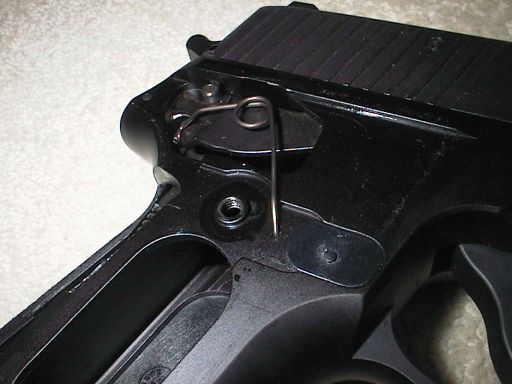
Any truth RE Sig design flaw??

There's at least one of these experts at every club. Can you please copy and paste a few of the more direct replies (especially Westicles) , print and hand them to the Sigmeister? Then let us know what he has to say :D

Mike

Oh yes, my 226 - Perfection...
 
Well, the CF has experienced light strikes with the Sig 225 and Sig 226.
That is one of the reasons the CF 9mm Ball ammo has been re-spec'd so this problem is rectified. The primers on the old 9mm ammo was too hard and you would experience a light strike and have to pull the trigger again, normally that would fire it, but not always.

Anyway, if your service ammo has the brass coloured primer you may have trouble with the Sig, if it is the shiney silver primer then you are good to go. All our ammo is the silver primer now, and has been for about 5 or 6 years.

As for a design flaw with the pistol?,, I would say no. The ammo the CF had was designed for the SMG, now it's not.
 
i picked up a fake Sig [Norinco NP58 40Cal] for a song and a dance. Anyone hear any reviews or anything? I was told it can take Sig parts its that much of a copy.
 
Well, the CF has experienced light strikes with the Sig 225 and Sig 226.
That is one of the reasons the CF 9mm Ball ammo has been re-spec'd so this problem is rectified. The primers on the old 9mm ammo was too hard and you would experience a light strike and have to pull the trigger again, normally that would fire it, but not always.

Anyway, if your service ammo has the brass coloured primer you may have trouble with the Sig, if it is the shiney silver primer then you are good to go. All our ammo is the silver primer now, and has been for about 5 or 6 years.

As for a design flaw with the pistol?,, I would say no. The ammo the CF had was designed for the SMG, now it's not.

Well most normal folks would simply replace the mainspring with a stronger one.

FWIW I shot many 1,000s of issued 9mm in the '90s and never had a light strike.

I would also point out that most modern revolvers have a rebound stop too. I have never heard anyone complain that it made them less reliable.
 
Most pistols have a weak point... as I recall the only SIG "issue" was with the trigger bar spring; and it's not a bad problem.

They used to break as well as eat through the frame (pic is revised version after 1993; doesn't break anymore and eats away the frame much more slowly): :)
P226newspring.jpg


That crap your friend was talking about doesn't make sense at all... why would an arms manufacturer design a hammer to NOT fall completely? All that stopping-force would be catastrophic on internal parts over a short period of time.
 
Last edited:
The SIG P22x series uses a hammer-block lever that keeps the hammer in an at-rest position until the trigger is pulled all the way through. This is somewhat similar to the transfer bar technology used by Ruger in their single-action guns in that the blocking lever must fall in order for the hammer to make contact with the firing pin.

If you dry-fire a SIG pistol and hold the trigger down, you will note that the hammer appears to end its travel well into the slide, making contact with the firing pin. When you release the trigger, the block resets and the hammer remains in the at-rest position, well short of the firing pin.

We have sold a great many of hte P22x series of pistols and have not yet heard any verified reports of light-striking on primers through these guns.

Hope this helps!
 
So I am pretty skeptical about this claim, but here it is.

A fellow shooter at my club claims Sig's are s**t because the hammer is designed to stop 1/16" short of the firing pin, and thus results in light primer strikes and poor reliability. (Apparently, the force of the hammer coming down causes some overtravel beyond the 1/6" stop point, and thats what is use to contact the firing pin)

I really can't see this being the case because what I have read, Sigs are very good quality guns. But said it was particularly the case with the Mosquito.

I am not very familiar with the Sig design, so I guess what I am wondering is

1) Are sig's actually designed like this?
2 If yes, any affect on reliability?

Sig utilize Inertia Firing Pin

A firing pin that is shorter than the guide in which it travels to strike the primer. If the firing pin is propelled quickly enough from its resting position, then it can contain enough energy to detonate the primer due simply to its own inertia.

Now imagine if that channel is dirty for any reason.
 
So I am pretty skeptical about this claim, but here it is.

A fellow shooter at my club claims Sig's are s**t because the hammer is designed to stop 1/16" short of the firing pin, and thus results in light primer strikes and poor reliability. (Apparently, the force of the hammer coming down causes some overtravel beyond the 1/6" stop point, and thats what is use to contact the firing pin)
The guy is a retard. If the hammer stopped short of the firing pin, the gun wouldn't fire at all. I don't know what you mean by "overtravel beyond the 1/6"", but that doesn't make any sense either.

As Westicle pointed out, Sig has a rebound safety. When decocked, the hammer is always in a half-#### position. IF you dry fire the pistol, and, without releasing the trigger, push the hammer all the way forward, you will see it coming in full contact with the firing pin.
 
Last edited:
Sig utilize Inertia Firing Pin

A firing pin that is shorter than the guide in which it travels to strike the primer. If the firing pin is propelled quickly enough from its resting position, then it can contain enough energy to detonate the primer due simply to its own inertia.

Now imagine if that channel is dirty for any reason.
This is a totally different issue. He's talking about contact between the hammer and the firing pin, not between the firing pin and the cartridge primer.
 
When I dry fire my 229, the hammer does not appear to come down and hit the firing pin at all, never mind just 1/16th" of an inch. It looks like it stops moving about a 1/2" away.

I'm sure that this is just an optical illusion of some sort, as I've never really had a problem with light primer strikes.

This is what I was thinking as well. If someone had no idea what they were talking about they might think the the hammer is not hitting hard enough. To the naked eye it can actually appear to be not hitting at all. In actual fact, as a bunch of guys on here have stated, there is another small spring which springs the hammer back.

I have a 228, 229, 239, and the NP-34 copy, and I used to have another 229 as well - I can't ever remember dropping the hammer on a live round and it not going off. My 229 9mm has about 20,000 rounds (in two years!) through it now. If that is not reliable I don't know what is.

The only thing I have had is... recently with the 228, I had two "phhhizz" squib load type situations with S&B 9mm ammo. The bullet cleared the barrel, but it didn't cycle the action all the way or eject the casing. That is the ammo though, obviously.

The other thing, over a year ago with the workhorse 229, I had some of that Fiocchi melted gold-coloured primer cap crap get stuck in the firing pin channel and impede the firing pin such that the pin would stay stuck forward. Again, crappy (cheap) Euro ammo.

On my NP-34, which I use as kind of an amateur gunsmithing/training/try new ideas $350 gun... I installed a WOLFF reduced power mainspring. It make the double action lighter and, therefore, the hammer strikes should be lighter, but not light enough to ever fail to make the round go boom.

Buddy doesn't know what he is talking about I'm afraid. If you are getting fail to fire on factory ammo with a SIG I think it is likely going to be: (1) severely worn mainspring; (2) too light an aftermarket mainspring; (3) incorrect reassembly of the hammer components; (4) some sort of problem with the firing pin assembly - wear, dirt, clogged somehow, something like that.

 
Last edited:
Back
Top Bottom