












































You are using an out of date browser. It may not display this or other websites correctly.
You should upgrade or use an alternative browser.
You should upgrade or use an alternative browser.
C Broad Arrow on a Chinese Inglis
- Thread starter Riflechair
- Start date


Interesting piece!
BTW, is that buttstock marked SAL or LB?
I'm 99% sure the wood stock is a replica. Wood really resembles the bananna wood the M14S stocks are made of and the craftsmanship simply is not terrible wonderful. Works well enough though!


Quite a few Inglis HPs made it into Canadian service with Chinese markings, IIRC from one of Clive Law's books. There came a point when it was obvious that much of the production for China would never make it there. Tons and tons of stuff was piled up in Burma, so it was decided to suspend further shipments.
After the war, some guns were put together from parts, and Chinese marked slides were often used. A large number of No1 slides were converted to No2 by Canadian Arsenals, and many of these had Chinese markings.
After the war, some guns were put together from parts, and Chinese marked slides were often used. A large number of No1 slides were converted to No2 by Canadian Arsenals, and many of these had Chinese markings.


I've bought those wood stocks before, but for an M712. The last one needed a few hours of work before it started looking nice. The slot needed to be re-machined to fit, the inletting where it fit needed shims, and the whole stock needed to have the shellac stripped and was refinished. The hardware had black paint over old bluing (probably milsurp parts) which was stripped and re-blued. Looked nice when I was done! But I think the Chinese stock goes well with the Chinese slide!
Quite a few Inglis HPs made it into Canadian service with Chinese markings, IIRC from one of Clive Law's books. There came a point when it was obvious that much of the production for China would never make it there. Tons and tons of stuff was piled up in Burma, so it was decided to suspend further shipments.
After the war, some guns were put together from parts, and Chinese marked slides were often used. A large number of No1 slides were converted to No2 by Canadian Arsenals, and many of these had Chinese markings.
I saw many inglis hi powers in the CF(years ago) with the rear sights area's milled out and the fixed rear sight silver soldered in. Not all were shipped.

Lee Enfield
CGN Ultra frequent flyer
- Location
- Republic of Alberta
How would this pistol have the C Broad Arrow stamp on it? Korean war capture? I have this opistol for sale in the exchange forum but now I'm starting to think twice.
Sorry to burst your bubble Richard, but they are all C^ marked.
Your's however has nice Chinese property markings, too bad that it's been refinished. The new finish appears to be blueing??
Sorry to burst your bubble Richard, but they are all C^ marked.
Your's however has nice Chinese property markings, too bad that it's been refinished. The new finish appears to be blueing??
Ahh OK thanks bro. I'm enlightened.
I'm thinking I should be keeping this pistol anyways or trade it for a Mk2 model with a fixed rear sight. Thanks everyone.
Oh and the finish is matte blueing. Too bad they didn't use phosphate. I'm suprised Valley guns chose not to pursue an authentic finish. But regardless they did a nice job and you can't really tell its not phosphate until you hold it.

I am no expert on pistols, but I will share what I know.
Plenty of Norinco and other Asian knock-offs floating around.
Also, many legit Brownings, made for the Chinese forces (circa WW2) with Chinese markings and Star on the pistol grips, that were supposed to have been routed to the Chinese but never made it, so they went into service here in Canada. I carried one with the Chinese markings in Croatia in 1993. We were still carrying them until a couple of years ago. Maybe a few units still have them???
Plenty of Norinco and other Asian knock-offs floating around.
Also, many legit Brownings, made for the Chinese forces (circa WW2) with Chinese markings and Star on the pistol grips, that were supposed to have been routed to the Chinese but never made it, so they went into service here in Canada. I carried one with the Chinese markings in Croatia in 1993. We were still carrying them until a couple of years ago. Maybe a few units still have them???

You have probably seen the response I posted on the milsurps.com forum, but FWIW I'll repeat the gist of it here -
The small C-broadarrow stamp you have noted on the right side of the frame of your pistol seems to have been applied during manufacture to most pistols - both the No. 1 ("Chinese" model) and the No. 2 ("Canadian" model) before the finish was applied and irrespective of ultimate destination, so in this case did not signify actual Canadian government acceptance or ownership, to my knowledge.
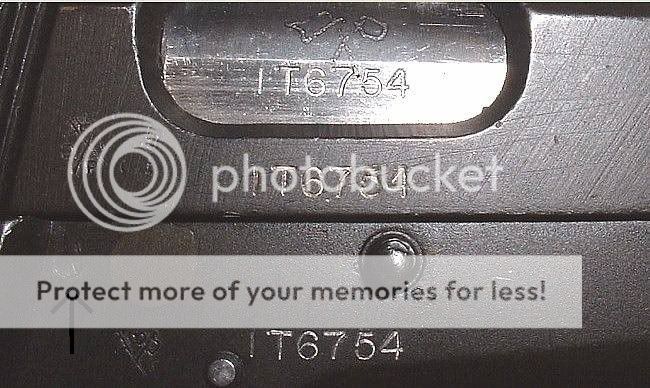

I don't see the issue of this mark being indiscriminately present on both types of pistol addressed at all in Clive's book, either in Chapter Eight ("Standard Markings on Inglis Pistols") or Chapter Nine ("Special Markings") and can't recall seeing any other explanation. Perhaps, because production originally began at the request of China to supply them with High Power pistols as part of Allied Mutual Aid arrangements, it was originally used as a sort of "faux ownership mark" akin to the "U.S. Property" marks applied to Lend-Lease materiel ..... Who knows?
In any case, the matter is further complicated by the fact that the great majority of pistols (of either type) which actually entered Canadian service do not seem to have ever been given any additional Canadian government/military ownership marks anyway - perhaps it was felt that the C-broadarrow already on them was sufficient. Again, who knows?
Having said all of the above, my own No. 1 pistol does have a separate C-broadarrow stamp - rather larger than the other one - stamped on the left rear of the slide (a "regulation" location for an actual Canadian acceptance/ownership mark on a semi-automatic pistol) and is the only one I have seen with such a separate C-broadarrow, in fact -
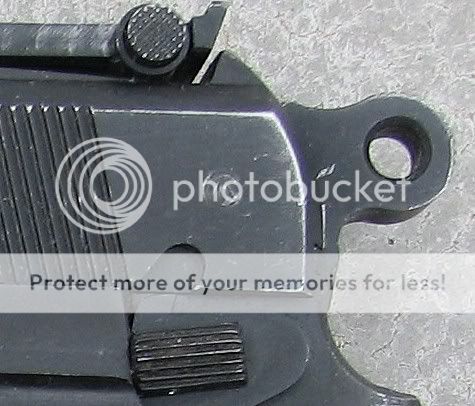
Production of the No. 1 ("Chinese") pistol was halted in October of 1944 (at serial number 1CH6576) because it had proven impossible to get them to the Chinese. Due to Japanese blockade of China and control of its coastal areas, war aid had to be airlifted over the Himalayas from India, and limited resources in that regard resulted in the pistols being assigned such a low priority that the 4,000 or so which had actually made it to Karachi were simply sitting there in stockpile, with little likelihood of delivery. Clive indicates that application of the original six character Mandarin inscription ("National Property of the Republic of China") was actually discontinued during May 1944, though it is believed that all of the 4,000 pistols which had made it to Karachi had the marking. At the time production was halted in October something in the order of 14,000 of that model were still sitting in Canada or being completed by Inglis. It was all these completed but undeliverable Chinese model pistols which then ended up being diverted to Canadian and British service. My example (1CH4149) is one of the pistols completed toward the end of that "first contract run".
Late in the war (June 1944) production of No. 1 pistols for China was resumed at serial number 1CH6589 (no explanation provided by Clive for the apparent 12-number gap) and continued up to 5CH9928 when production halted for good in October 1944. The serial number of your examplel unquestionably makes it one of these "second run" No. 1 pistols. Most of these later-production No. 1 pistols did get shipped to China - ultimately to be used by one side or the other in the civil war between Nationalist and Communist factions (and possibly even against UN Forces in Korea - see below.) If I understand correctly, the "second run" Chinese-contract pistols were not marked in Canada with any Chinese characters - any such markings were applied in China. As you have already indicated, the particular two-character mark on yours (Gong Qiang) roughly translates as "Public (or Official) Gun".
As I'm sure you know, your pistol has unquestionably been refinished - that much is clear from the fact that the serial numbers on the frame and slide (engraved through the parkerized finish at time of completion by Inglis) are filled in with finish rather than remaining "in the white". The question is when that refinishing took place. According to Clive, the post-1949 Republic of China (i.e. Taiwan) is not known to have refinished or refurbished any of its Inglis pistols in any way, and they were quickly replaced with .45ACP pistols received as aid from the United States. As for the People's Republic of China, certainly by the time of the Korean War Soviet armaments aid had resulted in their standard military pistol cartridge being the 7.62x25mm Tokarev rather the 9x19mm, but apparently many Inglis pistols remained in service until as late as the 1980s, primarily with police and other armed civil units. Clive notes that ".... many pistols later released as surplus from the People's Republic show evidence of having undergone at a minimum a complete refinishing, and in some cases a complete overhaul .....", apparently in military arsenals.
At the end of the day, I suppose it may never be possible to determine whether your pistol is one which was refinished/refurbished by The People's Republic, or was refinished by a surplus dealer or the like .....
As previously noted, the separate C-broadarrow on my own "first run" CH-numbered Inglis would definitely seem to signify Canadian issue. The two after-market magazines which came with it (each stamped on both the body and baseplate with the serial number of the pistol) indicate that this particular pistol is one of the 1.578 pistols given to Belgium in 1950 as post-war aid. Canada's policy was to standardize its own small-arms arsenal as No. 2 pistols so most, if not all, pistols sent elsewhere after the war - i.e. Belgium, Holland, etc. - came from the No. 1 pistols in Canadian service or stores, with a view to disposing of as many of those as possible. (In fact, a later program resulted in any remaining No. 1-configuration pistols in Canadian hands being modified to No. 2 specifications by removing the adjustable rear sight and milling off its base, and then pinning and brazing a No. 2-type fixed sight in its place. Thus my Canadian-marked pistol in unaltered No. 1 configuration (albeit refinished) is a relatively "rare bird" that I am very pleased to have in my collection.)

The small C-broadarrow stamp you have noted on the right side of the frame of your pistol seems to have been applied during manufacture to most pistols - both the No. 1 ("Chinese" model) and the No. 2 ("Canadian" model) before the finish was applied and irrespective of ultimate destination, so in this case did not signify actual Canadian government acceptance or ownership, to my knowledge.
I don't see the issue of this mark being indiscriminately present on both types of pistol addressed at all in Clive's book, either in Chapter Eight ("Standard Markings on Inglis Pistols") or Chapter Nine ("Special Markings") and can't recall seeing any other explanation. Perhaps, because production originally began at the request of China to supply them with High Power pistols as part of Allied Mutual Aid arrangements, it was originally used as a sort of "faux ownership mark" akin to the "U.S. Property" marks applied to Lend-Lease materiel ..... Who knows?
In any case, the matter is further complicated by the fact that the great majority of pistols (of either type) which actually entered Canadian service do not seem to have ever been given any additional Canadian government/military ownership marks anyway - perhaps it was felt that the C-broadarrow already on them was sufficient. Again, who knows?
Having said all of the above, my own No. 1 pistol does have a separate C-broadarrow stamp - rather larger than the other one - stamped on the left rear of the slide (a "regulation" location for an actual Canadian acceptance/ownership mark on a semi-automatic pistol) and is the only one I have seen with such a separate C-broadarrow, in fact -
Production of the No. 1 ("Chinese") pistol was halted in October of 1944 (at serial number 1CH6576) because it had proven impossible to get them to the Chinese. Due to Japanese blockade of China and control of its coastal areas, war aid had to be airlifted over the Himalayas from India, and limited resources in that regard resulted in the pistols being assigned such a low priority that the 4,000 or so which had actually made it to Karachi were simply sitting there in stockpile, with little likelihood of delivery. Clive indicates that application of the original six character Mandarin inscription ("National Property of the Republic of China") was actually discontinued during May 1944, though it is believed that all of the 4,000 pistols which had made it to Karachi had the marking. At the time production was halted in October something in the order of 14,000 of that model were still sitting in Canada or being completed by Inglis. It was all these completed but undeliverable Chinese model pistols which then ended up being diverted to Canadian and British service. My example (1CH4149) is one of the pistols completed toward the end of that "first contract run".
Late in the war (June 1944) production of No. 1 pistols for China was resumed at serial number 1CH6589 (no explanation provided by Clive for the apparent 12-number gap) and continued up to 5CH9928 when production halted for good in October 1944. The serial number of your examplel unquestionably makes it one of these "second run" No. 1 pistols. Most of these later-production No. 1 pistols did get shipped to China - ultimately to be used by one side or the other in the civil war between Nationalist and Communist factions (and possibly even against UN Forces in Korea - see below.) If I understand correctly, the "second run" Chinese-contract pistols were not marked in Canada with any Chinese characters - any such markings were applied in China. As you have already indicated, the particular two-character mark on yours (Gong Qiang) roughly translates as "Public (or Official) Gun".
As I'm sure you know, your pistol has unquestionably been refinished - that much is clear from the fact that the serial numbers on the frame and slide (engraved through the parkerized finish at time of completion by Inglis) are filled in with finish rather than remaining "in the white". The question is when that refinishing took place. According to Clive, the post-1949 Republic of China (i.e. Taiwan) is not known to have refinished or refurbished any of its Inglis pistols in any way, and they were quickly replaced with .45ACP pistols received as aid from the United States. As for the People's Republic of China, certainly by the time of the Korean War Soviet armaments aid had resulted in their standard military pistol cartridge being the 7.62x25mm Tokarev rather the 9x19mm, but apparently many Inglis pistols remained in service until as late as the 1980s, primarily with police and other armed civil units. Clive notes that ".... many pistols later released as surplus from the People's Republic show evidence of having undergone at a minimum a complete refinishing, and in some cases a complete overhaul .....", apparently in military arsenals.
At the end of the day, I suppose it may never be possible to determine whether your pistol is one which was refinished/refurbished by The People's Republic, or was refinished by a surplus dealer or the like .....
As previously noted, the separate C-broadarrow on my own "first run" CH-numbered Inglis would definitely seem to signify Canadian issue. The two after-market magazines which came with it (each stamped on both the body and baseplate with the serial number of the pistol) indicate that this particular pistol is one of the 1.578 pistols given to Belgium in 1950 as post-war aid. Canada's policy was to standardize its own small-arms arsenal as No. 2 pistols so most, if not all, pistols sent elsewhere after the war - i.e. Belgium, Holland, etc. - came from the No. 1 pistols in Canadian service or stores, with a view to disposing of as many of those as possible. (In fact, a later program resulted in any remaining No. 1-configuration pistols in Canadian hands being modified to No. 2 specifications by removing the adjustable rear sight and milling off its base, and then pinning and brazing a No. 2-type fixed sight in its place. Thus my Canadian-marked pistol in unaltered No. 1 configuration (albeit refinished) is a relatively "rare bird" that I am very pleased to have in my collection.)





















