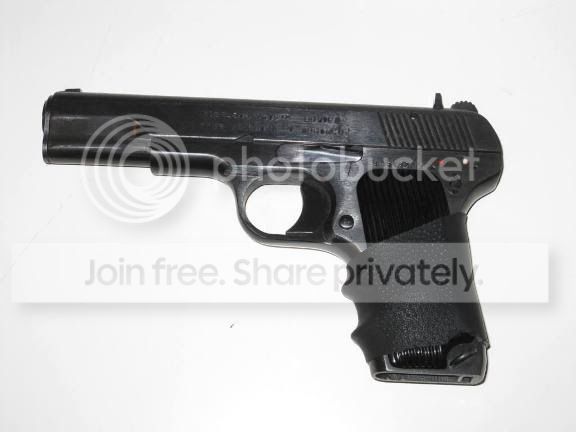
Norinco M213 DIY

direction88

Regular
EE Expired
Rating - 100%
4   0   0
I wanted to start this thread so people could post and read DIY solutions for the M213 without having to read through the 200 or so pages on the main 213 thread. I don't have much to contribute myself except for the easy removal of the safety so I will start with that and hopefully get the ball rolling!

On either side of the safety switch there are 2 obvious small Phillips screws. Take a small Phillips screwdriver and remove both screws then turn the safety switch clockwise until it can be gently pulled out. You will now be left with 2 small holes (from screws), one large ugly keyhole looking hole (safety switch) and 2 dimples (red and white from the ball of the safety switch). I have not yer filled in these holes but I have been told that others have used a sort of epoxy putty?

Thanks for reading and please post any and all DIY mods (with pictures if you have them) you have done or know of for the M213.
 
Feel free to contribute...

Well, I've had mine out to the range a few times, and probably shot 200 rounds through it. The ammo:
50 rds Winchester 124 gn
50 rds Remington 115 gn
50 rds Remington 147 gn
50 rds Seliot and Bellot 115 gn

Range report - best grouping on the 147 Remington UMC. Worst grouping on S & B. One FTE on Winchester 124

Two problems that had to be dealt with:
a) Extractor Assembly pin backed out of its hole, thus causing the extraction assembly to fall apart. I cannot say if there were warning signs, though a shot before the pin fell out, the rangemaster called a cease fire because he didn't like the color of the muzzle flare. Apparently there was a lot of an orange color to the muzzle blast.
b) High point on the hammer when cocking - made it difficult to #### unless you pull the hammer back first.

Both have simple solutions.

a) We took a sharp metal punch, put the assembly back together (it's a job that will require 4 hands, and for G*d's sake, don't loose that little 1/8 inch spring that the extractor pin uses) and then punched the the housing right at the lip of the extractor assembly pin
m213_extractor_pin_punch.jpg
(http://s279.photobucket.com/albums/kk157/fluke_05/?action=view&current=m213_extractor_pin_punch.jpg)
The reason this had to be done was that once the pin was put back in, I noticed after racking the action many times, the pin started to drift back out. By putting that little dent between the housing (slide) and the pin, the pin is now fixed in place.

2) When I was fixing the pin, I noticed that the hammer had a high spot on the right side of the hammer. Now, the way the slide and hammer interact is that the right part of the slide will hit the hammer first when racking the action. The left side of the slide will engage the hammer a bit later. So, I carefully filed down the left side of the hammer until I could see that the entire right side of the slide was engaging the hammer. At the same time, I noticed that the gun was a bit easier to rack when it was hammer down.

So from here, I still have some work to do on this pistol. I have to find the right flavour for ammunition, and if it doesn't start grouping consistently, I'll have to check the barrel. Maybe there's a problem with the crowning???? Does anyone know what the barrel is made of ie: type of steel, etc...

Overall though, for a 100 dollar gun, you can't ask for much. At the same time, this thing is incredibly easy to service, so modding it to get max performance seems to be a good possibilty.

One warning I've been given by a few people that are considered old hands with the construction/operation of this type of pistol: the UMC 147 gn is too heavy for this pistol: apparently this type of ammo will cause excessive wear on the spring. I'd be interested to hear from others what their experience has been. It also would be interesting to here if handloading might be the way to go here, in terms of getting the optimal load for this pistol.

Mod on folks!
Fluke
 
Last edited:
I've been meaning to post up these pictures and mod descriptions for a while now. So here goes.

#1- Many of you have complained about how hard it is to rack the slide when the hammer is down. In looking at my 213's and comparing the back corner of the firing pin housing that kicks the hammer to the cocked position I found them to be very rough and quite abrupt rather than the nicely radiused and smooth corners on my other semis. So out came a small flat needle file to better round this corner and a slip stone to help polish off the file marks. The same job could be done using a small'ish smooth cut square or triangle file with the side faces ground off so it doesn't cut into the side walls and some wetordry 400 grit sandpaper and oil folded over a stick to do the finish polishing. You're looking to form this corner so it more or less matches the curvature of a 1/4 inch drill or rod, so a 1/8 radius.

Slide_radius.jpg


#2- Next up was the magazines sticking when being inserted and the general razor like edges around the lips that made loading rounds a dangerous proposition. Just dubbing off the edges was simple and I used a super fine cut jeweller's file for the intial edge cut then a "polish up" with a couple of swipes of some 400 grit wetordry to smoothen them. No significant amount of metal should come off. Some extra rounding at the edge shown by the pencil pointer was done to try to let them slip past the mag catch more easily.

Mag_lip_profile.jpg


#3- But even the slight extra rounding off wasn't enough so I removed the mag catch and lightly profiled it to blend the rather abrupt stock edge that tended to catch the magazines when inserting. The split image shows a before and after. This made the magazines slip in and lock easily on one gun but the other was still dragging a little. Turns out the trigger hoop was a little thicker on one side than the other and was pushing the mags over and making them stick on insertion and when dropping. A little filing and dremel polishing on the one thicker side of the hoop fixed that pronto. Now the mags slip in and lock with a very nice light bump of the hand.

Mag_catch.jpg


#4- The release button is far too short to allow match like magazine drops. I tried to make up a new longer split pin style button but the section of metal is just too small and the metal burned too easily when I tried to use my heat treating setup which, sadly, is limited to a propane torch. The metal just lost something and snapped too easily when trying to temper it. So instead I made up an extension button that I soft soldered to the existing button. This involved grinding off the rounded head and then using a jig to hold the extension onto the flattened OEM pin while soldering. This worked out very well and blued up nicely. The solder line seems to accept some of the stained metal solution. So now both my 213's are sporting extended magazine release buttons that sit around 3/16 higher than the stock ones. The picture shows the two parts prior to soldering. This one is a replical of the stock smooth rounded button. The other uses a stepped dome shape for a little more grip.

Mag_release_ext_1.jpg


And all done and in place.

Mag_release_ext_2.jpg


#5- On to the action group. To reduce the trigger pull the flat return spring in the rear of the lower frame was ground down on either side to reduce the width to around 1/4 inch for much of its length. Only the top and bottom 1/4 inch long segments were left full width. This greatly reduced the return spring tension without any other issues. During testing the trigger hoop did tend to jump out of place if I pressed on the wrong part of the trigger. But when the grip frames are on there's a channel that traps the hoop from doing any up and down tricks. It only seemed to be a problem when the spring was lightened by narrowing it. And I was able to all but eliminate it by slightly altering the upper curve on the return spring where it contacts the bevelled edge on the rear of the trigger hoop.

Speaking of the bevelled edge this was polished on a super fine Arkansa stone to smoothen it and lightly break the sharp corners. This helped it with properly slipping against the return spring when the disconnector comes into play.

No pictures for this portion.

Continued in the next post....
 
BCRider mods continued....

#6- Next the hammer group was worked on. The sear return spring was very tight so I used my Dremel with a grinding wheel and then a rubberized abrasive wheel to polish the outer side into a rounded hill-valley-hill double ridge shape. By leaving the two "spines" instead of just making it all thinner I think I'm encouraging the proper support for the sear but perhaps I'm worring about this too much and just simply evenly grinding it all thinner would work just as well.

Sear_spring_thinning.jpg


#7- Next up was to swap out the hammer mainspring for a lighter version. These were custom wound by myself from some .038 music wire. I ran about 150 rounds through each with no issue but some recently acquired reloaded ammo seems to be using a tougher primer and one will only set them off about 60'ish% of the time. But the other one is 100% consistent after a couple of hundred rounds. It's likely close but it's working. The other is due for a new spring. Don't ask yet. I'll have to test them to see what the spring rate and length is. Also since I'm just making them up myself and don't have any way of passivating them or ensuring they won't fatigue with time I'm not going to sell any. So please don't ask. If it helps I see that Wolff Gunsprings sells Tokarev spring kits. You may want to try one of their sets. Order for a few guns but keep the prices under the magic $100 and it'll come directly up. They've got export permission. I got my revolver kits from them directly at my door.

Between the mods or replacement of the three springs involved in the trigger system the pull on one is at 4.5 and the other at a hair over 5 lbs as tested on a spring scale I've got.

No pictures for this either. It's just a spring after all.

#8- Last on the list of trigger mods but just as important as the other stuff put together. There's a lot of lost take up travel on the 213 trigger. I looked at some way of adding a set screw to let me adjust this out but there's no easy place to put one. In the end I went simple. The picture below shows a small block of brass that was soft soldered into place after lightly grinding away the blueing in the crook where the hoop attaches to the trigger. This block was then tested and filed down a little and tested and filed and tested and filed, etc until there was just a very little free travel. Now both my 213's have about a millimeter or less of free travel. Just enough to ensure the sear is correctly reset plus a hair more. Now the feel is more like my 1911 with no significant free travel. It was a simple mod but a great bang for the buck. The brass came from a little section of .050 x .25 strip I had bought from a model railroad hobby shop for something else. There's very little post firing travel on the 213's so I did not see any point in trying to eliminate what little there was. This shot also shows the narrowing grinding to the trigger return spring. EDIT- I just noticed that I forgot to mention the funky decorative "lightening" holes in this trigger. Again they were drilled and some cold blue used to touch them up. Frankly it was a useless thing to do but it makes the gun look a bit more custom.... :D

Trigger_stop.jpg


#9- If you're using the Lever Arms 9mm magazines you'll need to remove the mag well spacer. But something I had not seen anywhere is that there's still going to be an issue. It comes from the little ridge shown by the pen point as shown here....

Slide_tab.jpg


I'm guessing this ridge is there to help push the luger rounds into the chamber better. But when using the Lever magazines it can smack into the back of the magazine metal. It took me a while to figure out what was happening on this but the fix was simple. It just involved filing a little clearance groove out of the back of the top opening as shown....

LeverMagNotch.jpg


#10- Finally the slide barrel locking grooves and the ridges on the barrel were lightly deburred on the corners as per pretty much normal practice as outlined in a few articles and books on 1911's that I've seen. The only easy part being that I could do the barrel using my drill press instead of holding it by hand. This was a straight forward bit of work using a fine india half round slip stone and a couple of light passes.

Slide_deburring.jpg


barrel_deburring.jpg


#11- I filed out the mag well openings to form a 45'ish degree "funnel" opening as much as I could within the limitations of the frame thickness. It's not much but it helps with inserting the magazines a little more smoothly. After the filing the raw metal was touched up with cold blue. No pictures of this but it's pretty basic.

#12- On one of the guns I smoothened and rounded off the corners around the trigger guard and on the upper rear of the frame where the web of your hand wraps around. This helps avoid these edges rubbing into your hand during longer sessions. I'm going to do the same to the other. The raw metal was then well degreased and touched up with a couple of applications of cold blue with some steel wool carding and further cleaning with degreaser between applications of the blueing. I found this helped quite a bit with getting the patches to match pretty close to the factory blueing. It's still noticable but only if you're looking for differences.

#13- The useless safety levers..... They are in the positively worst place and have the worst possible shape. Even if you have hands of iron they are placed such that if you're using a nice high IPSC or other two handed style grip the web of your hand will push them forward and put on the safety about half way through the second or third magazine. And if you have normal skin the edges will wear a raw spot on your thumb to forefinger web darn quick. I tried to smoothen and re-blue one but while it wasn't as hard on the hand it still got pushed forward and activated during shooting. So now they are both out. I've got an idea for a more 1911'ish style shape but it'll have to wait until such a time as I want to use it for something like IDPA or IPSC where I'll need to holster the gun with a chambered round and cocked.

#14- A little thing but it's a nice one to do. The inner corners of the frame where the grip panel locking arms slide over were chamfered so they lift up over the edge a lot easier when locking them back on. A fine cut jeweller's file was again used for this followed with a light rub from the wetordry 400 to polish it up a bit. It sure makes putting the grips back on a lot easier. Also the inner edges of the grips themselves were filed back using a square file with a safety edge to trim the obvious rub points until the grips press in and out with a light snap instead of the amount you presently need where you swear it's going to break any moment. No pics for either of these but they are simple enough you shouldn't need any.
 
I welded a tiny blob onto the top of the barrel bushing. The action can cope with a little extra friction, and lockup is impressive.

Edit: batteries charging.
bushing.JPG
Very small blob at the moment, just a tap with a stick welder. JB Weld on trigger group where it touches the frame at the rear to reduce slide wobble :eek:. Bent the trigger leaf spring to reduce trigger pull, added JB Weld to grip panels to stop trigger rattling.
My Lever Arms 7.65/9mm doesn't have the lumps on the slide, or any mag problems.

If you wanted a TactiKool SMG PDW Carbine, you could add sheet metal to the sides with a shoulder stock and scope mount. Lacks the humour value of the $3000 Ar15 "builds" though.


Edit: Holy amnesia, I originally posted "bottom of the barrel bushing".
 
Last edited:
Juster, we need pictures or more of a description. How much of a blob? How tight to make it? Any other issues with clearance during cycling?

This sounds like a winner if it aids with accuracy of grouping. I've got no real complaints now but if it makes me look a little better for free then I'm IN ! ! !... :D
 
Juster, I may try this but instead of welding I'm going to look at peening the metal inwards slightly. If it works I'm guessing that it'll hold the nose of the barrel with a little more consistency as well as the peening should locate the bushing to the slide a bit more positively. I'll have to see how much play there is and do some research on match bushings and the like to get a feel for how tight all this stuff needs to be.
 
That's some great info BCRider! Thanks for taking the time to post all that :)

The mods I've made on mine have been minor. So far I've removed the safety, painted the front sight white for better visibility, and modified a Hogue grip to fit so it feels a bit better in the hand. When I first got it I also had to smooth out some rough edges on the feed ramp.

Edit: I've had a few PMs on this so thought I would expand on it. My grip solution is temporary - I'm still on the lookout for something better. For now, I'm using a small size Hogue sleeve grip that I cut down to fit the pistol better. It's not ideal, but it's good enough until I find something more permanent that I like :)

de2d403d5ff45d2c04e1cb08a3d2df50.image.250x300.jpg
Norc.jpg


As for ammo, mine seems to do best with American Eagle 115gr. I very rarely get FTEs with it, and 99.99% of the time the ones I do get are from me limp-wristing :p

Overall, I'm very pleased with this pistol. Can't do better for the price :)
 
Last edited:
If you're interested in wood grips for this pistol, check out this guy in Hungary:

http://www.marschalgrips.com/tt33wr/tt33wr.htm

He's expensive (you're looking at $50 or $80 plus shipping depending on the style) but it's quality work. He has different options with cutouts for the safety and lanyard as well.
 
I just did the filing on the slide, to ease racking on a dropped hammer (fix #1). It's now possible to pull the slide back! Very easy to accomplish.
 
I just did the filing on the slide, to ease racking on a dropped hammer (fix #1). It's now possible to pull the slide back! Very easy to accomplish.

A sharp/abrupt edge contributes to recoil absorption; if it's easier for you it's easier for the slide....
 
That's true. But the slide on the 213's doesn't come back with too strong a snap even with the rounding over mod. The two I have went from being rather lazy case throwers to ones that just arc them out nicely but not a long way. Also there isn't any sign of impact damage at any contact point in the slide or frame. So again indicators are that it's a valid mod.
 
I'm having a problem with 124g cast bullets constantly stove-piping. I'm thinking of switching down to 115 or even jacketed bullets. Does anyone have any DIY advice on how to make this thing work better with cast bullets or is it really an FMJ only gun?
 
Back
Top Bottom