Help me win a challenge ! (Lee Enfileld question)

Rifles were then designed to kill a man at about 300m with open sights.

A man sized target at 300yds with open sights is no problem with any sort of a rest (prone position, over a wall, against a tree, etc.) with reasonable lighting conditions.

I like open sights, but there is no denying the superiority of optics under poor lighting conditions and for longer range shooting. In close, with good light, open sights (especially a ghost ring style aperture setup) are easily equal or superior to optics. But in low light conditions and when reaching out a ways, optics are the way to go. It's horses for courses.

Mark
 
The range will have a bench to shoot from. Or maybe you will shoot prone. To group well you need a comfortable and steady way to rest and hold the rifle.

I sugegst you take a sand bag or a bean bag. You can make one real easy. Go to the store and buy a couple pounds of dried peas or white beans. Pour these in a wool sock and then tie a knot in the sock. You now have a light, portable and handy rest for about $2.00

At the range, hold the forend with your left hand and rest the back of that hand on the bean bag. You may have to put the bean bag on top of something to get the right height, such as a rifle case or steel ammo can.

get a nice big black bull to aim at. You might find it easier to aim at if you fold the bottome edge over, so the bull has a flat on the bottom, instead of round.

Focus on the front sight and aim at the bottom of the bull (called a 6 o'clock aim"). Don't touch the black with the front sight. Leave a band of white under the black, other wise the front sight can get lost in the black.

This will demonstarte that the rifle will group. To make it shoot to point of aim, be prepare to move the front sight left or right. (move it right to make the bullets go more to the left.) If it shoots hi or low, note the number on the front sight blade, and buy a higher or lower one at a gunshow. A higher one will lower bullet impact.

So long as the black aiming mark is big enough, one can shoot iron sights as far back as a scope. I have shot irons sights with a post front sight back to 1000 yards, many times.
 
Your brother in law is full of it.

There were times (when my eyes weren't 56 years old) when I shot better 100 yard groups with my 1911 Swedish Mauser in 6.5 than with my scope-sighted 243 Remington Model 700.

I recently put a receiver sight on a 1956 Winchester Model 94 30-30 a buddy gave me and got two-inch groups at 100 yards.

Hint: After practising with a 22, to get the elevaiton of your rifle right, shoot your 303 at 25 yards to see where to set the sight elevator on your rear sight. Once it is on at 25 yards, then try at 50, then at 100.
 
Last edited:
"...I would not see the target..." Should have seen that before. No. 1 sights aren't great, but seeing the target at 100 won't be an issue.
 
Lee Enfields have been putting round holes in square heads for over a century.
Looking at your rifle, it appears to be a good candidate for restoration.
I may be sermonizing a bit, but bringing it back to pre-bubba condition would be nice.
Again, please forgive me if I refer you to www.skennerton.com and suggest you purchase S.A.I.S. No.1. (small arms Identification series.) An inexpensive pahphlet that has exploded views of all the parts, pics of the accessories, and a potted history.

I suggest the booklet because it shows ALL the bits, and when ordering replacements, forgetting ONE bit will cause you to pay additional post and packing for the one item you forgot to order the first time:eek:
 
[QUOTE=John Sukey;
Looking at your rifle, it appears to be a good candidate for restoration.
I may be sermonizing a bit, but bringing it back to pre-bubba condition would be nice.


Funny you mention it, this is exactly the plan...
 
Range report

Well, let's say it was a total fiasco !!

I'm not mad about it. Main problem comes from the fact that I don't know where I group. At least I know it is not on a 8.5 x 11 surface at 25 meters ! I printed a black circle on a regular sheet of paper as a target. At 25 I aimed at the bottom of the circle. I hit the circle once, and the rest I don't know.

However there was a very nice grouping, just outside of the bottom right edge of the paper. Problem is, I don't know if those are my holes, or previous shooters. If they are mine, well I'll start from there and adjust the sights so I can bring the group to center.

That being said, next time I go I will print the 6 inch circle of a 36 x 24 white sheet of paper. This way I'll be able to tell where is the group.
 
The basic idea is to shoot regularly. M ost people can't afford to do that witht eh big boomers, so if you don't have a .22 yet, get one. Start putting 100rds downrange every week. Start at 25yds, then move on to 50 when all rounds end up in the black consistently, then move up to 100. Sooner or later you'll notice that all your rounds end up where you want them to end up without thinking about it much.

Then and only then do you grab your LE, fire a few rounds at 25 so you can figure out what your point of aim is, do the math to extrapolate when your POA should be at 100, put a few rounds downrange to confirm, and then you should be able to keep up with most casual scoped shooters. A scope is a great aid, but it does NOT replace all the fundementals which can only be consolidated with regular practice.
 
Well, let's say it was a total fiasco !!

I'm not mad about it. Main problem comes from the fact that I don't know where I group. At least I know it is not on a 8.5 x 11 surface at 25 meters ! I printed a black circle on a regular sheet of paper as a target. At 25 I aimed at the bottom of the circle. I hit the circle once, and the rest I don't know.

However there was a very nice grouping, just outside of the bottom right edge of the paper. Problem is, I don't know if those are my holes, or previous shooters. If they are mine, well I'll start from there and adjust the sights so I can bring the group to center.

That being said, next time I go I will print the 6 inch circle of a 36 x 24 white sheet of paper. This way I'll be able to tell where is the group.


Hey, dont be hard on yourself...you did a couple of good things; like starting at 25 yards and aiming always at the same point...were you using a good supported shooting position? let's call it 'inconclusive', that's what shooting is about, a serie of trials to get to where you want. Using an extra large target will help. Keep the good things you did and add a few lessons's learned and you will get + results,
Cheers
J
 
Thanks Jacques !

One question. Is there a way to verify if the sights are in line with the centre of the barrel to start with ? Yesterday I tried something. I traced a straight line on my workbench. I then layed the Lee upside down, with the rear sight (the one that controls elevation) flat, and centered with the line. I did the same up front, and I measured the distance from the centerline to the exterior of the barrel, with a small square. I discovered that the front sight was way off, so I adjusted it as best as I could to center it with the barrel.

I tried the same with the rear sight, this one is more complicated, but I managed to get it more centered. I know that it is not a very scientific method of adjusting a rifle, but we are talking about a 69 year old here...

I had a bipod installed on the stock of the Lee, so stability was taken care of.

Next time I go, I'll take the big white sheet of paper, I'll just do the 25 meters, and then I'll know if it shoot straight or not. I'm not asking for a bulleye, just a nice group so I can start from there.

I shot 2 rounds with my brother in law scoped 7mm, the two holes were 1 inch appart at 100 meters, so I don't think I'm that bad of a shooter.
 
first of all, lee enfield was probably one of the best rifles of all times (my opinion of course), I hope you show your bro in law up with it! From what I have read, they way the sights was set on these rifles was with use of the person using it, and an armourer. Armourer basically set up the sight for how the person using it was shooting. So if the sights look off, it might be like that for a reason and their is really no reasong to verify it's centering. Just adjust your site based on your grouping and go from there. I believe one blade width of the front sight will change your grouping by 6" at 100 yards.
 
Bore sighting

Next time you are at the range, take the bolt out of your rifle. Place a scope sighting target (large red cross) at the 25 yard mark. Having an adjustable front rest makes the next part easier. Look down the bore of your rifle and line it up on the center of the cross. Without moving the rifle, have a look at your sights. Now you will know where the rifle is aimed compared to where the bore is lined up. Adjust the sights and repeat the proceedure until the sights and bore are matched. Now shoot at the 100 yard target. Windage should be good, elevation might be a bit off. I used this method to sight in my Longbranch #4 when I changed to Parkerhale target sights.
 
Thanks Jacques !

One question. Is there a way to verify if the sights are in line with the centre of the barrel to start with ? Yesterday I tried something. I traced a straight line on my workbench. I then layed the Lee upside down, with the rear sight (the one that controls elevation) flat, and centered with the line. I did the same up front, and I measured the distance from the centerline to the exterior of the barrel, with a small square. I discovered that the front sight was way off, so I adjusted it as best as I could to center it with the barrel.

I tried the same with the rear sight, this one is more complicated, but I managed to get it more centered. I know that it is not a very scientific method of adjusting a rifle, but we are talking about a 69 year old here...

I had a bipod installed on the stock of the Lee, so stability was taken care of.


Next time I go, I'll take the big white sheet of paper, I'll just do the 25 meters, and then I'll know if it shoot straight or not. I'm not asking for a bulleye, just a nice group so I can start from there.

I shot 2 rounds with my brother in law scoped 7mm, the two holes were 1 inch appart at 100 meters, so I don't think I'm that bad of a shooter.

I think you are on the right track...getting familiar with the sight adjustment will be useful when you want to bring your grouping on target centre. Just make sure your front sight is set firm in place, if you drifted it, you have to ensure it is firm in place next time you shoot. Get that grooping first, then start adjusting the sight as required.
Gaining confidence and practice with the 7mm Rem is also a good thing...as mentionned on this forum, practice with .22 is also good for basic shooting technique acquisition.
Waiting for the next range report...
cheers
J
 
Another range report

Hi all

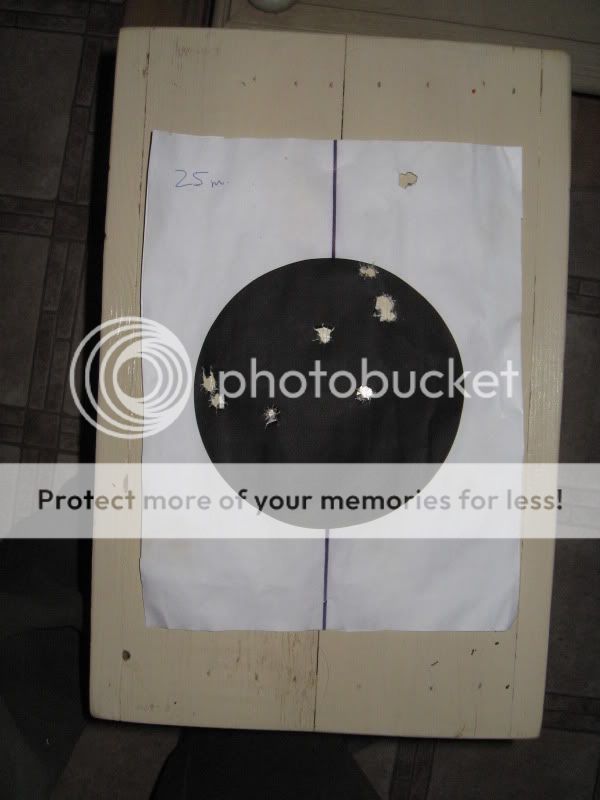
I returned to the range, and this time I did better. I had some 36 x 24 white paper, with a 6 inch black circle in the middle. This pic is from the 25 meter distance, I was aiming at the bottom of the circle, rear sight at 200m. At least this time I got 8 out of 10 in the circle.

range003.jpg


I also tried 50 meter, I was able to group 3 out of 5 in a 3 inch circle, about 6 inch above the circle, even if I was aiming at the bottom. No pics, the rain destroyed the target...

I also tried 100 meter, I did not touch the circle, but I was in the 36 x 24 white sheet.

It is not the best shooting for a Lee Enfield, but for a sporterized, it is not that bad I guess....
 
Nope, sitting with a bipod.....I know I know, not the best shoot......

I'm getting a rimfire next weekend, so I'll have a lot of practice for not a lot of $
 
Nope, sitting with a bipod.....I know I know, not the best shoot......

I'm getting a rimfire next weekend, so I'll have a lot of practice for not a lot of $

Well, that probably is a good idea. Note that I'm in no way suggesting you're a bad shot. Before I got some good coaching from Sly Old Fox about two or three years ago, with my .303 I probably wasn't able to hit the proverbial broad side of a barn. Interestingly, but beside the point, the French equivalent to this is: "J'aurais été capable de manquer un éléphant à 3 mètres dans un couloir". But I'm digressing.

Are there some good, experienced shooters at your range who could provide some tutoring? And while at it test that rifle for accuracy at 50 and 100 yards? Because technically, at around 25 yards with some type of rest, that rifle should at the very least shoot one inch groups, I believe.
 
Does the fact that the muzzle does not have the proper bedding (couple of pounds) of up-pressure have something to do with this ? It is a sporterized No 1.
 
Back
Top Bottom