MOOSE AT 550 yards

Why would anyone freehand a shot if there is any chance at a rest of some kind? That is one of the glories of a longer shot - the animal is not running (if you are going to shoot at 500 it better not be) - and the animal is not agitated and you have time to pick your shot and your set-up. There is no need to rush like a running, 50 yard snap shot, that many appear to prefer.

I know that in the open prairie that things are vastly different than in the close bush of other areas - but there is no reason a good hunter/shooter cant learn how to shoot at real life distances (here in any event) without being somehow called down for it.
 
You are not comparing apples to apples.
You are not the majority of hunters, you are a very small minority who practice and know there equipment intimately.

Go to the range and you will see the same couple dozen shooters week after week all year long, that is until a week before Moose or Deer opens.
Suddenly the flood gates open with the overwhelmingly large majority of hunters.
Haven’t looked at their rifle since last year hunting season never mind shoot it.
Show up with 1 box of factory ammo and not want to take more than 5 shots to sight in because ammo doesn’t grow on trees.

I have seen too many happy to hit the paper at 100 yds with an 8 inch group and in their mind their ready to go.

I have also had the pleasure of working in a busy gun shop for 12 years and have lost count of the number of guys that show up the week before the season opens and buy whatever ammo is on the shelf because they can’t remember what they used last year. They have no plans or desire to go to the range and see where their rifle shoots
“It was dead on last year, should still be dead on now”

These are the majority not the shooters like you find in these forums that actually enjoy shooting as well as hunting and practice, practice, practice.

JJ
 
So again I reiterate, long range shooting is not foe the average hunter.

I never said that it was for the "average" hunter.

Please remember, this is not the 1950's. More and more people are taking up long range shooting all the time. With the equipment available today it is not hard for a decent shooter who practices to become skilled at shooting longer ranges. This equipment is not specialized military rifles and scopes, it is off the shelf and available at almost any hunting retailer.

I will go back to this statement:

Don't judge others based on your limitations.

That is good advice to follow in this case...
 
I too use nothing but bolt actions, and maybe you can freehand a 600 yard shot. Good for you.

Who said anything about freehand?Certainly not me.

Besides, again what is the energy at 600 yards of say the .270

I don't use a 270.My 300RUM using my loads still has about 2200ftlbs,my 7mmstw is nearly 1700ftlbs,and even my 280AI is still at 1300ftlbs,all at 600 yards.
 
and my 375RUM with 300gr Sierra Gamekings with a muzzle velocity of only 2800fps has over 2200+ ft lbs @ 550 yards... :D
 
How about a reality check on this stuff?

Let's assume that shooting skills,rifle/ammo quality,range estimation,and compensation for wind are all 100% spot on and take a look at a couple of ballistics cases showing bullet drop @ 600 yds (from the Nosler ballistic tables).

Case 1: .300 Whachamacallit Magnum shooting a 180gr Partition bullet @ 3000fps MV with a 300 yd zero. Bullet drop@ 600 yds is 52.6 inches (a bit more than 4 feet!!!)

Case 2: .270 Win shooting a 130gr Partition bullet @ 3000fps MV with a 300 yd zero. Bullet drop @ 600 yds is 56.7 inches (just a tad less than 5 feet!!!)

Now if a hunter can assure himself that ALL of the preceeding assumptions about his shooting skills,rifle/ammo,range estimation and wind doping are correct-then by all means take the shot. Both bullets have the residual energy to make the 600 yd kill (.300 Mag 1468 ft/lbs,.270 Win 923ft/lbs) when delivered to the animal's vital area.

Now for the next question. How many people on this forum can actually attest that they can fulfill all of the above assumptions (let's be generous and say at least 60% of the time) in a hunting situation? After 47 years of hunting experience and 32 years of shooting at known distances and field conditions in the Army,I would like to lead the parade of the unworthies and confess that I cannot.
 
Since when does the average hunter use a pump action?Not one of the eight people that I hunt with uses a pump action,and none uses a 30-06.In fact,pump actions are not at all a common sight at our local range.

Jeez, I am glad that I am NOT an average hunter!

With 65 rifles in 23 calibers: 3 custom rigs specifically set up for 1000 yard shooting in 6.5-284, 308, and 300 Win Mag, Corlane 270 WSM with a Lilja barrel that groups 3 shots in under 0.3 inches, Custom built 204 Ruger that shoots 1 hole groups and a dozen other specialty rigs.... I can usually choose the ideal rifle for the task at hand out of my safes.........

SO I can hardly wait to fill my moose tag in November my my Remington 760 Pump in 30-06! 168 gr TSX Barnes! Reloader 22! Long live the "non-average hunter?":confused:

I do plan on getting a little closer though. 2 weeks ago on the week long bow hunting trip I got within 12 yards of a cow moose but she would not sprout antlers.

For "shooting", I love bolt actions above and beyond but for "hunting" it is hard to beat a pump or a Model 88 lever or a Model 100 Semi.

Would love the opportunity to be the "ninth" and ruin the stats!

Cheers and good luck moose hunting to all this fall!
 
Where would you anyone be hunting that you can't approach closer than 550yds to a bull moose? 550 yds isn't long range it's extreme range for hunting. Certainly a high risk shot for the majority of hunters.


Me thinks you need to have a look at a powerline, with swampy sections.

Just because you can't, wont or have'nt done it does'nt mean it can't, won't or has'nt ever been done.

Open your mind a bit.
 
Now for the next question. How many people on this forum can actually attest that they can fulfill all of the above assumptions (let's be generous and say at least 60% of the time) in a hunting situation? After 47 years of hunting experience and 32 years of shooting at known distances and field conditions in the Army,I would like to lead the parade of the unworthies and confess that I cannot.

I'm with you on that.
I have 30 years of shooting experience and only 22 years of hunting.

I limit myself to 300 yds on game, if I can't get closer I would rather pass than wound something .

JJ
 
30/06 Pump

Hi just wondering if anyone could tell me the best rifle, load, scope for knocking down a large bull moose at 550 to 600 yards. Have a 30-06 pump and did not want to take the shot being afraid it wouldn't have enough when it got there and did not want to wound it and turn it into wolf bait. Thanks

If the rifle you are referring to is a Remington 30/06 7400 pump. I would say no.That gun shoots 3-4" groups at best. At 600 yard you would have a 24" group.
 
Now if a hunter can assure himself that ALL of the preceeding assumptions about his shooting skills,rifle/ammo,range estimation and wind doping are correct-then by all means take the shot

As far as trajectory is concerned,I don't make assumptions,I try the load at all distances that I might possibly shoot at an animal.I don't make assumptions about shooting distance,I use my Leica Geovids to tell me the distance.My only assumption is wind drift,and I limit my shooting distance according to the wind conditions.Lastly,my self imposed limit is 500 yards,because that is as far as I practice regularly.
 
Something I haven't seen in all this manly chest thumping about ability to make long range shots is what happens after. tracking skills. I'd be willing to bet that not one long range shooter in 10 is enough of a hunter to track the moose that they shot across a second growth clear cut if the shot was over 500 yards and the moose walked off hit but not "dead right there". Just try to find the spot where it was standing in that kind of terrain. Very very difficult without nice new snow or a spotter to wave you over. Moose are not steel gongs. They can suffer and die wasted by people whose judgement may be clouded with a feeling of entitlement or something to prove.
If the hypothetical moose was standing on a snowy stubble field with no chance to approach closer, and the shooter has the skills and equipment, perhaps it's a different story but in normal moose hunting terrain what happens after the shot is as important as the shot itself. I have shot two bull moose at a relatively close range of 250 yards that were very difficult to find in tall grass and willows. Neither went far after good shots, but neither were simple tracking jobs either.
 
Something I haven't seen in all this manly chest thumping about ability to make long range shots is what happens after. tracking skills. I'd be willing to bet that not one long range shooter in 10 is enough of a hunter to track the moose that they shot across a second growth clear cut if the shot was over 500 yards and the moose walked off hit but not "dead right there". Just try to find the spot where it was standing in that kind of terrain. Very very difficult without nice new snow or a spotter to wave you over. Moose are not steel gongs. They can suffer and die wasted by people whose judgement may be clouded with a feeling of entitlement or something to prove.
If the hypothetical moose was standing on a snowy stubble field with no chance to approach closer, and the shooter has the skills and equipment, perhaps it's a different story but in normal moose hunting terrain what happens after the shot is as important as the shot itself. I have shot two bull moose at a relatively close range of 250 yards that were very difficult to find in tall grass and willows. Neither went far after good shots, but neither were simple tracking jobs either.


Well just to get back to the point of not ever losing an animal..

Should it happen that I do end up with a wounded animal,..I would be very hesitant in my tracking abilities over a long range,..within a couple hundred yards,.. well I could do that, but if it turned into much more than that, and there wasn't a good trail,.. I would certainly have difficulty,..I've never done it...
 
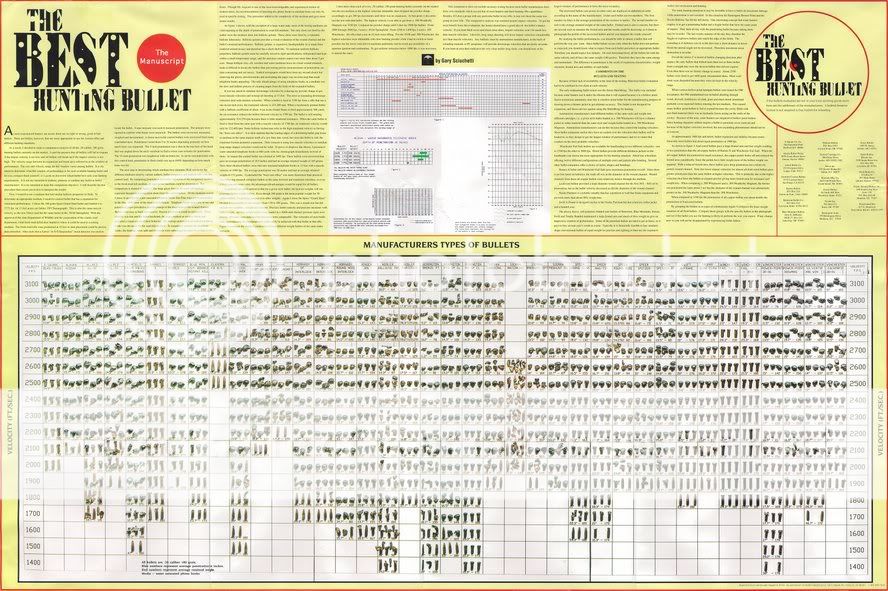
those are pretty pictures you have there
but with the exception of solid copper your still gonna get decent expansion all the way down to 1100 fps with most bullets and if you dont think there's much expansion under 2000 fps just ask all the dead deer taken with the good old 30-30 and a plethora of other calibers and bullet weights that are usually doin between 2000 - 1000 fps when the hit home :nest:

The question is not one of shooting big game with bullets designed to expand within the velocity range of the .30/30. By the way, .30 caliber big game bullets designed to expand fully at .30/30 velocities have become quite specialized and are not normally chosen for even a .308 or a .30/06. The question is about shooting big game with bullets designed to expand reliably and without failure when fired at high velocity but with low velocity impacts due to extended ranges. The pretty pictures you refer to are evidence that bullets designed for use in modern cartridges, and for use on big game, do not do particularly well when the velocity drops much below 2000 fps.
 
those are pretty pictures you have there
but with the exception of solid copper your still gonna get decent expansion all the way down to 1100 fps with most bullets and if you dont think there's much expansion under 2000 fps just ask all the dead deer taken with the good old 30-30 and a plethora of other calibers and bullet weights that are usually doin between 2000 - 1000 fps when the hit home

There was a chart with photographs posted in The Shooting Times several years ago where about 20 different commonly used hunting bullets were tested at impact velocities from around 1500fps to just over 3000fps.The vast majority of the bullets would expand decently down to about 1800fps,but at 1600fps or so,many of then acted like solids with no expansion at all.Several bullet companies actually offer special bullets for low velocity cartridges like the 30-30,because most common bullets do not expand well at lower velocities.Take a look at the links below if you doubt this.

http://www.speer-bullets.com/ballistics/bullets.aspx

http://www.sierrabullets.com/index.cfm?section=bullets&page=rifle&brandID=3&displayAll=1
 
Maybe I should make myself a little more clear on my previous comment... 550 yard benchrest shooting is much different than 550 yard hunting. With the number of uncontrollable variables and limitations of a hunting gun it is both unwise and in my opinion, irresponsible to take a shot where a clean kill is not guaranteed. I'm sure there are many here who could do it, but hitting vitals on a moose at 550 yards with a hunting gun is well beyond the ability of the average hunter.

Wow ! I never knew that 99.99% of hunters were that poor at shooting longer ranges. I guess we had all better stick to 100 yards or less with our turdy turdies. And $15000 for a rifle capable of doing such a crazy shot is way out of most of our budgets.

With facts like yours, who can argue...

With some of the crazy "facts" posted in this thread I would say that there are allot of folks who need to spend more time at the range and less time on the interweb. Just MHO of course...


Maybe 99.99% is an exageration. However put a pie plate at 550 yards, add a 5 mph crosswind, a light drizzle and a slight incline angle. Take into account the paralax error in a standard mid grade hunting scope, trigger pull on a hunting gun, and the number of times your hunting gun got "bumped" since you sighted it in 3 days ago. Lay down in the bush and take that shot and I'll bet the majority are unable to put 3 rounds in a row on that pie plate. I think I'll stick to shots inside of 300 when hunting and stick with clean kills. JMHO.....
 
550 yards? LMAO.... That's beyond 99.99% of the shooting public's capability. got wind markers? Bullet drop and wind drift will play havoc with a shot that far.

If you really are serious about taking a shot like that, buy a 50 BMG and some good optics, rangefinder and match grade ammo.... The whole set up will only cost about $15000....


although I dont condone long range shooting at game, 550 yards is not that far. You do not need an anti tank rifle to kill a moose at 550 yards
 
I agree with Crazey Davey (if you have not guessed) -- a 400 yd shot at a bully is a gimmee - with a good, normal bolt rifle with good scope etc .

Last week - a bully at 360 yds lazed afterwards - 270 win in the shoulder and timber on the spot. I cannot imagine not taking at shot at 400 -500 yds.

O well - to each their own I guess.

specialized military equipment ?????!!!!! a 30-06 with a scope is specialized military equipment - just learn how to shoot it.

Wow!
Some fairly sweeping statements!

400 yards a gimmee?
Where exactly do you aim for a 400 yard shot?
What if its blowing 10MPH...or is that 17mph?
What if the shot is a steep down angle? How steep? Where do you aim at a 400 yard moose with a 18% slope? How do you measure slope on your garden variety bolt action rifle?
What if you just cleaned your rifle barrel?
What if it's 20 below zero? Do you aim somewhere else?

As far as 500 yard shots with a conventional hunting rifle.....Exactly where do you line up a conventional reticule at 480 yards...How about 425?

I like long range hunting and shooting so don't jump down my throat here....There are answers to all of my questions, but I don't believe they come (reliably) from a standard hunting rifle, standard hunting scope, or even standard hunting support equipment.

I believe you oversimplify the long shot.
 
There was a chart with photographs posted in The Shooting Times several years ago where about 20 different commonly used hunting bullets were tested at impact velocities from around 1500fps to just over 3000fps.The vast majority of the bullets would expand decently down to about 1800fps,but at 1600fps or so,many of then acted like solids with no expansion at all.Several bullet companies actually offer special bullets for low velocity cartridges like the 30-30,because most common bullets do not expand well at lower velocities.Take a look at the links below if you doubt this.

http://www.speer-bullets.com/ballistics/bullets.aspx

http://www.sierrabullets.com/index.cfm?section=bullets&page=rifle&brandID=3&displayAll=1

I think you are referring to this one, but I don't seem to be able to make it bigger.
bestbullet.jpg


Again as I have said, I have nothing against the man who has proven his prowess as a long range rifleman and who has made the investment in time and equipment to be successful in the field. This is simply beyond the ability of the average hunter with his surplus rifle, Simmons scope, and blue box Federal ammo. Most of the time a long shot on a live target is beyond my ability, and I consider myself a competent shot but my gear is selected for general hunting conditions not long range. I choose not to hunt with my 20 pound target rifle nor with my 4-16X S&B PMII mounted on a sporter. If you use a conventional scope it is not handy to adjust your elevation to a specific range, or your windage to match the conditions at the moment of the shot. If you use a conventional reticle you are aiming at air, and if you aim at air chances are you will hit air.

Proper bullet performance is essential to the success of the shot. If the bullet fails due to fragmentation at high velocity or due to penciling through at low, all is for naught. The long range hunter takes to the field prepared to make a long range shot. His rifle if not chambered for a .300 magnum is chambered for a large case .338. His bullets are probably match bullets that, due to their thin jackets, exhibit more consistent upset at low velocity than does a modern hunting bullet.

His scope can be quickly adjusted for range and wind conditions, and his reticle allows precise hold offs should he need them. He chooses to hunt in the early morning and in the evening so that mirage is manageable and winds tend to be light. Perhaps he uses a laser range finder or perhaps he is familiar with the area and has pre-ranged and recorded those points where he anticipates his shot will be made.

IMHO, 500 yards is where the esoterica of long range shooting begins. A competent rifleman can manage a quarter mile without specialized equipment, but I don't believe everyone who carries a rifle in the field is competent. Does one need an anti-tank gun to kill a moose at 500 yards? Probably not, but he does need more retained velocity than is possible with a .308 or a .30/06 if he hopes to have desirable bullet performance. At the very least he will want his handloads to print MOA at that range. If he uses a conventional scope with a conventional reticle, he wants a reticle that can give him some idea of his hold off such as a duplex. Has he taped a drop and drift table to his stock or scope?

If the wind is blowing, he must be able to do the math on the fly in order to compensate adequately, particularly if the wind is quartering, bouncing back and forth as it can. Does he shoot at the gust or wait for a lull? Does the country provide any indicators? Does vegetation or topography break the airflow along the bullet's trajectory?

 
Back
Top Bottom