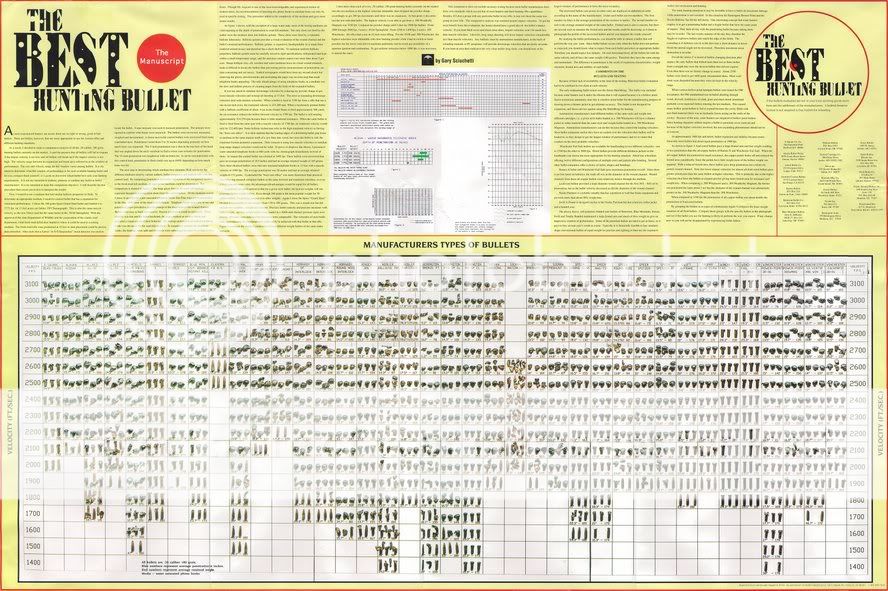
There was a chart with photographs posted in The Shooting Times several years ago where about 20 different commonly used hunting bullets were tested at impact velocities from around 1500fps to just over 3000fps.The vast majority of the bullets would expand decently down to about 1800fps,but at 1600fps or so,many of then acted like solids with no expansion at all.Several bullet companies actually offer special bullets for low velocity cartridges like the 30-30,because most common bullets do not expand well at lower velocities.Take a look at the links below if you doubt this.
http://www.speer-bullets.com/ballistics/bullets.aspx
http://www.sierrabullets.com/index.cfm?section=bullets&page=rifle&brandID=3&displayAll=1
I think you are referring to this one, but I don't seem to be able to make it bigger.
Again as I have said, I have nothing against the man who has proven his prowess as a long range rifleman and who has made the investment in time and equipment to be successful in the field. This is simply beyond the ability of the average hunter with his surplus rifle, Simmons scope, and blue box Federal ammo. Most of the time a long shot on a live target is beyond my ability, and I consider myself a competent shot but my gear is selected for general hunting conditions not long range. I choose not to hunt with my 20 pound target rifle nor with my 4-16X S&B PMII mounted on a sporter. If you use a conventional scope it is not handy to adjust your elevation to a specific range, or your windage to match the conditions at the moment of the shot. If you use a conventional reticle you are aiming at air, and if you aim at air chances are you will hit air.
Proper bullet performance is essential to the success of the shot. If the bullet fails due to fragmentation at high velocity or due to penciling through at low, all is for naught. The long range hunter takes to the field prepared to make a long range shot. His rifle if not chambered for a .300 magnum is chambered for a large case .338. His bullets are probably match bullets that, due to their thin jackets, exhibit more consistent upset at low velocity than does a modern hunting bullet.
His scope can be quickly adjusted for range and wind conditions, and his reticle allows precise hold offs should he need them. He chooses to hunt in the early morning and in the evening so that mirage is manageable and winds tend to be light. Perhaps he uses a laser range finder or perhaps he is familiar with the area and has pre-ranged and recorded those points where he anticipates his shot will be made.
IMHO, 500 yards is where the esoterica of long range shooting begins. A competent rifleman can manage a quarter mile without specialized equipment, but I don't believe everyone who carries a rifle in the field is competent. Does one need an anti-tank gun to kill a moose at 500 yards? Probably not, but he does need more retained velocity than is possible with a .308 or a .30/06 if he hopes to have desirable bullet performance. At the very least he will want his handloads to print MOA at that range. If he uses a conventional scope with a conventional reticle, he wants a reticle that can give him some idea of his hold off such as a duplex. Has he taped a drop and drift table to his stock or scope?
If the wind is blowing, he must be able to do the math on the fly in order to compensate adequately, particularly if the wind is quartering, bouncing back and forth as it can. Does he shoot at the gust or wait for a lull? Does the country provide any indicators? Does vegetation or topography break the airflow along the bullet's trajectory?