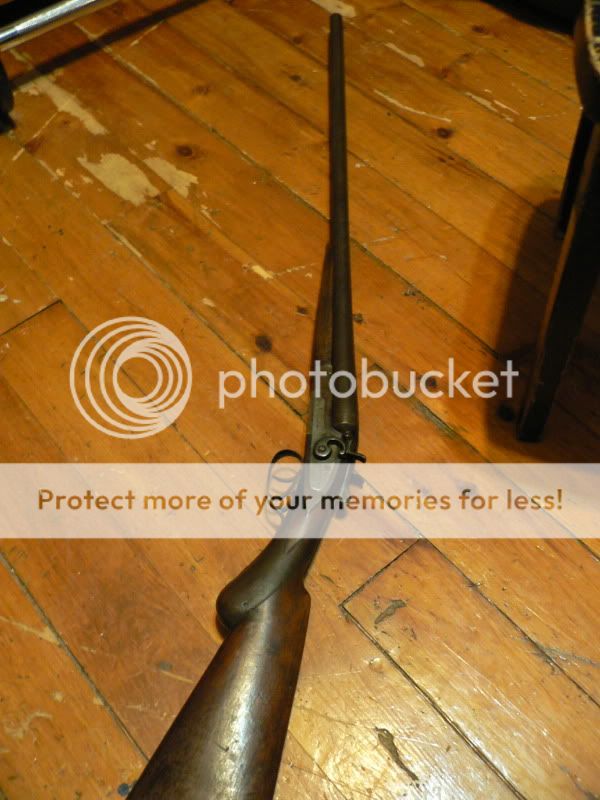
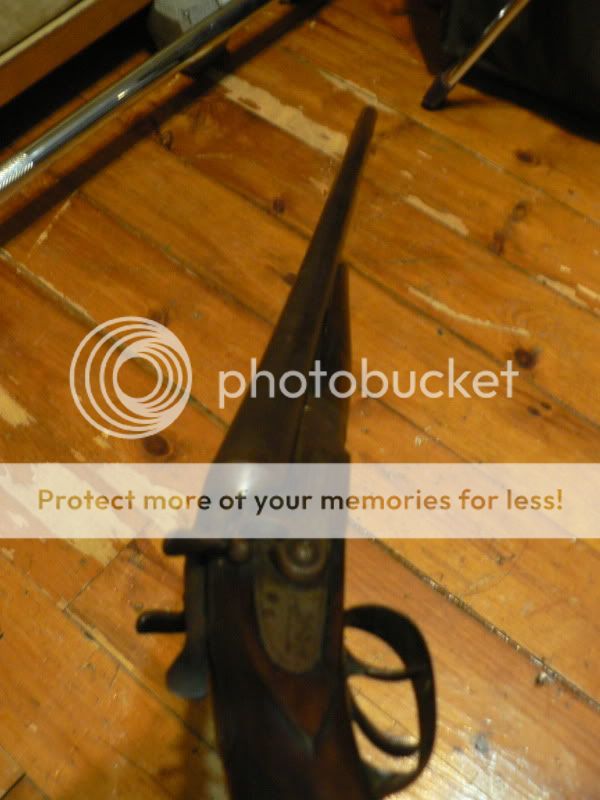
Identify: Sam Holt Arms Co. 12ga double barrel

KRASHED

CGN Regular
Rating - 100%
26   0   0
Location
Central Ontario
Can't seem to find any info on this shotgun. What i can see is that it is a Sam Holt Arms 12ga double barrel shotgun. Left barrel is full choke, right barrel is no choke. Here are some pictures below. Was given to me by my Opa for my birthday. Thoughts? Shootable? (aside from the blueing being worn it seems in fine operating condition)

P1080060.jpg

P1080058.jpg

P1080059.jpg
 
From the pics i can't tell if it's damascus or not, the name may be an example of Belgium makers using a similar name to a quality American or British , in hopes that buyer may not be savy to this. I'd def. take it to a good gunsmith or at least someone that knows these older hammerguns before I tried to fire it . I just wonder if the name isn't a play on "Sam Colt".....the legendary US armsmaker.
 
From the pics i can't tell if it's damascus or not, the name may be an example of Belgium makers using a similar name to a quality American or British , in hopes that buyer may not be savy to this. I'd def. take it to a good gunsmith or at least someone that knows these older hammerguns before I tried to fire it . I just wonder if the name isn't a play on "Sam Colt".....the legendary US armsmaker.

It is not a damascus twist barrel.

Also I will take more pictures of proof marks when i get back home from school.
 
"Sam Holt" shotguns were Belgian made for the mail order trade. Sears 1900 catalogue lists them at $10.45. Barrels are described as being "Raleigh Steel", whatever that is.
In the same catalogue, the basic Remington hammer gun was $20.00, the Ithaca $21.00.
The very cheapest double hammer guns in the catalogue are $8.75.
 
I have shot many of these old guns that are in good shape.
BUTI would bet that it will have a 2 1/2" chamber
, not 2 3/4 inch.
 
I have shot many of these old guns that are in good shape.
BUTI would bet that it will have a 2 1/2" chamber
, not 2 3/4 inch.

Right you are.

Remember folks, the chamber includes an extra quarter of an inch to allow for the crimp. Thus, a gun chambered for 2 1/2" shells will measure approximately 2 3/4 from the breech to the beginning of the forcing cone.
 
Right you are.

Remember folks, the chamber includes an extra quarter of an inch to allow for the crimp. Thus, a gun chambered for 2 1/2" shells will measure approximately 2 3/4 from the breech to the beginning of the forcing cone.

Wrong you are. A 2 1/2 inch chambered gun is just that. A 2 3/4 inch shell will be less than 2 3/4 inches long until it is fired. That is why a 2 3/4 inch shell will cause high pressure if fired in a 2 1/2 inch chamber.


Sharptail
 
Wrong you are. A 2 1/2 inch chambered gun is just that. A 2 3/4 inch shell will be less than 2 3/4 inches long until it is fired. That is why a 2 3/4 inch shell will cause high pressure if fired in a 2 1/2 inch chamber.


Sharptail

That's the second time I've got that bass ackwards. But, don't worry, by the time I've posted the same erroneous information 50 times, I'll get it straight in my head.:redface:
 
I found the words "laminated steel" on the barrel. I'm guessing that makes it a damascus barrel which is unsafe to fire right?

Laminated steel barrels are a process that includes twist and damascus variants. They aren't inherently dangerous as many believe. But, like all guns, they must be proofed for the type of powder that will be used. In addition to containing the correct powder, the shells used must be the correct length for the chambering of the gun, and must contain the correct type of shot.

New guns are still available, constructed with damascus barrels. And, they are typically very fine guns, indeed. However, due to the labor intensive nature of barrel making by any laminated technique, they are enormously expensive.

The poor reputation attributed to damascus barrels is a result of two factors:

  • Most of the examples that are commonly found in this day and age are 80+ years old. Many of them well over 100 years old. And, they have often been subjected to less than ideal conditions at some time in their long existences. Also, they are sometimes loaded with shells containing nitro (smokeless) powders. Combining corroded damascus barrels with over pressure nitro shells can have disastrous results for both gun and shooter.
  • Secondly, the bi-metal (iron and steel) nature of laminated barrel construction is more prone to corrosion. For this reason, they must be well cared for throughout their lifespans and they should never be subjected to pressures greater than those for which they were designed.

Your gun shows readily apparent signs of corrosion, so I'd suggest you're absolutely right - it shouldn't be fired, even with black powder shells (unless proof tested by a competent proof house).

 
Laminated steel barrels are a process that includes twist and damascus variants. They aren't inherently dangerous as many believe. But, like all guns, they must be proofed for the type of powder that will be used. In addition to containing the correct powder, the shells used must be the correct length for the chambering of the gun, and must contain the correct type of shot.

New guns are still available, constructed with damascus barrels. And, they are typically very fine guns, indeed. However, due to the labor intensive nature of barrel making by any laminated technique, they are enormously expensive.

The poor reputation attributed to damascus barrels is a result of two factors:

  • Most of the examples that are commonly found in this day and age are 80+ years old. Many of them well over 100 years old. And, they have often been subjected to less than ideal conditions at some time in their long existences. Also, they are sometimes loaded with shells containing nitro (smokeless) powders. Combining corroded damascus barrels with over pressure nitro shells can have disastrous results for both gun and shooter.
  • Secondly, the bi-metal (iron and steel) nature of laminated barrel construction is more prone to corrosion. For this reason, they must be well cared for throughout their lifespans and they should never be subjected to pressures greater than those for which they were designed.

Your gun shows readily apparent signs of corrosion, so I'd suggest you're absolutely right - it shouldn't be fired, even with black powder shells (unless proof tested by a competent proof house).


Perfect, thanks for the info! Above the fireplace it goes.

 
Back
Top Bottom