Barnes TSX - Performance on deer

All of the modern barnes,swift & etc bullets were developed after the Partition, which was/is, the standard they were and are trying to compete with.
They're wannabes in fancy packaging. Buy the real thing.

Partition is a great bullet, but there has been some improvements in bullets since it came out in the 1940's....
 
The Partition was developed after the round-ball, to which it has been compared at some point or another. It must be a wannabe.

Ridiculous.

R&D is a good thing.

Hay I still use "round balls" and they work great LOL. I shoot a .25-06 and don't like the mess the SST left this past season, so I plan on trying the Barns. It is either that or go back to the .30-30. I have shot some on paper and accuracy is good, so now I just have to try them out on a Whitetail.
 
I don't think you'll be disappointed. I have shot a dozen deer, at least, with the 100gr TSX and TTSX and only 1 has gone anywhere but straight down, and it's because I hit it a little too far back, nicking the rear of one lung. Even she didn't make it very far.
 
To the OP, there is no doubt that the tsx (and x bullet predecessor) has been one of the most successful, and controversial, bullet introductions .... well, ever.

They are a well designed, good performing bullet. However, they are expensive. They will run you over $1 each. If you are willing to spend the money and shoot a lot, then they are an excellent choice. However, if you are a "I only shoot 3 shots a year; 2 to sight in and 1 for my *deer/elk/moose/etc.*" then I guess they are also a good idea, as you will likely need the penetration performance of the tsx sooner or later. If you are getting into reloading to save money AND shoot more, then there are many other good choices out there that will also perform admirably on game and not break the bank in a days shooting.

Seriously, I shoot a lot less then many people I know, and I still manage to shoot through a few hundred rounds out of my hunting rifles in a year. FWIW, I am not willing to spend $1.25+ per round for practice, and I only practice with my hunting rounds. Do not believe for 1 second that you need the "premium" bullets to kill a deer (or whatever). The tsx is great for those who are willing to pay for it, and is an excellent choice for a number of hunting applications (big bears, hyper-velocity cartridges and close range shots) but they are not necessary.


Im well aware of that. Im just looking for options. I know next to nothing about Barnes Bullets. Just doing some research.

Price is an issue I guess for me, so i suppose I will be loading up other bullets for extensive paper shooting, but i still may do some Barnes. I can shoot my .308 for less then half of what it costs me to shoot my .270 WSM (I put 100+ rounds through it last year).
 
The reason for choosing a light weight TSX is that the lighter bullet is the same length as a heavier lead core bullet, so it can be driven at higher velocities, allowing a flatter trajectory over normal hunting ranges, and similar terminal performance once it gets to the target. Reliable terminal performance of the TSX has a low velocity limit of around 1800 fps, where 1.5X expansion can occur reliably on a live target, which is similar to many traditional lead core, copper cup style bullets. The real advantage the TSX has over the traditional lead core bullet is that the maximum impact velocity it can tolerate without failure is much higher, making it a better choice for those who like "go fast" cartridges.

All TSX bullets have the same depth of hollow point within caliber, so you gain no terminal performance by choosing a heavier bullet as you would with a lead core bullet. The higher impact velocity of a lighter bullet produces penetration equal to the penetration of the heavier bullet with a lower impact velocity when fired from the same rifle at the same range. A heavy lead core bullet has a longer lead core which expands to a larger frontal area, and this greater frontal area results in a larger wound volume provided there is enough shank left so that the rotational velocity around a linear axis is not lost. Rotation around a linear axis when combined with the center of gravity moving to the nose of the bullet are the two most important factors that result in stability during the bullet's passage through the target. The heavier TSX has a longer shank which neither enhances nor detracts from it's terminal performance, and the hollow point is designed not to upset in excess of 1.5X the shank diameter, so the choice of weight should be determined by which bullet produces the best accuracy in your rifle.
 
The TSX are probably one of the worst choices out there for strictly deer hunting, unless you are one of those guys that obsesses about blood shot meat and plan on eating the lungs too. If that's the case grab some TSX and you are good to go,,,, very little damage to your precious lung meat.
 
The TSX are probably one of the worst choices out there for strictly deer hunting, unless you are one of those guys that obsesses about blood shot meat and plan on eating the lungs too. If that's the case grab some TSX and you are good to go,,,, very little damage to your precious lung meat.

Care to explain your opinion?
 
The TSX are probably one of the worst choices out there for strictly deer hunting, unless you are one of those guys that obsesses about blood shot meat and plan on eating the lungs too. If that's the case grab some TSX and you are good to go,,,, very little damage to your precious lung meat.

I loaded some 130 gr TSXs to 2600 fps for my nephew's .30/06, to keep the blast and recoil manageable for a youngster. It bang-flopped his spike. I"m curious to hear about your observations. I've tested these bullets in a number or cartridges, and in most cases the performance results in 1.5X expansion regardless of velocity, providing the impact velocity stays above 1800. Most folks knowledgeable about terminal ballistics will suggest that bullet expansion of 1.5X is optimal. I don't agree with this in all cases, but neither will that level of performance fail with good shot placement.

If you prefer a bullet that grenades inside the body cavity there is no doubt that this level of performance produces some spectacular kills. That choice is fine provided you use this type of bullet within is design parameters of velocity and with consideration to the type of shot you are presented. But to suggest that any TSX is the "worse choice" for deer, particularly if fired from a fast small bore, is a poor choice of words. I prefer a bullet that will produce reliable performance form any angle, and if possible exit, but that's just me, and I don't suggest that more fragile bullets are incapable of killing deer.
 
This isn't the first thread I have ever read where the shooter thought that a TSX bullet hadn't performed to its advertised abilities. You can find this kind of discussion on boards all over the world.These TSX products are fairly new to this 100 year old market place. We as hunters have been killing deer for many decades before the introduction of this product with all kinds of different projectiles. Do the TSX bullets perform every single time? For many of us they seem to, but for some folks they don't. FS
 
Boomer first of all find me a TSX that expands it's frontal area to 1.5 times it's original diameter, you cant, because they won't do it.


And secondly, long winded posts involving homebrewed quasi physics do not always make you right. Especially if you cannot comprehend the basic action of what is involved (see above paragraph)

Just say'n:D:D:D
 
Drinkin' the Barnes Koolade?:D

They are ok I suppose. :stirthepot2:

I've killed dozens of Deer and Moose with Sierra Game Kings, Speer Mag Tips, and Hornady Interlocks. I'm just cheap. TSX are just simply over priced and no one is going to convince me otherwise that a TSX is better than 180 grain interlock.

The only time I shell out is when I load for my .338. It likes 250 grain partitions.
 
Boomer first of all find me a TSX that expands it's frontal area to 1.5 times it's original diameter, you cant, because they won't do it.


And secondly, long winded posts involving homebrewed quasi physics do not always make you right. Especially if you cannot comprehend the basic action of what is involved (see above paragraph)

Just say'n:D:D:D

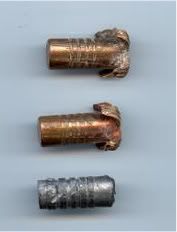
When I test a bullet, the results matter to me, because I might have to use a bullet for something more serious than killing a deer. Here's a couple of 450 gr .458s along with a 480 gr cast. As you can see, the expanded diameter is roughly 1.5X the shank diameter. This should be reasonable proof that the TSX will expand reliably at low velocity.

Scan1-1.jpg


The 180 gr TSXs fired from our two .30/06 rifles performed well, as did the 130s I loaded for my nephew. The 270 and 300 gr TSXs from 3 different .375s performed well enough that I keep a few boxes around. The 570 gr original X I fired from a John Wilkes .500 Nitro and recovered from my cape buffalo was right out of Barnes' advertising. Not to mention the dozens I've fired in testing. I pal of mine showed me a 140 gr 7mm TTSX that he recovered from a moose, again looked like it came from a picture in the manual. The 350 gr X I used almost exclusively in the .416 Rigby. I have shot TSXs and X in most bore sizes from .224" to .510," (6.5 mm, 8mm, .338, and 9.3 mm and .423" would be exceptions) so think I have enough experience to offer an opinion on the subject.

As for not understanding the subject of terminal ballistics, I haven't seen you offer much other than an unsubstantiated knee jerk reaction to what was undoubtedly a poor shot. Where is your evidence to the contrary? You don't even say what the result was on the deer your shot, only that it was a poor bullet. What exactly was the failure? Did it blow up? Did it pencil through? Did it tumble? Did it fail to hit the deer? You did sight in your rifle, right?

I don't like the Xs: the TSX, TTSX, XLC, or the original X, (I haven't tried the MRX) as much as I do a bonded lead core solid shank bullet, as far as I'm concerned the entire X family are built backwards because increasing the weight does not increase the terminal performance. But they do work, they do give a lighter bullet weight the advantage, and they are reliable.
 
I've shot the odd head of game with TSX's. Shot placement is king as with anything else. Broken bones help with "bang flops" and I've personally seen them fail to open and I had a Mule Deer run north of 400 yds after taking one high through both lungs. I will continue to use them as they are diggin sons of guns and failure to open beats failure to stay together. Every time.
 
Well stated Boomer (and well explained).

My earlier post was selling my own personal bias, that being that I am too cheap to pay $1+ for projectiles for the amount of shooting I do.

As I said, I have no doubt that they work well, but for the type of hunting I do the SST has proven itself to be exactly what I am looking for: a bullet that expands rapidly as most of the shots I take on deer are headshots (everyone can keep their ethics statements to themselves), but holds together enough if I need to take a body shot, which in my experience they do.

Having said that, the idea of a 110 gr tsx running at 3300+ in the 270 is starting to intrigue me.
 
Here's my "over 1.5x" TSX collection. Of course, they are all exceptions:p.

Barnes .264 120gr TSX
Average Penetration (inches): 13.67
Average Weight Retained (grain): 120.1
Average Weight Retained (%): 100
Average Expansion (inches): 0.592
Barnes120grTSX.jpg

120grTSX.jpg


Barnes .264 130gr TSX
Average Penetration (inches): 18
Average Weight Retained (grain): 129.9
Average Weight Retained (%): 100
Average Expansion (inches): 0.552
Barnes130grTSX.jpg

130grTSX.jpg


Barnes .358 225gr TSX
Penetration: 20"
Expansion: 0.737, 0.755, 0.686...avrg: 0.726
Weight retention: 225.1, 225.0, 224.9...avrg: 225.0
35225grTSXsideviewjpg.jpg

35225grTSXtopviewjpg.jpg
 
Back
Top Bottom