Uberti has chambered their 1873 reproduction in 44 Magnum

Yes, it will be interesting to see how this pans out. Maybe another "myth" about weak actions is about to be put to rest. If the steel is good and the fitting of the links is done properly I don't think there will be a problem.
 
IF the action DID fail, I'm curious what's the concensus on how it would fail?

Would it beat/crack the toggle to failure or would it violently force the action open, or a combination of both?
 
We could say that the evolution of the science and the technology in the 1800's was as quick that in our actual time. The metallurgy made big steps forward in the 19h century.

The winchester 92 used alloy steels, hardly 20 years after the coming of the winchester 73. The new Uberti 73 .44 mag. uses certainly actual material.

Also, we should not forget that Puma offers their 92 in 454 Causul wich is far away the 44-40 pressure level...
 
:confused: Sorry tradionalist here, why? what for? '73 great rifle in its original calibers, fine for CAS, hunting? I would assume one would use the model 94.

Just add, 1873 not made for 45 Colt but :

45 Colt design date : 1872
44 Magnum :1956
 
Last edited:
:confused: Sorry tradionalist here, why? what for? '73 great rifle in its original calibers, fine for CAS, hunting? I would assume one would use the model 94.

Straight wall cases are less work to reload with carbide dies and .44-40 and .38-40 cases are easy to damage while resizing. This is likely the same reason that reproduction leverguns are made in .45 Colt, even though the originals weren't.

I'm surprised that a toggle link action can stand up to .44 Magnum, given that I have always heard that these actions aren't very strong. I wonder if they have changed the internals.

1892 copies might be made in calibres like .44 Magnum and .454 Casull, but this is a far stronger action than the older toggle link rifles.
 
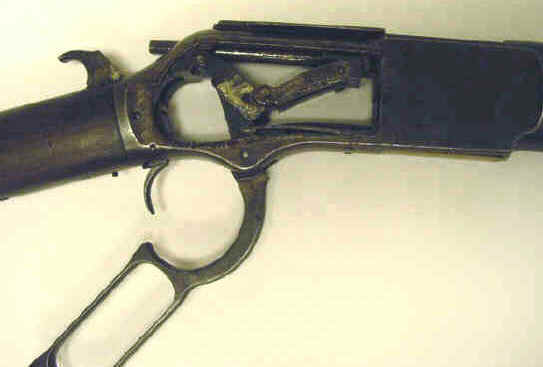
Just for clarity of the action, here's a pic of the type we're talking about.


togglink.jpg
The photo is of the Model 1876 Winchester which was the last and largest of the toggle joint design leverguns.. The design is the same as the Model 1873.
The rear of the toggle joint is anchored by a pin through a shoulder milled into the frame of the rifle. The forward link of the joint is attached by a similar pin to the rear of the breech block. Throwing the lever down (forward), which is attached to the middle of the toggle by a pin, collapses the toggle and slides the breech block out of battery to extract the fired case. At the end of the forward motion of the lever the follower raises a new round into position. Rearward movement of the lever slides the breech block forward which chambers the round. Full movement of the lever to the rear, cams the toggle joint into a "locked" position.
It is not a strong method of locking a breech block, though it works fine with black powder pressures. Shooters should be aware and load accordingly.


http://www.leverguns.com/leverguns/togglelink.htm
 
Myself, having read P.O. Ackley's books, and from my own experience with straight case walls, I expect that the 44 Mag will work. But I'm leery of what will happen with a lubed case, or an oily chamber, and I expect case life will be short.
If anyone wants to donate one of these rifles to the cause, I'll be glad to test it out for a decade or three.
 
The idea that the toggle link action is weak has been around forever. In the late 1800s, Winchester themselves did a test and published the results. As I recall, they filled a model 76 powder and stuffed more and more bullets in until they caused a problem. With eight bullets and 200 grains of powder and it just stuck closed. The 76 is the same action as the 73 but longer. And this was with period steels.
The .454 Casull makes over 60,000 CUP, but the straight case holds the chamber walls well. I am sure it will hold for barrel strength, I just wonder if it will jam the action with any oil on the case or wear with time. Have to see I guess.
 
I've shot 3 Cowboy Action matches so far this year and couldn't help notice that the shooters that suffer most rifle problems are using Winchester '73 replicas. Its my understanding that it is very ammunition sensitive and doesn't tolerate sloppy reloaders. Mind you I shoot .44 magnum, too.

If the price was a little more reasonable, I would be tempted. $1300.00 and change by the time you include for taxes and shipping is one hunk of a chunk of change to bet on something you might not like. In the mean time I'll say with my 1906 Winchester M1892 and Marlin M1894S, both in .44 Mag.
 
I used an original 1873 in .38-40 quite a bit and I would agree that they don't tolerate marginal case sizing well. They don't have a lot of camming power to push in a round out of size at all. They are fun and nostalgic and so on, but I think the 92 is a far better rifle/carbine if you want to put a lot of rounds through. The 73 is very smooth, but so is a good 92. I have no experience with Marlins to speak of regarding comparison.

 
I used an original 1873 in .38-40 quite a bit and I would agree that they don't tolerate marginal case sizing well. They don't have a lot of camming power to push in a round out of size at all. They are fun and nostalgic and so on, but I think the 92 is a far better rifle/carbine if you want to put a lot of rounds through. The 73 is very smooth, but so is a good 92. I have no experience with Marlins to speak of regarding comparison.


I agree wholeheartedly. The 38-40, for the uninitiated, changes dramatically when fired the first time. Major fire forming, at least in my old '92.
 
Back
Top Bottom