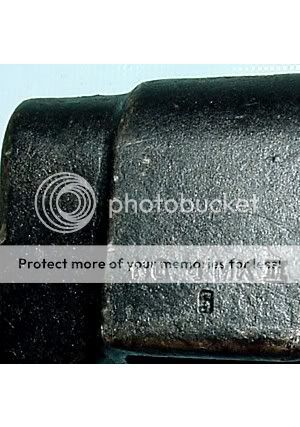
No4MkII*?

Sardaukar

CGN Ultra frequent flyer
Rating - 100%
31   0   0
Today I saw for the second or third time, somewhere on the net, a bayonet that is supposedly a 'No4MkII*' or for a 'No4MkII*'.

Is there such a thing as a No4MkII*? I'm 99.9% sure there is not, but i don't know, maybe a certain model of bayonet was named No4MkII*.

This looks more like someone who doesn't know much about what he is selling. Anyway, i'm pretty sure you guys can give me a definitive answer.

Thanks

Sardaukar
 
No such rifle as a No.4 MKII*, but there is a bayonet. There are several variations of bayonets and scabbards for the No.4 series of rifles.

- No4 MKI
- No.4 MKII
- No4 MKII*
- No.4 MKIII
- No. 7
- No. 9
 
Last edited:
All right, thanks.

I'm starting to think the * may be messing with Google results, as there are basically no relevant hits for 'No4Mk2* bayonet'.
 
No such rifle as a No.4 MKII*, but there is a bayonet. There are several variations of bayonets and scabbards for the No.4 series of rifles.

- No4 MKI
- No.4 MKII
- No4 MKII*
- No.4 MKIII
- No. 7
- No. 9

They didn't use Roman numerals for the Marks of the No.4 rifles. So it was

No.4
No.4 Mk1 (some modified with Mk.2 type trigger, restamped as No.4 Mk 1/2)
No.4 Mk1* (some modified as above, restamped as No.4 Mk1/3)
No.4 Mk 2

If you find one with Roman numerals stamped, either someone has messed with it or you have a rare anomaly that may be of special interest or value to collectors. (Try to find out and tell us all.)
 
Tooner I know that you are trying to be funny, but if you would have read my post you would have seen that I am talking about bayonets and not rifles.


smk11b.jpg
 
Thanks a lot for the info.

I just got a Lee-Enfield No4Mk1* last week and I still have a lot to learn about them, including a more rigorous use of the terminology. I should haved picked up the II/2 difference and figured this out by myself.

I finally just bought a bayonet on ebay(No4MkII, no star), and it was made by Long Branch in the same year as my rifle, so they must be a match. Anyway, it's not for a museum, only for my personal satisfaction, and I'm satisfied.

Thanks again for the info.
 
Last edited:
The problem arises from the fact that we are speaking ENGLISH. The Quartermaster Corps didn't: they spoke "Quartermasterese" or something. Everything was backwards, but it made sense. They stored things by WHAT they were, THEN by the model and so forth.

Look at the old Smellie, for one example. In Quartermasterese, it is the:
Rifle, Short, Magazine Lee-Enfield, Calibre .303, Mark III
or the
Rifle, Short, Magazine Lee-Enfield, Calbre .303, Mark III*
which indicates the absence of the cut-off and dial sights.

In 1927, they went to a slightly-newer system, giving the RIFLES Numbers, so the same rifle now became the
Rifle Number 1, Mark III
or
Rifle Number 1, Mark III*
being that all Rifles, Number 1, were .303"-calibre Magazine Lee-Enfield short rifles in the first place.
Funny, though, the bayonets usually continued to be referred to as the Bayonet, Pattern 1907 Mark I.

The replacement for the Number 1 Rifle was the Number 4, and we have just seen its variants described.

But RIFLES are one thing and BAYONETS are something else, so BAYONETS had their OWN system of Numbers and Marks. FORTUNATELY for the sanity of the rest of the world, the BAYONET was Numbered to the RIFLE, but its own MARKS continued in a separate series, which we also have been given (thankfully). As the BAYONET Number 4, Mark 1 was so slow and expensive to make, it was quickly superceded by the BAYONET Number 4, Mark 2 and subsequent variants.

But that's how they did it: THING first, then its NUMBER, then the MARK of THAT NUMBER of THAT THING.

I find that a large glass of rum can assist greatly in sorting it all out. For correct historical versmilitude, use SR,D: Service Rum, Diluted. You can always tell the wife that it's historical research or something.

Oh, but it's fun!

 
Tooner I know that you are trying to be funny, but if you would have read my post you would have seen that I am talking about bayonets and not rifles.

Er, no I wasn't trying to be funny. I did read your post and misunderstood you. Sorry. :redface:
 
The problem arises from the fact that we are speaking ENGLISH. The Quartermaster Corps didn't: they spoke "Quartermasterese" or something. Everything was backwards, but it made sense. They stored things by WHAT they were, THEN by the model and so forth.

Look at the old Smellie, for one example. In Quartermasterese, it is the:
Rifle, Short, Magazine Lee-Enfield, Calibre .303, Mark III
or the
Rifle, Short, Magazine Lee-Enfield, Calbre .303, Mark III*
which indicates the absence of the cut-off and dial sights.

In 1927, they went to a slightly-newer system, giving the RIFLES Numbers, so the same rifle now became the
Rifle Number 1, Mark III
or
Rifle Number 1, Mark III*
being that all Rifles, Number 1, were .303"-calibre Magazine Lee-Enfield short rifles in the first place.
Funny, though, the bayonets usually continued to be referred to as the Bayonet, Pattern 1907 Mark I.

The replacement for the Number 1 Rifle was the Number 4, and we have just seen its variants described.

But RIFLES are one thing and BAYONETS are something else, so BAYONETS had their OWN system of Numbers and Marks. FORTUNATELY for the sanity of the rest of the world, the BAYONET was Numbered to the RIFLE, but its own MARKS continued in a separate series, which we also have been given (thankfully). As the BAYONET Number 4, Mark 1 was so slow and expensive to make, it was quickly superceded by the BAYONET Number 4, Mark 2 and subsequent variants.

But that's how they did it: THING first, then its NUMBER, then the MARK of THAT NUMBER of THAT THING.

I find that a large glass of rum can assist greatly in sorting it all out. For correct historical versmilitude, use SR,D: Service Rum, Diluted. You can always tell the wife that it's historical research or something.

Oh, but it's fun!

Is that Mk I or MkI* service rum :D

the Number 4 rifle Marks were done using Roman numerals originally for the Mk I and Mk I* they changed it to Aribic numerals by the time they got to the Mk2 and for more fun they did some conversions of the previous marks and you get a Mk I/2 converted from the Mk I and a Mk I/3 from a Mk I* with the * struck over

I'll have to dig out My No5 to look and see if its a Mk 1 or Mk I :D
 
Thanks Smellie, that's a great explanation. Now, to make sure I understood it correctly, i'll try some SR, D. Mixed with Drink, Carbonated, Coca-Cola Mk1.
 
You have the idea, my friend!

BTW, SRD was issued to the men in large quantities following the gas attack at St. Julien (Second Ypres) as it was an excellent solvent for washing off the Chlorine gas with which the men had become contaminated. So that's TWO fine historical uses for the stuff, both of which require very serious research.
Now, where'd I put that damn jug?

Welcome to the Wonderful World of Lee-Enfields!
 
OK, now you've got me doing some research about SRD. Google brings up some fascinating stuff.

A few months ago the last canadian veteran of the Great War died at 109. I bet this man remembered SRD even to that day.

The only problem about this whole thing is that now, on top of a WWI-era SMLE, I have to get one of those SRD earthenware jars!!!

Damn militaria will get me bankrupt!
 
Hey, a matched set! Most of them are like a dog's breakfast, being that not all rifle factories made bayonets and not all bayonet factories made rifles. But Savage did both... and you have the set.

Rear sight is the cheapest type, but correct for the rifle and the period. (It can be replaved with a better sight easily, and the original stores nicely in a 35mm film canister).

And it also has the "Dreaded Ishy Screw", so it has been to India as well. Some folks try to replace the wood or repair it to get rid of the 'unsightly' screw, but it is a part of the rifle's history. To replace it would be like dying my beard brown again: a waste of time and money as well as being a lie.

Nice shape, too!

Treat her gently and feed her well and she WILL be your pal!
 
Thinking on SRD for a minute.....

When I lived in rural Newfoundland, any 1-gallon earthenware jug still was referred to as a 'rum jug', even if it dated to long before the Great War. The Real Thing had "SRD" on it, of course, generally in red.

"You shouldn't drink so much," said Jackie Bissett's character in "THE DEEP", "You're always drunk on that rum!"
"Rum?," said Robert Shaw's character, "RUM's not drinking; rum is.... survival."

Gotta run, do have fun!

 
The troops also called SRD "seldom reaches destination". When the Navy stopped the daily rum issue (splicing the mainbrace I think they called it) back in 1972, the "Army of the West" got hold of the entire remaining stock from Esquimalt and stored it in the Camp Wainwright guardhouse.:dancingbanana: As I recall that lasted us in 1 Brigade for about the next 3 yrs. It was a welcome thing in the field and would be issued on foul/rainy/cold days as a boost for the troops.:) It had to be consumed under command supervision so that the boys would'nt squirrel it away for a pi$$-up at a later time.:( Most of us drank it in our coffee with plenty of cream and sugar. Some of the guys did'nt care for it, so it also found a use as a cleaning solvent for the Coleman stoves in the tent groups.:eek:

 
Back
Top Bottom