












































You are using an out of date browser. It may not display this or other websites correctly.
You should upgrade or use an alternative browser.
You should upgrade or use an alternative browser.
Cartridge with the highest velocity
- Thread starter Camper
- Start date


Farlsincharge
CGN frequent flyer
- Location
- Saskatchewan
22-243 middlestead at plus 5200 f/s
5278 is the fastest I have seen recorded (not in person).
It is strange to me that some of the crazy .22 wildcats out there can't come close to the middlestead.

I loaded up some 300 win mag cases with 100 grain 30 cal bullets.....overloaded the highest charge I could find (for a 125 grain bullet) by 10%. I don't know how fast they were going, but it wasn't slow, that's for sure. Accuracy was worse than crap.
Not technically a cartridge, but http://en.wikipedia.org/wiki/Railgun

- Location
- Somewhere on the Hudson Bay Coast
My vote is the '06 necked down to .224". With a 45 gr mono metal bullet it will break 5000.
I suspect that a larger capacity cartridge passes the point of diminishing returns and little or no additional velocity would be observed.
I suspect that a larger capacity cartridge passes the point of diminishing returns and little or no additional velocity would be observed.


cdnredneck_t3
Regular
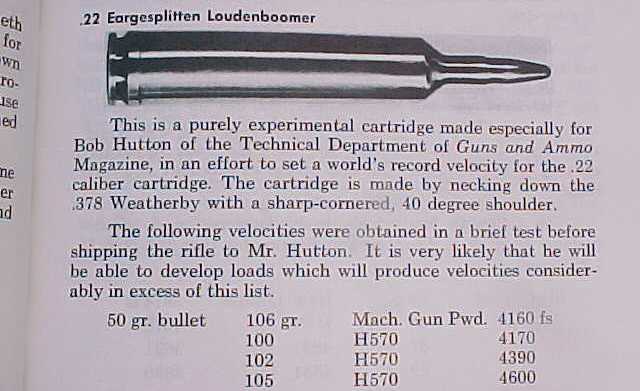
This is a scan from an Ackley book.
This is a scan from an Ackley book.
For velocity, bigger isn't better. There is a theoretical limit around 5,000 fps for a conventional rifle/powder combination. (It is based on the speed of the flame front, not pressure).
Here is a gun designed to be an all out velocity champ and designed to break 5,000 fps. The 17 Flintstone Super Eyebunger got up to 4,798 ft/s. It is a 17-250 with a 52" barrel.
If you want to truly get over 5,000 fps, you will need a sabot, and multi staged propellant charges. http://www.canadiangunnutz.com/forum/showthread.php?t=418967 see page 3
Anywhere you read that so-and-so got over 5,000 fps with his hunting rifle, lets just say that is an INTERNET record....... (or a malfunctioning chronograph). Gerald Bull got one of the HARP guns up to about 5,400 fps. It was a 7" smoothbore with a 3" diameter saboted round, 55' long barrel, loaded with 110 lbs of powder.

22-243 middlestead at plus 5200 f/s
What he said....this would make a great 1 day cartridge for a gopher infested field.
Get several barrels at once if you are planning on going with one of these...looks like 500-700 rounds should be max for minute of gopher accuracy....LOL
well i remember a cartridge .17/.50bmg a .17 cal bullet with a necked down case of a .50bmg. reports of a there abouts 10,000 fps, and i think u get about a couple of hundred shots before there is some definate change in accuracy as the barrel is being destroyed inside out.


ROFL!!!! Did anybody notice the name ?
This is a scan from an Ackley book.
cdnredneck_t3
Regular
ROFL!!!! Did anybody notice the name ?
It is a good name. Makes me wonder how loud it would really be.
There's only one way to find out .... Somebody must have one of those kicking around ...
It is a good name. Makes me wonder how loud it would really be.

rnbra-shooter
CGN Ultra frequent flyer
- Location
- New Brunswick
For velocity, bigger isn't better. There is a theoretical limit around 5,000 fps for a conventional rifle/powder combination. (It is based on the speed of the flame front, not pressure).
The limit is related to the speed of sound in the gun gas (the products of the powder's combustion), not the speed at which the powder burns. The outright theoretical limit is what's known as a "free expansion", that's the case where you have a bullet with a weight of zero, and your gun gas expands at a very high (but finite) speed.
Higher muzzle velocities than 5000fps are possible, but this is seriously in the realm of diminishing returns. I think I recall reading something semi-credible (in Handloaders Guide to Cartridge Conversions, perhaps?) that reported achieving 5,280fps (i.e. one mile per second was his goal). This is within the realm of believability, if not practicality(!).
There are various ways to get higher velocities
- different powder formulations, aimed at increasing the sound speed in the gas produced by the powder. The two main routes to this are to decrease the average molecular weight of the gas molecules produced (e.g. change the powder chemistry so you get more H2 and CO, less CO2), the other is to increase the temperature of the products of combustion
- "travelling charge effect"
- "light gas gun"
- "driver" or "2-stage" gun
If you want to truly get over 5,000 fps, you will need a sabot, and multi staged propellant charges. http://www.canadiangunnutz.com/forum/showthread.php?t=418967 see page 3
Anywhere you read that so-and-so got over 5,000 fps with his hunting rifle, lets just say that is an INTERNET record....... (or a malfunctioning chronograph). Gerald Bull got one of the HARP guns up to about 5,400 fps. It was a 7" smoothbore with a 3" diameter saboted round, 55' long barrel, loaded with 110 lbs of powder.
Interesting stuff you wrote over that at post #30. I had never heard of "firebrakes" in an artillery charge before, though it sounds like a plausible concept (this would be an effort to achieve the "travelling charge effect"). And it's always nice to read about HARP stuff.
Something to keep in mind with these really high performance guns. There is a parameter called "C/W", which is the ratio of the weight of the powder charge (C) to the weight of the bullet (W).
An ordinary centerfire rifle cartridge will see a C/W in the 0.3 ballpark, e.g. in my .308 target rifle, 45 grains of powder pushing a 155 grain bullet makes for C/W = 0.29. A pretty high performance cartridge would have C/W=0.5 (say a 7mm Rem Mag using 70 grains of powder to fire a 140 grain bullet). If you consider a crazy-overbore cartridge say a .30-378 using 120 grains of powder to push a 125 grain bullet, you get C/W = 0.96.
In the real high velocity guns, C/W ratios of 5 or even more are used to achieve the 5500+fps velocities you read about.
Using 5 - 10 times as much powder as your bullet weighs, truly is in the land of "diminishing returns"!!






















