
RAS systems -- Reed Knight did it first.
.
I thought #### Swan pioneered the weaver rail system which later evolved into M1913 picatinny system.













































RAS systems -- Reed Knight did it first.
.
Seriously?
Why would you care what he says or how he says it?
I couldn't care less if he was standing on his head when he said it wouldn't make one iota of a difference to me if the rifle is what it is supposed too be the only thing that will keep me from buying it is if the price is too high...

The guy has a serious beef with Remington especially after they stole the XCR name for the XCR model 700. Which Robinson sued and won and now Magpuls alledged theft of the bolt release design on the Remington ACR which is currently before the courts in another battle with Robinson.
So the guy has a right to be a little suspicious of Magpul and Remingtons activities and he now trys to keep his cards close to his chest. As for the comments they are a little juvenile but if the guy makes a quality product who cares.
At one time I stopped going to McDonalds for about four years, because I hated their commericals so much, even though I do like the taste of many of their menu items.
OK, for those who do not really know me, or worked within my company, or with the government lab, at Colt, or Canadian military back in the mid 1980's, working with us to the early 90's, you don't have first hand knowledge of the 1913 rail development. I will help clarify with appropriate facts re that rail. First of all, there is a lot of information in the Black Rifle two book, but not all there is, but more than enough to see that the standard did indeed come from A.R.M.S., just have to read the original documents within that book will show that.
I see someone says the detachable rails on the SIR are not mil spec. That I know is based on not understanding the spec, and or from false information based on a non spec plastic hang grip that doesn't fit various rails, that are in spec. If any of the S.I.R. rails were not in spec., A.R.M.S. would not have passed all the requirements, and received a contract for up to approximately 93.000 SIR 50M-CV hand guards, just like the other two selected companies also received, Daniel Defense, and KAC. ie These three companies, (D.D., ARMS, KAC) were selected as having the hand guard rail systems that were preferred by the end user spec-ops selection process, after first meeting all rigorous tests and evaluations of every nature, naturally to include being in spec to the 1913 dimensions.
The 1913 rail was standardized in 1995, however the dovetail it's self, was developed by A.R.M.S. in the early 80's. The cross notches were experimented with and became semi standard in the early 90's, to accommodate various eye relief requirements by different optic makers, using different size cross bars. All of those optics were being attached to A.R.M.S. mounts, and the receiver of the new flat top that A.R.M.S. also developed the dovetail dimensions of, see A.R.M.S. non-disclosure agreement shown in the Black Rifle Two book, that Colt signed in August of 1990.
The mil standard didn't exist at that time, but was being formulated, based on best ways of mounting various optics to the receiver. A.R.M.S. was a mount maker, (COLT WAS NOT) and A.R.M.S. was also developing various built in mounts for optics that the military were interested in. Some of those experimental optics, and the built in mounts made by A.R.M.S., are shown in the First Black Rifle book, by the same publisher, Blake Stevens of Canada.
The first thing to be addressed, was standardizing on the dovetail dimensions for the receiver. A.R.M.S. was already building it's standard dovetail dimensions into various mounts, to include what became our #2 mount in 1984, that dropped into the fixed, and new detachable carry handles.
The government lab, Picatinny visited our facility on several occasions, and so did Colt, and various optic makers. The A.R.M.S. #2 drop in carry handle mount was already being used by the U.S. military and others, in very large quantities, and to have interchangeability of what was already out there, we used the same dimensions for our flat top receiver dovetail, and were adopted under agreement by Colt, with the full support and insistence of Picatinny.
Remember, the Receiver was the main focus at that time. If anyone reads the 1913 specs, that last part, section 6, is where it gets into the hand guard and mountings, and can be confused with the receiver specs, as they do vary in a couple of places. The receiver has an accommodation to accept the A.R.M.S. #38 Swan Sleeve, that provision is the dimensions found on the flat surface below the bottom angles of the receiver dovetails, and is what is referred to in the first 5 par’s. of the 1913 spec. The Patent filling date for the Swan Sleeve was made a year after it was first publically shown, and in development well before the patent filling, compare the patent filing date to the date of the NDA that Colt signed on August of 1990.
Par 6. of the mil std. 1913, needs to be read carefully, to understand how it applies to ancillary equipment. A railed hand guard is also ancillary equipment, just like any mounting attachment that will be attaching to the rail hand guard, the upper receiver is not ancillary, it is the heart of the weapon, that every thing else depends on. In other words, not all dovetail dimensions for the receiver, apply to the hand guard.
A.R.M.S. does not use the wide flat surface on our hand guards like used on the flat top receiver, reason is very simple, to keep the hand guard away from the hot gun barrel as much as possible, yet allow any attachment that fits the receiver, to also fit the hand guard, all using the same size notches.
The tests being done at Picatinny for optics, were finding that various makers could possibly complain about eye relief adversely affecting their test results, if there were not more notches available to accept the various cross bar position placements. Hence a temporary solution of many extra notches became part of the standard.
A.R.M.S. was very involved with various optic makers, referred to us by Picatinny. Some of those early companies are still with us, to include Elcan, and Trijicon, etc. Some of the other companies involved in those early days, but did not continue for what ever reason, were S-TRON from CA, Eastman Kodak, Rochester N.Y., SuSat from England, and others I do not recall at the moment.
That is a thumb nail sketch covering a lot of work, over several years.
One of the many things also not in the Black Rifle Two book, is the Colt drawing of the A.R.M.S. upper receiver dovetail rail, and it's placement off the center line of the bore dimensions. The non disclosure agreement shown in the book, is the companion to the drawing, both having the same date that we signed the agreement. Colt informed the writer of the Black Rifle two book, that they did not want those dimensions made public, that's why the drawing is not in the the book. However, those dovetail dimensions and placement off the bore, are the property of A.R.M.S, and myself, so I will decide if they are made public. Colt did not protect those dimensions by patenting those receiver dovetail aspects they got from me, and everyone is reverse engineering them. I think the solution is to redact the certified numbers, and release the rest of the drawing information, I will think about that for awhile.
Since the drawing has my name on that approval line, plus on many other documents, published and not published, all have my name on them for one reason: they were and are the dimensions developed by A.R.M.S., and accepted as so by both Colt and Picatinny, and the Canadian Government.
Others who wish to claim the work I did, as theirs, I take it partially as a compliment, but on the other side, it can get annoying.
If anyone wish to dispute anything I have put forward here, please be sure to be accurate as to what other ref. you are going by, not by someone not there, or directly involved. After working in the mount and rail field for the last 30 years, and over 70 Patents, Trademarks, and copy rights, related to this subject, I thought I should step forward with some documentable facts of history.
Best Rgds, #### Swan
The bolt release is from a FAL - okay its also on the other side - wow - to say Magpul/Reminton stole it is a reach...

I am surprised Alex has not gone after HK they use a very simular bolt release in there G 36 ,But wait the H&K's G 36 was out several years before the XCR.
Thanks for sharing now I know not to take your comments seriously...
Different countries/continents possibly. I think you have to actually file for protection in different locations, but I could be wrong on that.
The fact that you don't have an XCR in your pattern room speaks volumes as to the problems with the rifle. As does the massive hate on you have for it.Well, at least I've formulated it over the course of owning or having used about 90% of the auto designs out there.
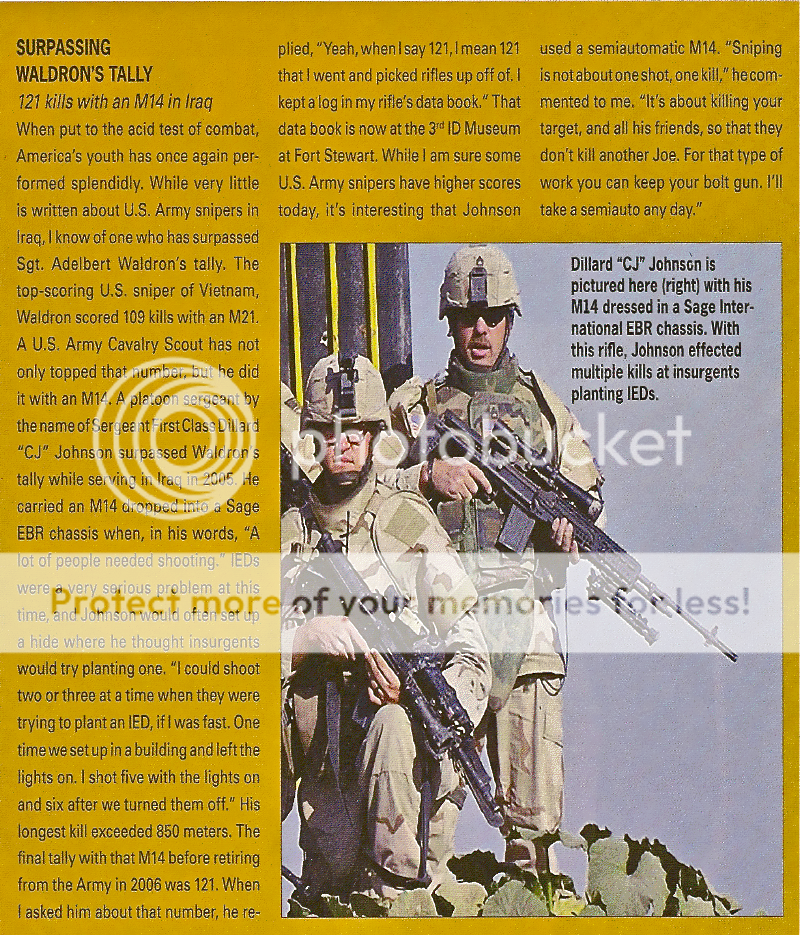
Tacticalized M14?
Spare me, no more Grandpa in spandex please.
It is ambidextrous it sits in the trigger guard and can be operated by either hand.May be you should look at a real G 36.The G36 bolt release is NOT ambidextrous. The patent is for an ergonomically placed AMBIDEXTROUS bolt release.
Sufficiently different to get a new patent.

























