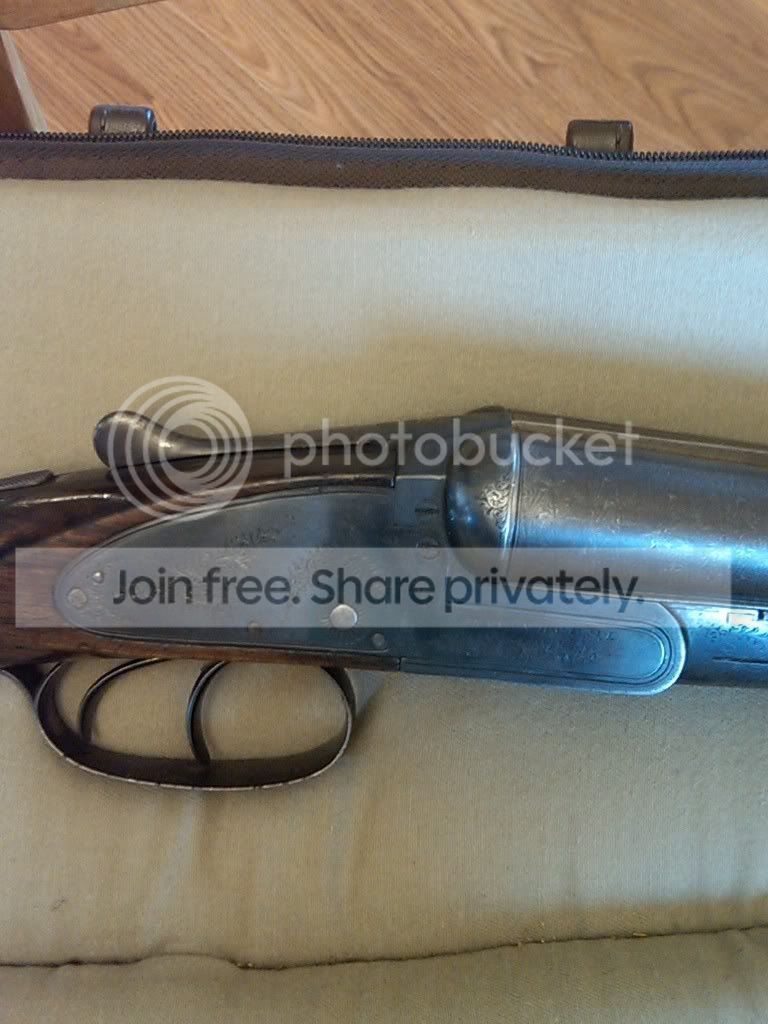
Army and Navy value? NOW WITH MORE PICS

toebako

Regular
Rating - 100%
82   0   0
Location
Alberta
A buddy has an Army and Navy 12 gauge SxS. He wants to get a rifle for his boys and needs to sell something to get something. So he asked me to find a rough value on his shotgun. I will do my best to describe it. It has damascus barrels. You can see the pattern really well on both. The bores need a clean but look shiny. The wood is not bad and seems to have no cracks behind the action. It has a blank plate to put your initials on in the butt. Steel butt plate. The action has crisp engraving and is shiny blued. It has a few random pits on the outside of the bbl and one small patch of rust probably from storage. It has extractors and seems to lock up tight. I will check the chamber also to see what it is. 2.5 or 2 3/4" . The bad news is the first firing pin is broken. The second works fine.
Any help would be appreciated.
Thanks
 
Last edited:
IMG00098-20100903-1538-1.jpg


IMG00097-20100903-1537.jpg


IMG00096-20100903-1537.jpg
 
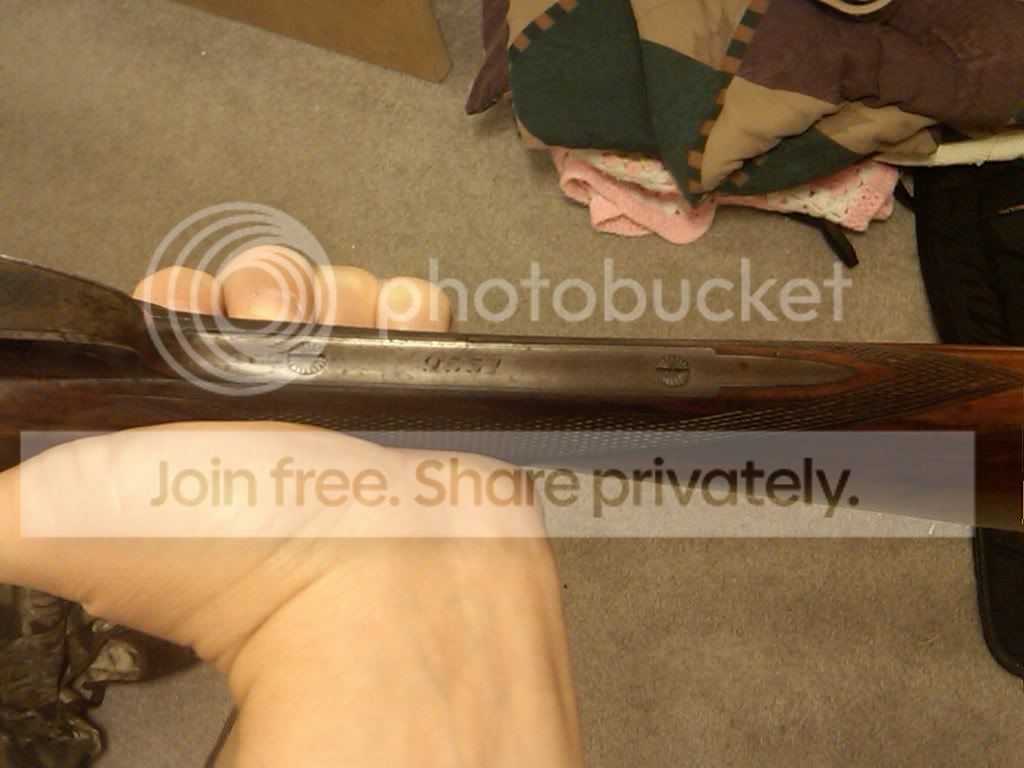
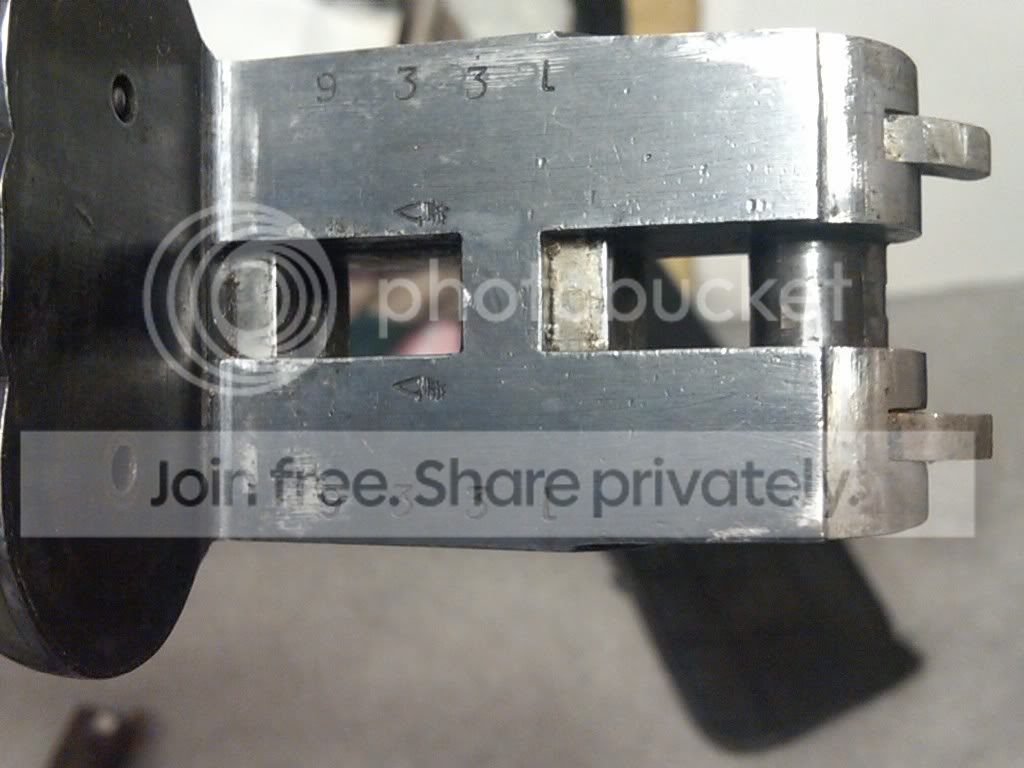
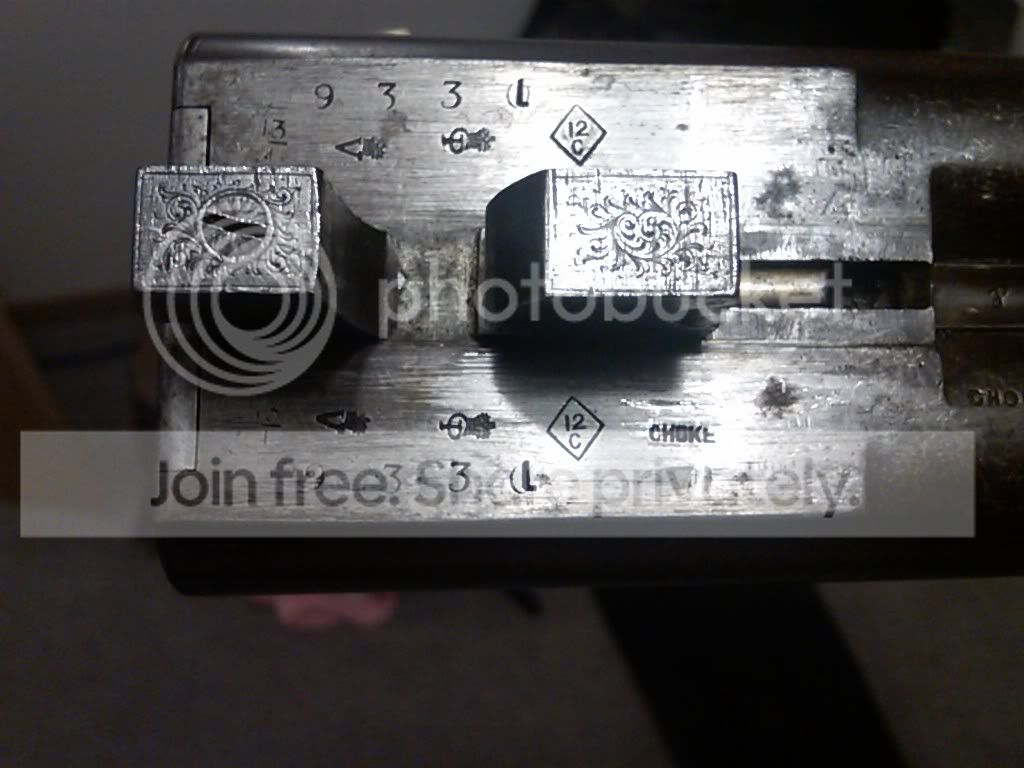
The pics of the flats and water table are good but for a price estimate we need more pics.....the stock, the receiver, the barrels, the engraving, profile of the receiver when locked up, the rust patches etc. are good.

Imagine you are considering buying the gun....you want to see the whole gun, not just one or two small parts.

I own a good number of old shotguns, as do many others on here. At this point we don't even know if it's a boxlock or a sidelock. To make a pricing/buying decision we need to see all of the gun, good and bad.

Hope to see more pics.
 
There's no indication from the proof marks that it (originally) had long chambers (ie. 2 3/4") so very likely only 2.5".

I believe that Army & Navy were not gunmakers themselves and bought from a variety of makers. Many other retailers and gunmakers also did this - but it can be relevant to know who the builder was.

Cheers,
Bob
 
Last edited:
Most likely W & C Scott, but we need to see more of the gun. I have one, likely older than this one but with fluid steel barrels (not nitro proofed).

Because Army & Navy had guns built for them by a variety of makers, there can be vast differences in quality.

There's no indication from the proof marks that it (originally) had long chambers (ie. 2 3/4") so very likely only 2.5".

I belive that Army & Navy were not gunmakers themselves and bought from a variety of makers. Many other retailers and gunmakers also did this - but it can be relevant to know who the builder was.

Cheers,
Bob
 
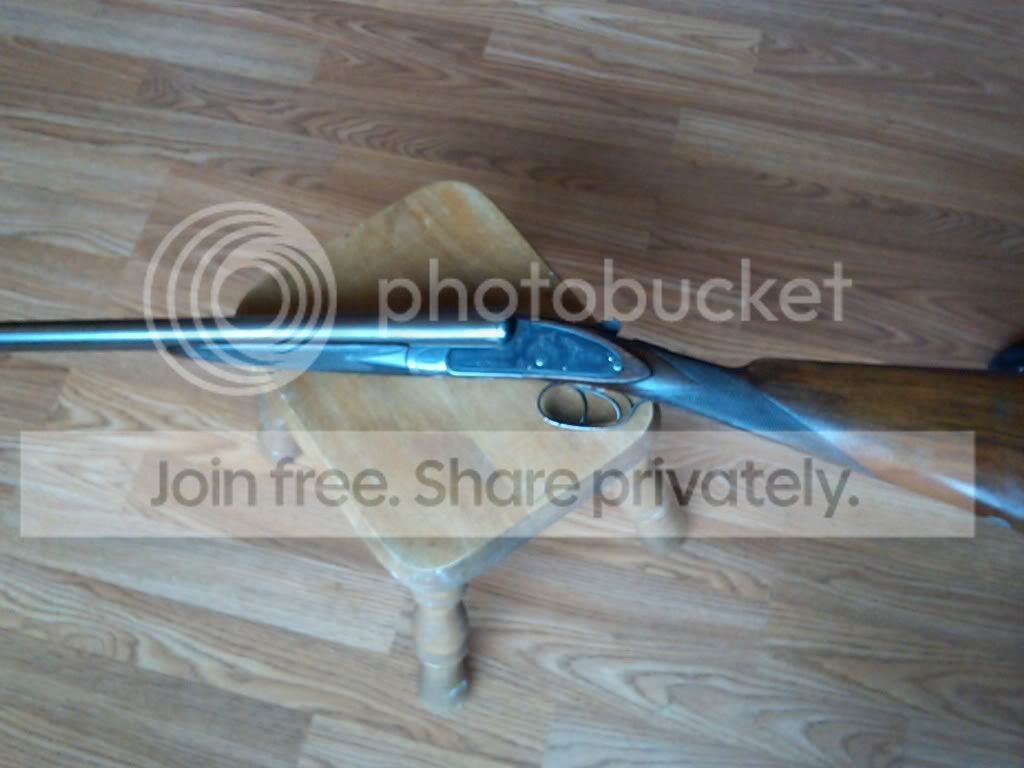
Toebako, that is a very interesting gun your buddy has there. A sidelock with London proof marks is usually enough to capture any gun nut's attention. The barrels are true Damascus, not twist or stub. The walnut is not too bad (has the chequering been recut?) and overall the gun does not look like it has been monkeyed with too much.

This is not a "best" gun however, rather it is an economy model. The evidence for this is the sparse engraving, and the presence of back action (as opposed to bar action) locks without safety sears.

It is those very locks which are so interesting. They are not of usual construction. Your last photo clearly shows the two screws which hold the lock plates on, and the large pin which is the tumbler axis. Also visible is the small pin at the rear of the lock plate which is the usual position of the mainspring anchor. There are two other small pins, below and on either side of the tumbler axis. They are the interesting part. There are usually three pins instead of just two (more, if they were expensive locks). These should be the bridle pins. Having just two pins, and having them located at the bottom of the lock plate only, is not the most common method of construction.

For all the world the locks look like the William Baker patent coil spring locks of 1902. However, the old black powder proof and Damascus barrels make me believe that the gun is more like 1880-ish vintage than 1902. I would love to see the inside of those locks.

You will get a chance to see the hidden side of the locks if buddy chooses to repair the firing pin. Fortunately, the firing pins of sidelock actions are usually separate pieces, not built integrally into the tumblers (hammers) like many boxlocks. The screw at the front of the action just above the lock plate should be the firing pin retaining screw. Remove the locks, take out the good firing pin and have a gunsmith or good machinist make a couple of new ones. If you do that, please take a picture or two of the inside of the locks. Note that there may be other problems with the afflicted lock, but there will be no way to tell until the locks are pulled.

NOTE: If he is going to attempt this himself,please take the time to grind a screwdriver to the proper size, and try not to do any further damage to the screw heads. It is really easy to bugger up old English screw heads, and nearly impossible to fix them, so be careful!

As I said, an interesting gun and while it looks well used, it also looks largely intact and (if repaired) quite shootable with black powder loads. In its present condition (broken firing pin and possibly other, as yet unknown damage) no one will give him much for it. They would be taking a risk, gambling on what it would cost to fix. In a repaired, shootable state (ie. no play in the barrel bolting, no dings in the barrels) but not refinished, the gun would be attractive to many shooters. London proven sidelock SxS's are not something you see every day, after all. In repaired, shootable condition I'd ask $1,200 for it and bide my time. Just my opinion, though, I advise you to get more.


Sharptail

 
I'd second Sharptail's comments and highlight a couple of things:

When Sharptail suggests $1200 in repaired and shootable condition, note he is also suggesting your friend may have to wait a while to get the $1200.

The things that get in the way of getting cash out of the gun now are that it's broken, it's not nitro proofed and it's damascus barreled. While those last two items, along with the interesting locks, might make it special for a focused market, they also make it un-appealing for a much larger potential market.

If it was my gun and someone offered me $400 as is, I wouldn't think twice.

And if I was thinking of buying it, I would need to have closer look at the barrels, including having them measured for wall thickness.

Sharptail's advice on fixing it yourself is cost effective but potentially damaging if you don't know what you're doing or don't use the right tools (see his advice about screws). Lot's of gunsmiths won't do it right either, because working on old doubles is not what they do.
 
Canvasback makes a very good point about the wall thickness of the barrels. For a black powder shooter the minimum wall thickness should be absolutely no less than 0.020 inches. Deep pits will also be of great concern.

Fortunately, every year at the Calgary gun show, Holt's (the British auctioneers) brings barrel measuring equipment and performs the service for free. While they did miss last year due to a staff change, they have promised to be back again for the next show.

With this gun it is best to take one's time, do things right and be patient looking for the right buyer. While this might not be what buddy wants to hear, the alternative is to accept a very low price for it, and it will still take a long time to find a buyer.


Sharptail

 
Back
Top Bottom