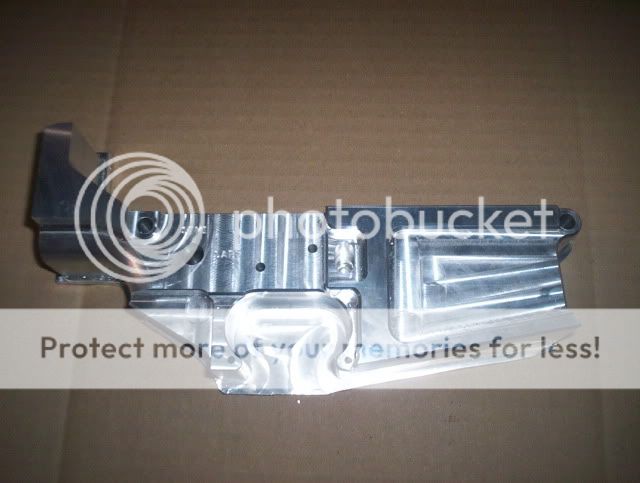
Guide to finishing an 80% Lower from Dlask Arms?

My friend and I looked at the raw forgings and it was actually way easier to make them from scratch. At least with a nice square block you have your own starting point for later referance. Big thing is that for a one or 2 off we would have to get about $300 each, and that's still a white piece of alluminum. Anodising has a minimum charge. For our anodiser it was $120. It cost $120 to do one piece and $120 to do 3 pieces. You also have to factor in the buffer tube tap and the time spent on fixtures. The hardest part of the job and it's beyond the capabilities of most machine shops is the magwell. It has to be burned or wire cut , that is about $80 for a one off. Most production ar magwells are broached which takes about a minute. It was an interesting project but to do it again I would just work the overtime and buy one and have enough money left over to buy the internals. We did a couple of ar 15's and 2 AR 10 lowers.
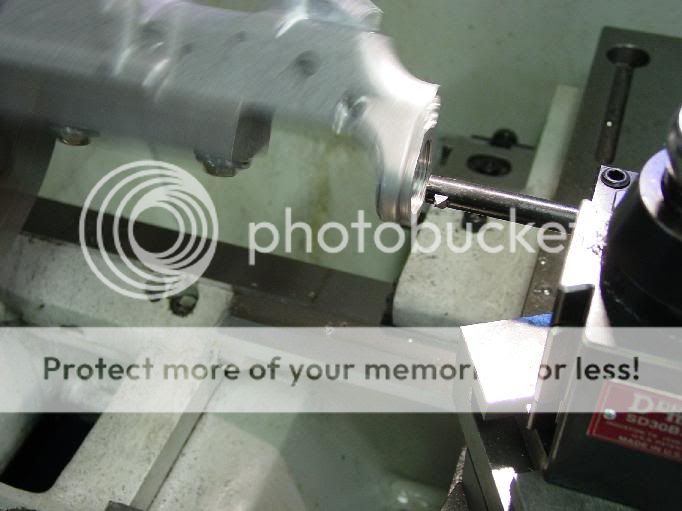
The cheapest way to do the buffer threads is to single point thread mill it. If you have the thread mill, it costs you nothing. I just use a thread boring bar, cheap and we have them on hand. Of course, that requires a CNC mill.

As for the mag well, they can be done in a vertical mill. Drill 1/8 holes in all the corners, then rough out the mag well. It will require filing and hand fitting, but an hour with a file is cheaper than EDM or broaching.
 
The 80% look nice, if you need a paper weight. If somebody had the machinery expertise and equipment to finish an 80% lower perfectly they could probably build thier own from a billet block anyways.

There is a lot of truth in this statement.

The lathe would be for single point turning the buffer tower, as opposed to using a tap.

How in the hell do you grab hold of an AR lower in a lathe chuck? By the time you managed to work that out, it might be easier and cheaper to just buy the tap.

ar10early-1.jpg


Why wouldn't you have machined an integral trigger guard instead of going through all the trouble to screw around with that silly removable trigger guard?
 
How in the hell do you grab hold of an AR lower in a lathe chuck? By the time you managed to work that out, it might be easier and cheaper to just buy the tap

You clamp it to piece of square stock held in a four jaw chuck. Not the easiest way to do it, but I've seen pics of people who have done it that way.

Why wouldn't you have machined an integral trigger guard instead of going through all the trouble to screw around with that silly removable trigger guard?

Seeing as I made the program and did that particular operation, I'll answer for dogzilla: Because Dogzilla has big fingers and I didn't want him to get the gun stuck on his finger ;)
I dunno, I kind of like the silly trigger guard, it wasn't really any bother to do it that way or the other, just flipped a coin and thats what won out.
 
You clamp it to piece of square stock held in a four jaw chuck. Not the easiest way to do it, but I've seen pics of people who have done it that way.

Except that bit of square stock would have to be machined in order to accept the receiver tightly and securely. By the time you went to the trouble to make such a setup, it would be way cheaper to just buy the tap.
 
How in the hell do you grab hold of an AR lower in a lathe chuck? By the time you managed to work that out, it might be easier and cheaper to just buy the tap.

or treat the lathe as a horizontal milling machine and bolting the reciever to the carriage .

you can cut the treads for the buffer tube the same way , reciever bolted to the carriage , boring bar bewteen centers . this is really really finicky but can be done .

you are only limited by your imagination .
 
Except that bit of square stock would have to be machined in order to accept the receiver tightly and securely. By the time you went to the trouble to make such a setup, it would be way cheaper to just buy the tap.

Hey, you don't have to tell/convince me, I/we used a tap. I'm just saying I've seen other people do it on a lathe.
The tap isn't too expensive either considering the size, I think it was $60 from Brownells.

Here's a page where someone makes one from a forging step-by-step on a manual machine(s). If you go all the way to the bottom theres an add-on that shows how you can do it on a lathe. Actually doesn't require that much, only two screws to hold it to the bar.
http://www.scribd.com/doc/6118170 /ar15-lower-receiver-stepbystepmachining
 
Last edited:
or treat the lathe as a horizontal milling machine and bolting the reciever to the carriage .

you can cut the treads for the buffer tube the same way , reciever bolted to the carriage , boring bar bewteen centers . this is really really finicky but can be done .

you are only limited by your imagination .
Bolting the receiver to the carriage isn't going to cut the threads in any way that I can think of.
 
So you think it would be easier to get a unit with the FCG milled and then tap the buffer tube yourself?

thats what I'd do if I was gonna finish one. Get the buffer tube tap (and maybe a drill if the hole is undersized, I have seen this once or twice before) and slowly cut the threads.
 
I envisioned him either talking about a boring bar with 60* cutting tool between centers that you'd adjust manually each pass.
Here's how I envisioned turning the threads.
I understand how you would cut the threads with the receiver mounted in the spindle.

Edit: Ok, I get what he was saying. You increase the diameter of the single point cutter with each pass until you get to your thread spec. No offense to anyone, but that's sounds ridiculous and a terrible way to do a simple job.
 
I understand how you would cut the threads with the receiver mounted in the spindle.

Edit: Ok, I get what he was saying. You increase the diameter of the single point cutter with each pass until you get to your thread spec. No offense to anyone, but that's sounds ridiculous and a terrible way to do a simple job.

I could see if you have a lathe with nearly no swing where that might be a useful way to extend your capabilities.
 
I envisioned him either talking about a boring bar with 60* cutting tool between centers that you'd adjust manually each pass.
Here's how I envisioned turning the threads.
post-8-69349-AR_tower.jpg

yes you got it .

each pass you would have to move the bit out of the boring bar , with the help of a dial guage .

worst case senario you don't get threads deep enough BUT the threads that are there will be square and straight , so it would just a matter of running a tap through to clean up the threads remaining .
 
Back
Top Bottom