













































You are using an out of date browser. It may not display this or other websites correctly.
You should upgrade or use an alternative browser.
You should upgrade or use an alternative browser.
How to streghten a rifle barrel
- Thread starter TGC
- Start date

Not really understanding due to typos etc, but if you mean you have a bent barrel, you're hooped. Rebarrel the gun. Might be able to "bend" it back, but unless it's a very very special gun, would likely make more sense to rebarrel.
If the barrel was damaged and has been bent, get rid of it. You can bend it back, but it will forever have stresses in it that will change with temperature.
Many barrels come from the factory with lots of run-out (warping) including some custom barrels. It does not mean they will not shoot.
Many barrels come from the factory with lots of run-out (warping) including some custom barrels. It does not mean they will not shoot.

I know that many of the big arms manufacturers have a big press for straightening barrels with very minor bends or curves, but I've never seen how it's done. Like has already been mentioned, your best bet would be to rebarrel, since you could never be sure of the old barrel shooting well after straightening. As the barrel heated up, it would warp again in the area of the repair and cause very poor accuracy.

- Location
- The Conservative part of Ontario
How bent, is bent?
I have a #4 Lee Enfield that needs the front sight tapped out a quarter inch to the right.
Shoots fine, but looks weird.
I'm considering scoping it, so I can forget about that sight. It's a sporter anyway.
Straighten a barrel, sure, most gunsmiths can accomplish this, or know where to get it done. But like said above, it will have stress built in as a result. You can have that stress removed, with a heat treatment, but a new barrel is likely cheaper.
My uncle once claimed he missed a deer because of a bent barrel.
My grandfather then took his rifle, and proceeded to shoot the center out of the target with it.
I have a #4 Lee Enfield that needs the front sight tapped out a quarter inch to the right.
Shoots fine, but looks weird.
I'm considering scoping it, so I can forget about that sight. It's a sporter anyway.
Straighten a barrel, sure, most gunsmiths can accomplish this, or know where to get it done. But like said above, it will have stress built in as a result. You can have that stress removed, with a heat treatment, but a new barrel is likely cheaper.
My uncle once claimed he missed a deer because of a bent barrel.
My grandfather then took his rifle, and proceeded to shoot the center out of the target with it.


vagrantviking
CGN Ultra frequent flyer
- Location
- Southern Alberta
I ahve heard of people doing it in the field with a sharp eye and a handy tree.
If you have given it up as a loss you have nothing to loose but its not likely going to be a gun that will win you any prizes or anything.
If you have given it up as a loss you have nothing to loose but its not likely going to be a gun that will win you any prizes or anything.

You need a setup like this:

It's in the Savage factory.
What's interesting about that picture, is that the test of a straight barrel is a shadowline, or concentric rings and an eyeball. Back in the day barrels were staightened with a lead hammer and a shadowline during production. I'd be suprised if it wasn't still being done by some makers, large and small.
Here is the video: http://www.ojp.usdoj.gov/nij/traini...k=module04/images/fir_m04_t06_04.flv&slides=0
Straightening
Home > Modern Firearms Manufacture > Rifled Barrels > Straightening
After reaming and/or lapping, barrels may be straightened. An operator aims the barrel at an optical pattern on a nearby wall. The pattern design is such that its reflection on the interior surface of the barrel reveals the straightness of the bore, relative to the long axis. If the reflection indicates that the bored hole is not concentric to the axis, the operator places the barrel in a large hand press and applies pressure to points on the barrel that will improve straightness.
Click here to watch a video from Savage Arms of a gun barrel being straightened
Barrel straightening is a manual operation that requires a very skilled operator, adding to the cost of the barrel-making operation. It behooves the designers and operators of barrel-making equipment to create and maintain machines that produce straight barrels every time.
http://www.ojp.usdoj.gov/nij/training/firearms-training/module04/fir_m04_t06_04.htm

- Location
- Edmonton,AB,Canada
If the barrel was damaged and has been bent, get rid of it. You can bend it back, but it will forever have stresses in it that will change with temperature.
Many barrels come from the factory with lots of run-out (warping) including some custom barrels. It does not mean they will not shoot.
Not trying to be ignorant here, far from it, but your two statements contradict each other.
Having said that, back when I went to B.C.I.T. for motorcycle mechanics, we had to take a bent fork tube and straighten it. We accomplished this using a hydraulic press, V-blocks, and a dial indicator. There was NO mention of residual stress that could compromise the tubes. While these were not subjected to any kind of heat cycling they were deemed fit to go back into use. I may be wrong but, if I can straighten a fork tube so it has no run-out, it seems to me that it can be done with a barrel as well. Realistically, how many rounds would need to be fired from a barrel in normal use to have ANY residual stresses affect accuracy? And as for heat build up, same thing; we're not firing a machine gun here.
I look forward to more discussion on this topic.
Not trying to be ignorant here, far from it, but your two statements contradict each other.
Having said that, back when I went to B.C.I.T. for motorcycle mechanics, we had to take a bent fork tube and straighten it. We accomplished this using a hydraulic press, V-blocks, and a dial indicator. There was NO mention of residual stress that could compromise the tubes. While these were not subjected to any kind of heat cycling they were deemed fit to go back into use. I may be wrong but, if I can straighten a fork tube so it has no run-out, it seems to me that it can be done with a barrel as well. Realistically, how many rounds would need to be fired from a barrel in normal use to have ANY residual stresses affect accuracy? And as for heat build up, same thing; we're not firing a machine gun here.
I look forward to more discussion on this topic.
Big difference between a fork tube and a barrel in terms of the stress it is subjected and how you want the tube to respond.
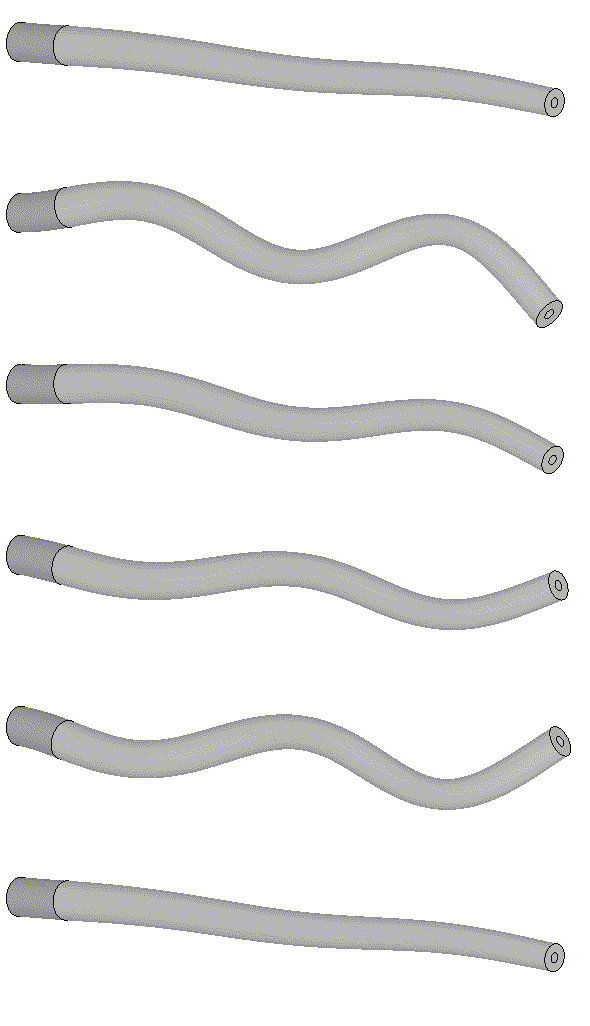
When a bullet is fired thorough a barrel, the barrel vibrates in may different modes, and for accuracy, you want the barrel to vibrate in exactly the same way for each shot. Meaning the muzzle is "pointing" in the same direction when the bullet leaves the barrel.
Because of the great distances to the target, a very small change in "angle" where the barrel is "pointing" during its vibration cycle, makes a huge difference on the target.
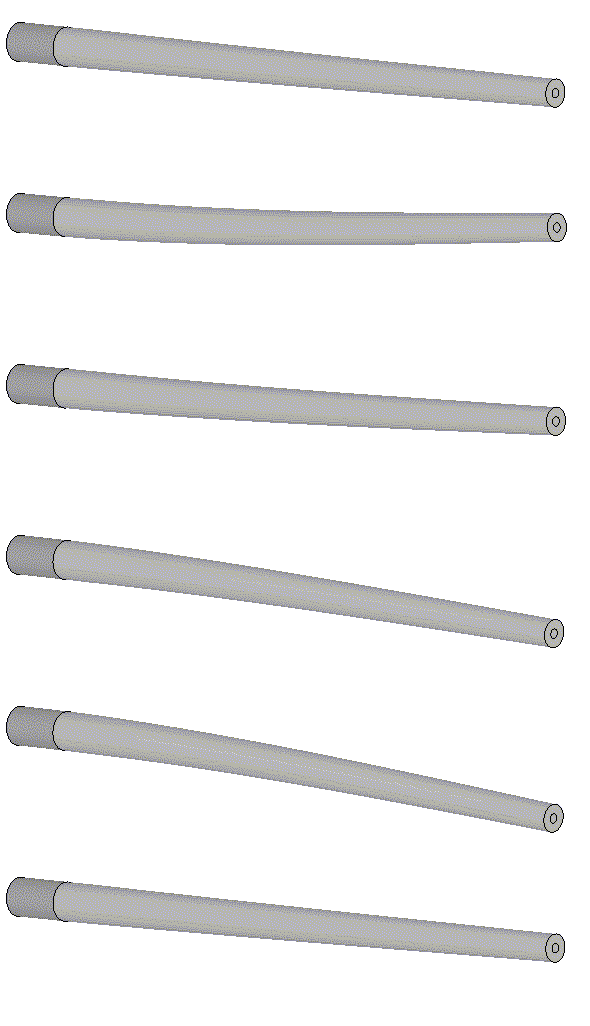
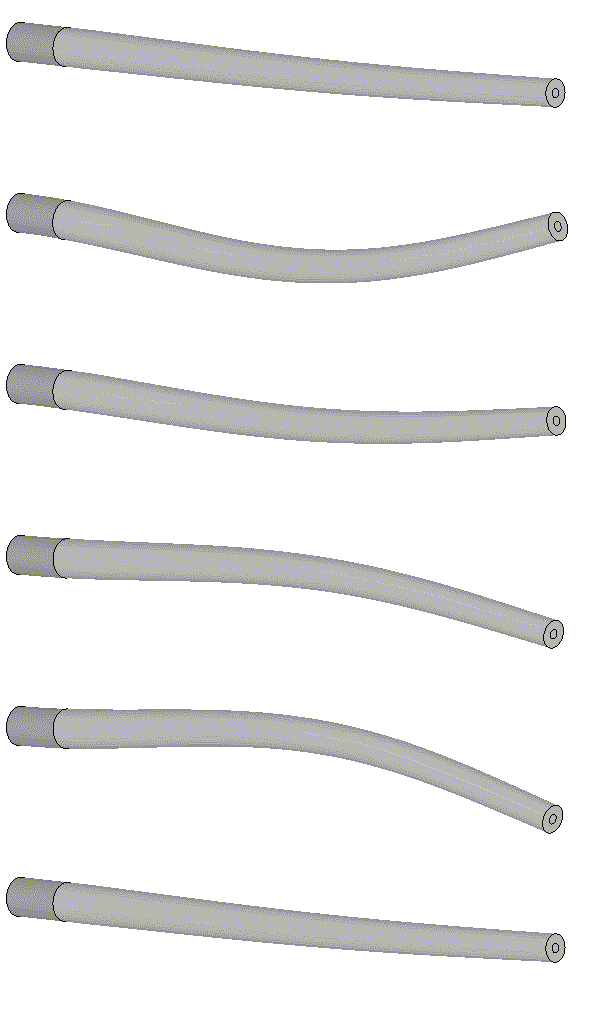
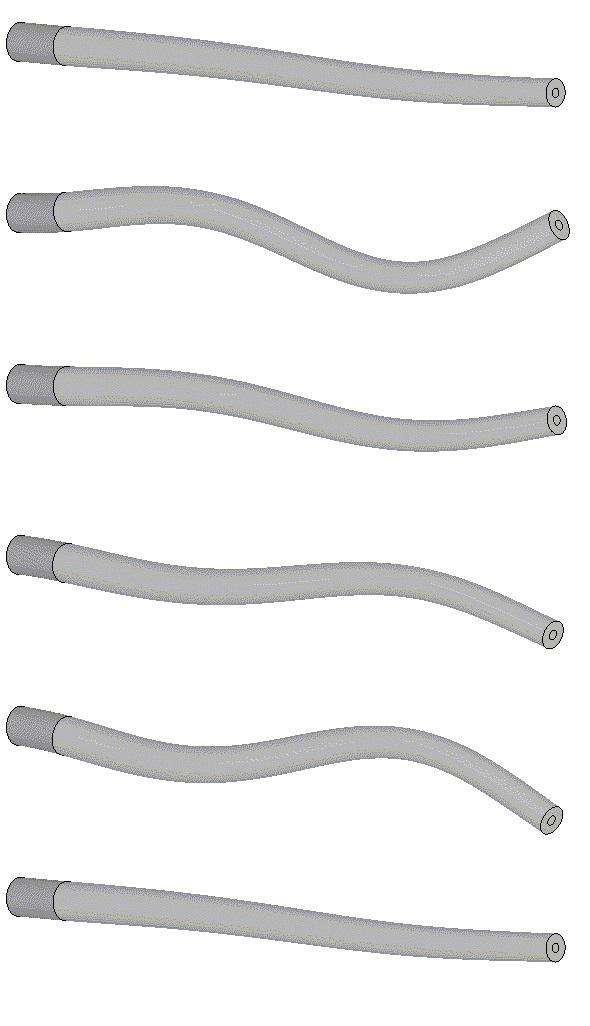
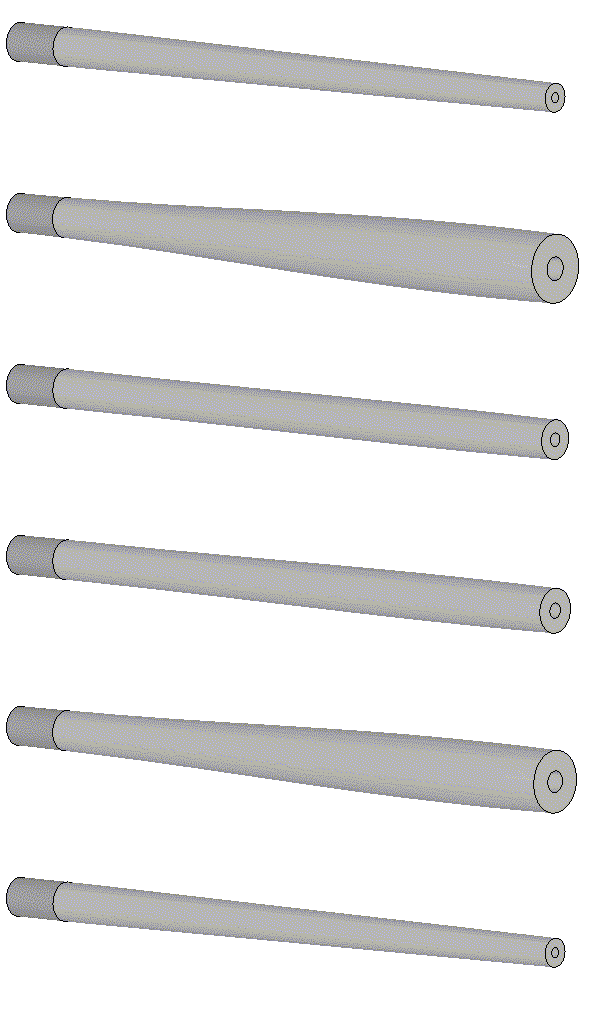
Examples so a couple of the numerous modes of vibration as a bullet is fired. Note that all of these happen simultaneously. (exaggerated in these animations)
You can imagine how a stress concentration in one spot could potentially mess up nice "clean" vibrations.
stickhunter
CGN frequent flyer
- Location
- Victoria, B.C.
Not trying to be ignorant here, far from it, but your two statements contradict each other.
Having said that, back when I went to B.C.I.T. for motorcycle mechanics, we had to take a bent fork tube and straighten it. We accomplished this using a hydraulic press, V-blocks, and a dial indicator. There was NO mention of residual stress that could compromise the tubes. While these were not subjected to any kind of heat cycling they were deemed fit to go back into use. I may be wrong but, if I can straighten a fork tube so it has no run-out, it seems to me that it can be done with a barrel as well. Realistically, how many rounds would need to be fired from a barrel in normal use to have ANY residual stresses affect accuracy? And as for heat build up, same thing; we're not firing a machine gun here.
I look forward to more discussion on this topic.
This is a good question, and I don't have enough knowledge to give a definitive answer; however, after watching the Savage video that was posted, I think it's important to make sure we mean the same thing when we say "straighten the barrel".
I assume with the fork straightening that you were removing runout as measured on the exterior surface of the fork. I believe it's not uncommon for the bore of a barrel to be drilled out-of-alignment with the longitudinal axis of the barrel blank, yet the bore could still be "straight".
It looks like the barrel bender in the Savage video is straightening the bore by observing shadows in the light reflected down the barrel. In this case, a straight barrel may in fact have lots of runout.
The question I have is what's more important: removing runout as measured on the exterior of the barrel or ensuring that the bore is straight (i.e., removing runout as measured on the interior of the barrel)?
As SandRoad described, there are a lot of dynamic forces involved when a barrel is fired, so I wouldn't be surprised if there's not clear answer to what's more important.
- Location
- Edmonton,AB,Canada
Sandroad and stickhunter, you both bring up good points. The cyclic "wavering" of the barrel I was aware of, just needed to be reminded again. It makes sense that any kind of stress would alter this cycling. As well, it makes sense that the barrel exterior could have 0 run-out, but the actual bore could be off. I guess thats why they straighten barrels using the reflected image method. Good info guys!!
How bent, is bent?
I have a #4 Lee Enfield that needs the front sight tapped out a quarter inch to the right.
Shoots fine, but looks weird.
I'm considering scoping it, so I can forget about that sight. It's a sporter anyway.
Straighten a barrel, sure, most gunsmiths can accomplish this, or know where to get it done. But like said above, it will have stress built in as a result. You can have that stress removed, with a heat treatment, but a new barrel is likely cheaper.
My uncle once claimed he missed a deer because of a bent barrel.
My grandfather then took his rifle, and proceeded to shoot the center out of the target with it.
Like has been said unless it is a really valuable gun it should be rebarrelled. John Y Cannuck, I've run into that problem before and scoped the rifle and then ended up having to shim the scope mounts instead as I ran out of windage on the scope.

gunrunner100
CGN Ultra frequent flyer
- Location
- NW Ontario
I've had mixed luck with straightening barrels. ATV's are good at producing cracked stocks and bent barrels.
I did a BLR that had a slight upward twist to the left. After careful pressures in key areas, I got it shooting dead on.
I tried a Sako 75 a few years ago that had been run over, kind of like barrel #3 in the above GIF. I wound up rebarreling.
I did a BLR that had a slight upward twist to the left. After careful pressures in key areas, I got it shooting dead on.
I tried a Sako 75 a few years ago that had been run over, kind of like barrel #3 in the above GIF. I wound up rebarreling.


If I may add another two pennies' worth to the fray, it should be mentioned that wars do tend to produce a lot of bent barrels both in the field, and in the factories.
The British developed a series of 6-inch plug gauges which they used for testing barrels. They found that the direction of the final 6 inches of the bore is where the bullet will go, more or less, so they made 6-inch gauges to show them where the rifle was going to shoot, adjusted the sights accordingly and issued the rifle. It worked, too.
That said, the first rifle I ever bought was an 1870 Vetterli-Vitali-Mannlicher Model 1870/87/1915 out of Italian East Africa and through far too man wars. When it arrived here the muzzle was out half a calibre from the breech. Lathe centres and a big lead hammer took care of the problem. It is now 45 years later and it still shoots okay.
BTW, British Army used to use V-blocks and a lead hammer. Worked fine.
.
The British developed a series of 6-inch plug gauges which they used for testing barrels. They found that the direction of the final 6 inches of the bore is where the bullet will go, more or less, so they made 6-inch gauges to show them where the rifle was going to shoot, adjusted the sights accordingly and issued the rifle. It worked, too.
That said, the first rifle I ever bought was an 1870 Vetterli-Vitali-Mannlicher Model 1870/87/1915 out of Italian East Africa and through far too man wars. When it arrived here the muzzle was out half a calibre from the breech. Lathe centres and a big lead hammer took care of the problem. It is now 45 years later and it still shoots okay.
BTW, British Army used to use V-blocks and a lead hammer. Worked fine.
.


Bent barrels
SMELLIE is right about the "last 6 inches of barrel." I have seen and used a guage set for the Lee Enfields, when the rifle was in service in Canada.
I have also used the lead blocks and lead hammer to straighten barrels. I would say, though, if it is in a hunting rifle, then you have a fairly good chance of success, as the heating/temperature problem is probably going to be of little issue as you are only going to fire maybe three rounds at one time. In a target rifle, this factor changes, and I would rebarrel the rifle in that case.
The worst one I have seen was a Voere, 98 Mauser action, with a very light contoured barrel. It was out of line almost 2 inches. By careful use of the lead hammer and blocks, I managed to get it back to where it was shooting on target. Again, a hunting rifle, and the first three rounds would shoot within 1 1/2 inches, so it would stay on any game animal. I had bought the rifle for $65 with the intention of rebarreling it, but decided to give it a try as nothing would be lost.
Location of the bend is important. The Voere was bent about half way down the barrel, so I would have had about 11 or 12 inches to play with.
.
SMELLIE is right about the "last 6 inches of barrel." I have seen and used a guage set for the Lee Enfields, when the rifle was in service in Canada.
I have also used the lead blocks and lead hammer to straighten barrels. I would say, though, if it is in a hunting rifle, then you have a fairly good chance of success, as the heating/temperature problem is probably going to be of little issue as you are only going to fire maybe three rounds at one time. In a target rifle, this factor changes, and I would rebarrel the rifle in that case.
The worst one I have seen was a Voere, 98 Mauser action, with a very light contoured barrel. It was out of line almost 2 inches. By careful use of the lead hammer and blocks, I managed to get it back to where it was shooting on target. Again, a hunting rifle, and the first three rounds would shoot within 1 1/2 inches, so it would stay on any game animal. I had bought the rifle for $65 with the intention of rebarreling it, but decided to give it a try as nothing would be lost.
Location of the bend is important. The Voere was bent about half way down the barrel, so I would have had about 11 or 12 inches to play with.
.






















