need some advice on seeing a big cat while going south on hyw 400

MRCLARK

CGN frequent flyer
Rating - 100%
85   0   2
I was driving to work last week, around 8am and I am on the 400 south just north before the new simcoe signs before the hill that drops you down into the Holland Marsh area. I look over to my left and see this open area probably farm land etc etc, anyhow I see this animal running south real fast in the open in the field. At first I thought it was a dog but as I got close I could see it was running like a cat. If you have ever seen a leopard run it was something like that. I was faster than anything I have ever seen.

Its body was long and tubular, its legs muscular, ears pointed, and it had the defined face of a cat, I could clearly see that.

No long jaw/snout of a wolf or coyote and its ears where small and pointed.

The colour was a golden brown (I,m coloured blind so be gentle)

Now heres the wierd thing is the tail was not short and stubby like a bobcat or whatever (checked on the net afterwards) it was long not bushy like a wolf or my perception of what I believe to be a wolfs tail. It was long and thick.

Anyhow just curious what you may think it was. It was clearly a cat, a big one but what kind, and why the hell in this area?
 
I have had two friends claim they have seen a bobcat. One was in Stouffville in the 90's and another was in Innisville in the early 2000's.

I don't doubt you saw what you think you saw. I just can't say if they are escaped pets or just uncommon but migrated into this area.
 
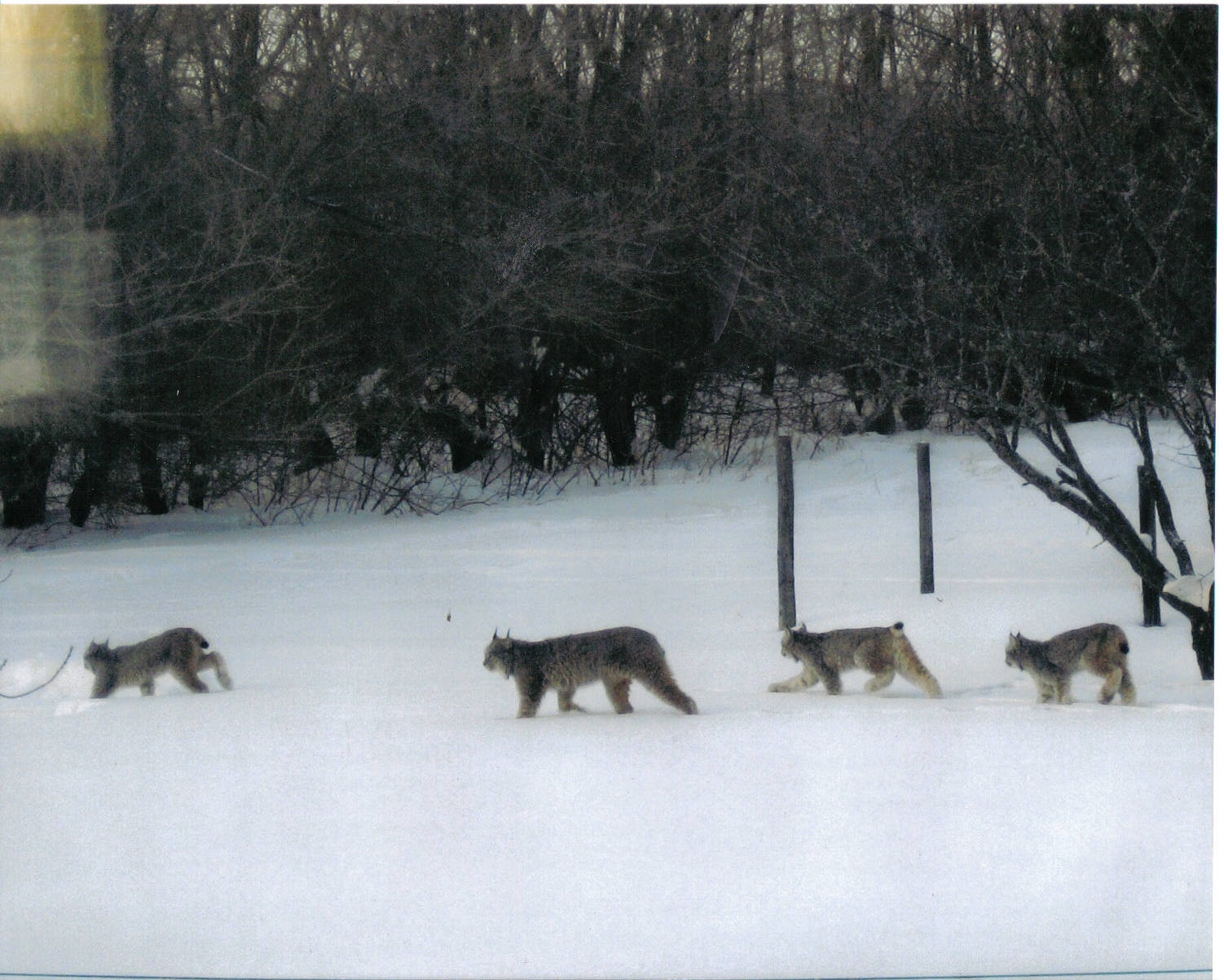
Lynx have short tails and characteristic tufts of black hair on the tip of their ears.They have a ruff under the neck, which has black bars (not very visible), resembling a bow tie. They have large padded paws for walking on snow, and long whiskers on the face.
The large body colour varies from medium brown to gold-ish to beige-white; and occasionally, is marked with dark brown spots, especially on the limbs. All species of lynx also have white fur on their chests, bellies and on the insides of their legs, which are extensions of the chest and belly fur. Also, the lynx's colouring, fur height and paw size varies by its climate range—in the Southwestern United States, the fur and colour are short-haired, dark and the paws are smaller and less padded; as the lynx ranges to its colder northern climates, the fur gets progressively thicker (for warmth), the colour gets lighter (for camouflage) and its paws enlarge and become more padded (for snowy environments). Their paws may become larger than a human hand or foot.
They have extremely good hearing and have 28 teeth, which stab deeply into their prey. This can be especially helpful to the lynx because they are not the most efficient hunters and they lose most of their prey to a variety of factors.[citation needed]
The smallest species are the bobcat and the Canada lynx, while the largest is the Eurasian lynx, however there are considerable variations within species.


Lynx_family_Dauphin_Manitoba_Canada.JPG


article and pic from wiki
 
Whatever it was the MNR says they don't exist in Ontario.......:rockOn:

Yeah, right.

I have a file of newspaper clippings relating to cougar/puma sightings in the Owen Sound area.

Matter of fact, MNR themselves released a couple into the wild near Flesherton about 6 years ago. Two weeks later, they were reported east of Owen Sound, the area where I live.


I now always carry a NR firearm of some kind while roaming around my property.
 
Matter of fact, MNR themselves released a couple into the wild near Flesherton about 6 years ago. Two weeks later, they were reported east of Owen Sound, the area where I live.

you have proof of that, right?


mrclark, you saw a cougar. i saw one 10 minutes west of brantford last summer while quading. 110% sure it was a cougar as it was less than 40 yards away and we both saw it. theres nothing around here that even comes close to resembling a cougar...
 
interesting responses, it definetly was not a bobcat the ears are to tall and sharp, then that tail, it was long and muscular, or at least longer than the ones I saw in the pics you guys posted.

I,m going to go back there soon before this snow melts, or at least after I kick this flu and take some pics of the prints I,m sure there still there or these some more of them.

If it was there once, it was there a few times.
 
found this: looks like the MNR is acknowledging there existance here now?

The Sun Times

MNR confirms cougars, but questions remain

By Denis Langlois

Cougars roam Ontario, the Ministry of Natural Resources has confirmed, but questions about the big cats remain.

“We just don’t know where they’re from,” MNR spokeswoman Jolanta Kowalski said Tuesday.

The cougars could be an indigenous population that has slowly grown in numbers since almost being wiped out in the late 1800s, or they could be escapees from zoos or transients from the northern United States or Manitoba, said Stuart Kenn, president of the Ontario Puma Foundation.

“I’ve estimated the number in Ontario at 550,” he said. “And that’s not a lot for 1.2 million square kilometres. It’s very few.”

The last cougar shot in the province was found south of Collingwood in 1884.

Since 2002, about 2,000 cougar sightings have been reported to the MNR, but few traces have been collected.

The sightings include a cougar spotted near Meaford a year ago.

Kowalski said the MNR has never denied that cougars, also known as pumas or mountain lions, live in Ontario.

In fact, the MNR website lists the cougar as an endangered species in Ontario, similar to the barn owl and American badger.

The MNR has been conducting a study on the seldom-seen carnivores since 2006. More than 30 pieces of evidence have been collected, such as scat samples, DNA and pictures of cougar tracks, to verify the large cat’s existence in the Ontario wild.

So far, no one has come forward with a definite picture of a cougar.

Kowalski said the four-year study of cougars in Ontario is not complete, as erroneously reported by other media.

“It is an ongoing research project,” she said.

The agency is continuing to monitor wildlife cameras, which have been set up in in northern Ontario where cougars have been spotted.

Kenn said he is surprised by the media attention surrounding the ongoing MNR project, with which the puma association is involved.

He received many e-mail and telephone requests for interviews Tuesday after a newspaper in Ottawa reported on the MNR study.

“It’s just nuts,” he said.

Kenn also found nothing new with the MNR study, saying there has been no denying cougars exist in Ontario.

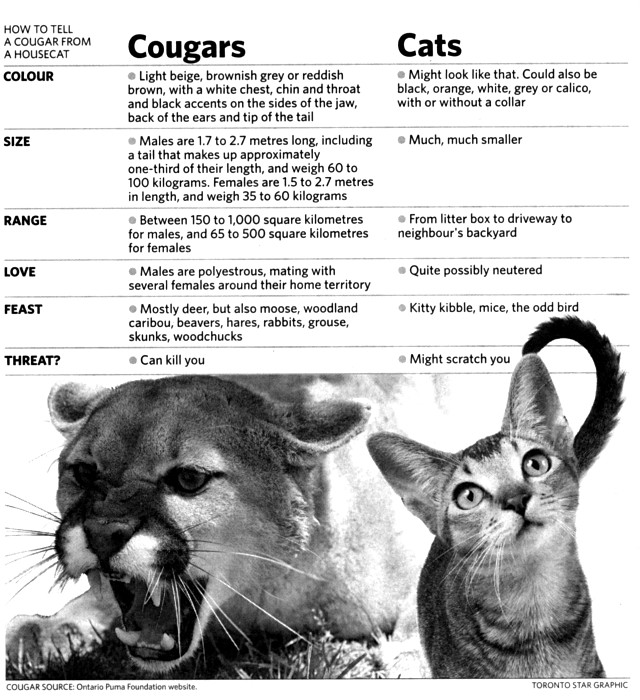
However, he said 95% of so-called cougar sightings are actually other animals, such as bobcats, coyotes, lynx or even house cats
 
Was the tail about equal length to the body? If so, I would guess cougar.

(and if her tail was about 3 times as wide as her body, definitely cougar)
 
Back
Top Bottom