












































You are using an out of date browser. It may not display this or other websites correctly.
You should upgrade or use an alternative browser.
You should upgrade or use an alternative browser.
.25/35 Winchester
- Thread starter #1fishslayer
- Start date


do a search on the 'net...must be info out there.
My old 1960's Hornady manual shows it a bit longer than the 30-30, more taper, shallower shoulder angle and of course, necked to 25 caliber...
looks like you could make cases from 30-30 but they would be a bit short,...they should still work OK.
My old 1960's Hornady manual shows it a bit longer than the 30-30, more taper, shallower shoulder angle and of course, necked to 25 caliber...
looks like you could make cases from 30-30 but they would be a bit short,...they should still work OK.

It and the 30/30 were the first smokeless rounds chambered in the win.94, its a good cal. with it's very fast twist it works good with heavier bullets. Bullets must still be flat point, making the cartridge a mid-range rifle at best and probably the least powerful deer rifle out there. A fun gun to shoot as it does not recoil much, but my 25/35 was not cast bullet friendly, so I couldn't use it as a low cost plinker.

Hornady makes a 117gr flat nose soft point for it and and with that bullet at a muzzle velocity of about 2400fps I believe it is a great 150 yard deer rifle. You are lucky to have one.
There is a good article on this cartridge on Gunblast...
There is a good article on this cartridge on Gunblast...

- Location
- Winnipeg,Man.
The 25-35 Winchester was introduced in 1895 for the 1894 rifle It was one of the 3 high velocity smokeless powder hunting carts, which include the 30-30 and 32 Special. In its day, the jump in velocity from 1300 fps( black powder) to 2300 fps ( smokeless powder)provided more killing power, and the flatter trajectory allowed more distance ranges.The barrel of the 25-35 Winchester had the fastest twist of all pre 64 carts chambered for the 1894 rifle or carbine.Winchester so called stopped manufacture of the 25-35 in 1936. Though I have one 25-35 that is confirmed as to being made in 1949. These rare chamberings can be worth mucho cash if in good , original condition. I reload for mine and enjoy deer hunting with it. That is what they were supposed to be used for. Mine put one down at about 150 yards. Spine shot.
I beleive that the Jordan buck was taken with a 25-20.
I beleive that the Jordan buck was taken with a 25-20.
I beleive that the Jordan buck was taken with a 25-20.
Yes, your right about that. Just spent a few minutes on google and confirmed that.

Missing Something
Regular

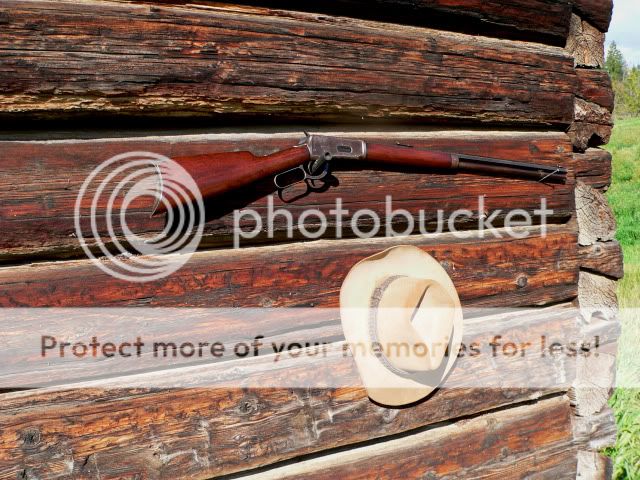

When my late mother was in a care home there was an old native cowboy from the Chilcotin in there too, always wore his cowboy hat. His name was Dave.
"Dave," I said one day when I was visiting, "You ever shoot moose?"
"Oh yeah," Dave replied. He was a man of few words. "Shoots lots moose."
"How about bears, did you shoot any bears?"
"Yup."
"How about grizzly bears?"
"Yup. Shoot lots grizzly bears."
"So what did you use? A 30-30?" I asked, assuming that he was using a lever action saddle gun.
"Nope. 25/35. Shoot 'em right here," Dave replied, pointing to his side right under the armpit.
"Dave," I said one day when I was visiting, "You ever shoot moose?"
"Oh yeah," Dave replied. He was a man of few words. "Shoots lots moose."
"How about bears, did you shoot any bears?"
"Yup."
"How about grizzly bears?"
"Yup. Shoot lots grizzly bears."
"So what did you use? A 30-30?" I asked, assuming that he was using a lever action saddle gun.
"Nope. 25/35. Shoot 'em right here," Dave replied, pointing to his side right under the armpit.
Last edited:
When my late mother was in a care home there was an old native cowboy from the Chilcotin in there too, always wore his cowboy hat. His name was Dave.
"Dave," I said one day when I was visiting, "You ever shoot moose?"
"Oh yeah," Dave replied. he was a man of few words. "Shoots lots moose."
"How about bears, did you shoot any bears?"
"Yup."
"How about grizzly bears?"
"Yup. Shoot lots grizzly bears."
"So what did you use? A 30-30?" I asked, assuming that he was using a lever action saddle gun.
"Nope. 25/35. Shoot 'em right here," Dave replied, pointing to his side right under the armpit.
Now that's a great story.
I'm sure it is what the OP was hoping for.

Turkeyslayer 1300
CGN Ultra frequent flyer
- Location
- Russell, Ontario
I have always wanted to work with a .25-35, a few were made in the "last run" of New Haven 94's. It's a neat little cartridge that for some reason appeals to me.
It's old-fashioned, it's obsolete, it's RIMMED fer Gawdssakes, and it's the one Winchester cartridge I find interesting.
It deserved a lot better than it got, but got shoved into the shadows by the .30-'06 and the eternal quest for "More POWERRR".
It is an intensely PRACTICAL cartridge and still quite useful today. There was also a rimless version put out by Remington; originally called the .25-35 Rimless, it was later renamed the .25 Remington. Worked fine in all those pumps and Model 8 semi-autos. Loading data is identical.
I was pallbearer for an old family friend named Eddie Schmaus. Eddie supported the rest of the family (brothers, sisters, parents, etc) through the Dirty Thirties with his trap line and a little (a lot) of poaching. He had a Remington slide-action and one box of .25 ammo, sighted in, won a rifle match, took 16 animals for meat, had to use a second round on one an still had 1 round left over. Those old-time survival hunters knew their stuff. They HAD to: no Welfare department.
.25-35 would have been equally useful and would have done the same job. Eddie was just using the rimless version.
.
It deserved a lot better than it got, but got shoved into the shadows by the .30-'06 and the eternal quest for "More POWERRR".
It is an intensely PRACTICAL cartridge and still quite useful today. There was also a rimless version put out by Remington; originally called the .25-35 Rimless, it was later renamed the .25 Remington. Worked fine in all those pumps and Model 8 semi-autos. Loading data is identical.
I was pallbearer for an old family friend named Eddie Schmaus. Eddie supported the rest of the family (brothers, sisters, parents, etc) through the Dirty Thirties with his trap line and a little (a lot) of poaching. He had a Remington slide-action and one box of .25 ammo, sighted in, won a rifle match, took 16 animals for meat, had to use a second round on one an still had 1 round left over. Those old-time survival hunters knew their stuff. They HAD to: no Welfare department.
.25-35 would have been equally useful and would have done the same job. Eddie was just using the rimless version.
.
It's old-fashioned, it's obsolete, it's RIMMED fer Gawdssakes, and it's the one Winchester cartridge I find interesting.
It deserved a lot better than it got, but got shoved into the shadows by the .30-'06 and the eternal quest for "More POWERRR".
It is an intensely PRACTICAL cartridge and still quite useful today. There was also a rimless version put out by Remington; originally called the .25-35 Rimless, it was later renamed the .25 Remington. Worked fine in all those pumps and Model 8 semi-autos. Loading data is identical.
I was pallbearer for an old family friend named Eddie Schmaus. Eddie supported the rest of the family (brothers, sisters, parents, etc) through the Dirty Thirties with his trap line and a little (a lot) of poaching. He had a Remington slide-action and one box of .25 ammo, sighted in, won a rifle match, took 16 animals for meat, had to use a second round on one an still had 1 round left over. Those old-time survival hunters knew their stuff. They HAD to: no Welfare department.
.25-35 would have been equally useful and would have done the same job. Eddie was just using the rimless version.
.
Well Smellie, as you once said it's too bad you and I can't get together to talk things out, so we will just have to do the next best thing.
I was a bit too young to shoot big game during the 1930s, but I had an older brother who did supply a large family with good meat, twelve months of the year for the entire decade. Near the end of the 30s I was shooting squirrels to make spending money. I got twelve cents for a perfectly skinned and looked after prime squirrel hide. Bullet holes in the head didn't discount the price, but any bullet hole behind the ears cost two cents. Thus, a perfect hide shot crosswise through the ribs would bring only eight cents. I learned how to shoot straight at a very early age!
I also remember the entire era very well. I always had a penchant for observing and remembering rifles. This was in the boon docks of bushland northerly Saslatchewan. I can remember dozens of different rifles the various homestead people, and trappers used, but strangely, I don't remember a single 25-35 being used! The game was moose and elk, with whitetail deer increasing as the bush land was opened up. 30-30 was the predominant calibre, but thnk of a calibre, and some fellow used it to bring in the food supply.
The only thing I see wrong with your piece, is you referred to the people as poachers. Of course they all shot game any month of the year and no one ever had a hunting licence, but they were not poachers. They were survivors. And in the business of surviving they often had to play games to avoid the game warden, not always successfully and the long arm of the law would then send them to the Prince Albert jail for 30 days. But I doubt if anyone knew the meaning of the word "Poacher."
Interesting stories. I used to listen to the "old guys" at the camp for hours talking about years ago. Now I am one. A lot of this stuff should have been recorded as it is now lost or reduced to whatever the listener can recall. Nothing like hearing a good story told by someone who was there. One guy said when he was a teenager there was a 25 cent bounty on porcupines here in N.B. instigated by the lumber companies. The bounty was paid by the government on receipt of one porcupine nose skinned off the carcass. He ran around the woods with an old Eatonia .22 and shot quillpigs. Being an enterprising young man, he would skin the nose and each of the four foot pads and poke two nostril holes in them with a darning needle. Presto, $1.25 for one porcupine. Pretty good wages for a kid in those days.

My son shot his first three big game animals, Sitka Blacktail deer, using a beat up 25-35 Model 94, when he was just ten years old. I got it from an old-timer in Whitehorse, who told me it came up the Chillkoot Pass in 1899.
The stock was really beat up and had some deep gouges, the bluing all gone, and the bore dark. I shortened the stock and installed a recoil pad for him, and we headed to the range with some CIL Dominion ammo. It shot so good, I bought a set of dies and started loading for it. He became quite proficient with it, and we went to Chicagoff Island the next year to hunt with some friends of ours there. The ironic thing was that he was the only person to bag a deer on that hunt.
Still use the same load in that rifle, 117 gr Hornady round nose, ahead of 25 gr of IMR 3031. Had Bill Leeper correct the headspace in it a few years ago, and it still goes to the range regularly.
Now his boys are lined up to use it.
Ted
The stock was really beat up and had some deep gouges, the bluing all gone, and the bore dark. I shortened the stock and installed a recoil pad for him, and we headed to the range with some CIL Dominion ammo. It shot so good, I bought a set of dies and started loading for it. He became quite proficient with it, and we went to Chicagoff Island the next year to hunt with some friends of ours there. The ironic thing was that he was the only person to bag a deer on that hunt.
Still use the same load in that rifle, 117 gr Hornady round nose, ahead of 25 gr of IMR 3031. Had Bill Leeper correct the headspace in it a few years ago, and it still goes to the range regularly.
Now his boys are lined up to use it.
Ted
Last edited:
My son shot his first three big game animals, Sitka Blacktail deer, using a beat up 25-35 Model 94, when he was just ten years old. I got it from an old-timer in Whitehorse, who told me it came up the Chillkoot Pass in 1899.
The stock was really beat up and had some deep gouges, the bluing all gone, and the bore dark. I shortened the stock and installed a recoil pad for him, and we headed to the range with some CIL Dominion ammo. It shot so good, I bought a set of dies and started loading for it. He became quite proficient with it, and we went to Chicagoff Island the next year to hunt with some friends of ours there. The ironic thing was that he was the only person to bag a deer on that hunt.
Still use the same load in that rifle, 117 gr Hornady round nose, ahead of 25 gr of IMR 3031. Had Bill Leeper correct the headspace in it a few years ago, and it still goes to the range regularly.
Now his boys are lined up to use it.
Ted
Great story Ted!






















