Is This What You Would Call A No. 4?

Chizzy

CGN Regular
Rating - 100%
17   0   0
Hello:

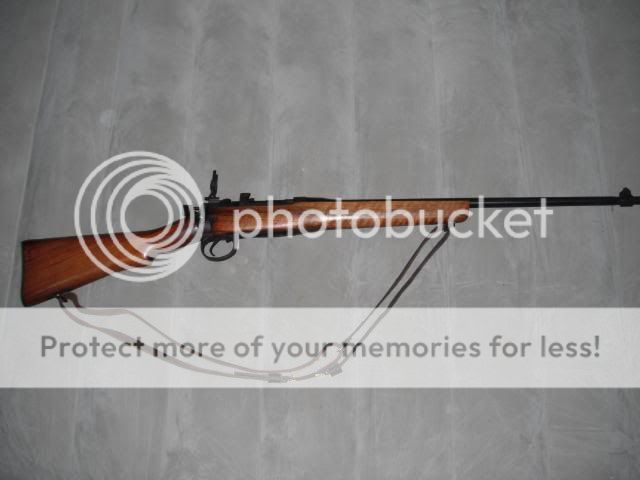
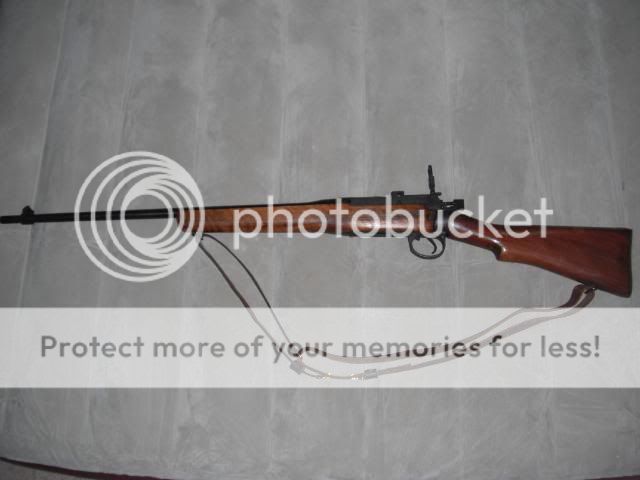
I have a Lee Enfield rifle that used to belong to my grandfather; I was wondering if I am correct when I refer to this rifle as a Lee Enfield No.4 Mk I?

3f55f908.jpg


ee33d8aa.jpg


976fafa7.jpg


I have never shot this rifle; however, I am thinking that it might be fun to give it a go.

Looking at the pictures is this gun in its original form or did Bubba have a go at it somewhere down the line?

Thanks in advance for your input.

Regards,

Chizzy
 
It's not bubba'd, it's just sporterized.

That's an Enfield I can assure you. The No.1's don't have flip up rear battle/peep sights so it's a No.4
 
It's a piece of Canadian culture, a 'sporterized' No4 MKI*. If this country had a soul instead of too many Pierre Trudeau administrations, there would be a law requiring the ownership of at least one rifle exactly like that per household. Take it out and shoot it, you'll never be closer to your Grandfather.

PS someone will come along in a few seconds to tell you to have the headspace checked, though I've never actually met anyone (or heard of anyone) injured by a Lee Enfield with too much headspace.
 
It's not bubba'd, it's just sporterized.

That's an Enfield I can assure you. The No.1's don't have flip up rear battle/peep sights so it's a No.4


Hello Rocket Surgery:

Thanks for the quick reply! Now educate me on what the term sporterized refers to. Did this rifle have longer forearm wood at one time and got chopped or was it a complete stock repleacement. Thanks again forn your time.

Regards,

Chizzy
 
It's a piece of Canadian culture, a 'sporterized' No4 MKI*. If this country had a soul instead of too many Pierre Trudeau administrations, there would be a law requiring the ownership of at least one rifle exactly like that per household. Take it out and shoot it, you'll never be closer to your Grandfather.

PS someone will come along in a few seconds to tell you to have the headspace checked, though I've never actually met anyone (or heard of anyone) injured by a Lee Enfield with too much headspace.

Thanks enefgee:

I think that I will do just that. It would be cool to shoot a coyote with this rifle just to keep its history alive. :)

Thanks for your assistance.

Regards,

Chizzy
 
You're welcome, the rifle has had it's full military wood replaced (or remodelled, but it looks way to good for that) and it's military magazine either replaced or shortened to make it easier to hunt with. There are varying degrees of quality in rifles like this, some are very well done and others aren't, yours seems to be somewhere in the middle. Take a look at the bore, give it a good cleaning - ditto for the bolt and receiver, as I said - it's a real piece of Canadian culture.
 
PS someone will come along in a few seconds to tell you to have the headspace checked, though I've never actually met anyone (or heard of anyone) injured by a Lee Enfield with too much headspace.

But too much headspace is such a PITA. Enjoy the rifle chizzy.
 
it's military magazine either replaced or shortened to make it easier to hunt with.

It does have a longer magazine that I did not have inserted for the pictures; I believe that it is a 10 round magazine; although I have never varified that.

Thanks again,

Chizzy
 
This particular rifle started off as a Number 4 Mark 1*, with the * pronounced as "star".

It is rather interesting for a number of reasons.

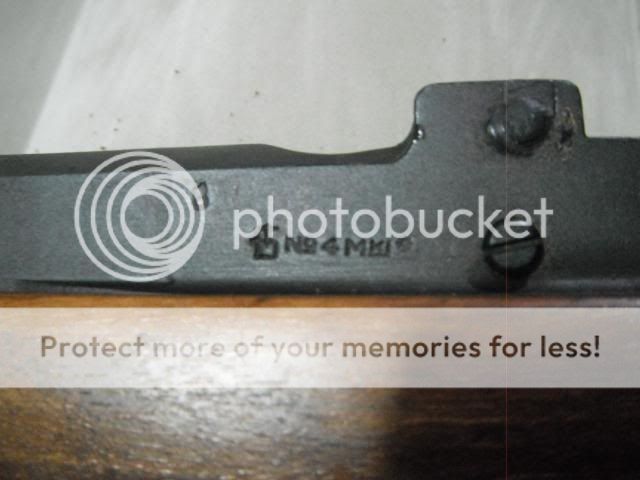
For one, it was made in Chicopee Falls, Massachusetts, by Savage. Originally, these were done on contract for England, but England went broke. The US Army then adopted the rifle and forgot to buy any ammo, so the rifles continued in producton. That tiny stamp with the circle and the flame is a US Board of Ordnance "flaming bomb" ownership stamp. The rifles then were "surplussed" to England, even though they still were in production. This all was before the US came into the War. Once the US was fully in the War (after Pearl Harbor), then Lend Lease was passed and there was no need for this kind of fiddle-faddle.

Exactly the same rifle was made at three plants in England and at Long Branch, Ontario. The Savage and the Long Branch were the best-made, but the parts interchange between all 5 manufacturers as well as with the very few actually made at Enfield.

It is a wonderful chunk of history from the worst, darkest phase of World War Two, that period when England and the Commonwealth, very nearly totally unpepared for war, stood alone against Hitler..... who had had 6 years of very intense rearmament before the first shot was fired and THEN had taken over the Polish, Czechoslovakian, Austrian, Belgian, Danish, Norwegian and French factories.

It was also your Grandfather's rifle. Treasure it. NEVER sell it. My grandfather was an actual fur-trader with the Hudson's Bay Company at Fort Edmonton. I would give ANYTHING to have one of his guns.... but they all were sold off, 80 years ago.

Clean the barrel carefully, be sure the screws are done up tight, load up some ammo and go have fun.

And think good things about Grandpa while you're doing it.

If you want help or advice, come back here. Someone will help, that's for certain.
.

 
This particular rifle started off as a Number 4 Mark 1*, with the * pronounced as "star".

It is rather interesting for a number of reasons.

For one, it was made in Chicopee Falls, Massachusetts, by Savage. Originally, these were done on contract for England, but England went broke. The US Army then adopted the rifle and forgot to buy any ammo, so the rifles continued in producton. That tiny stamp with the circle and the flame is a US Board of Ordnance "flaming bomb" ownership stamp. The rifles then were "surplussed" to England, even though they still were in production. This all was before the US came into the War. Once the US was fully in the War (after Pearl Harbor), then Lend Lease was passed and there was no need for this kind of fiddle-faddle.

Exactly the same rifle was made at three plants in England and at Long Branch, Ontario. The Savage and the Long Branch were the best-made, but the parts nterchange between all 5 manufacturers as well as with the very few actualy made at Enfield.

It is a wonderful chunk of history from the worst, darkest phase of World War Two, that period when England and the Commonwealth, very nearly totally unpepared for war, stood alone against Hitler..... who had had 6 years of very intense rearmament before the first shot was fired and THEN had taken over the Polish, Czechoslovakian, Austrian, Belgian, Danish, Norwegian and French factories.

It was also your Grandfather's rifle. Treasure it. NEVER sell it. My grandfather was an actual fur-trader with the Hudson's Bay Company at Fort Edmonton. I would give ANYTHING to have one of his guns.... but they all were sold off, 80 years ago.

Clean the barrel carefully, be sure the crews are done up tight load up some ammo and go have fun.

And think good things about Grandpa while you're doing it.

If you want help or advice, come back here. Someone will help, that's for certain.
.

Wow!!! Thank you smellie! You know your stuff! I was never expecting to obtain this kind of detail from my initial post. I appreciate it more than you will know.

Regards,

Chizzy
 
Clean the barrel carefully, be sure the crews are done up tight load up some ammo and go have fun.

I recieved some cartridges when I took possession of the rifle (of the same vintage???); would they be okay to use or would their age be a safety issue?

Regards,

Chizzy
 
I recieved some cartridges when I took possession of the rifle (of the same vintage???); would they be okay to use or would their age be a safety issue?

Regards,

Chizzy

Is it soft point hunting ammunition or FMJ?,

If it's FMJ you will have to clean the barrel to prevent corrosion. If the ammo looks good it probably is. Just make sure the cases aren't coroded and the primers on the bottom of the case look clean.

If you just want to shoot, you should be able to find commercial ammunition at almost any firearms store that would be new and for sure fine to shoot.
 
If you can READ what's on the base, it should be okay for shooting. By this, I mean things such as REMINGTON or WINCHESTER or DOMINION.

If you can't read it, likely it is military code. That's when you go to the store and get yourself a box of .303 British ammunition and go shooting. When you're finished, come back here and post the codes for us and somebody will tell you exactly what you have.

There were several varieties of military ammo which got into circulation which can be hard on the rifle. Others can start fires REALLY well.... and happen to be worth 10 years in the slammer just for possessing them in this Free Country of ours. And then there is the Explosive type, which was NEVER inteded to get into circulation. They are awfully rare, but they ARE out there. And PROOF rounds are a no-no also; each rifle was supposed to digest exactly ONE of them, when it was made. I have one here that I picked up at a gun show from a tray of odd cartridges for 2 bits, so they are out there also. And there are also original Dum-Dums in circulation. They look like regular hunting or hollowpoint ammo but you don't want to bang them off because the cheap ones are worth 10 to 20 bucks a shot and the scarce ones are REALLY expensive.

So you stay with SAFE ammo and you have fun.

Hope this helps.
.

 
I got one of those (Longbranch #4 Mk1*) from my Dad (it's what got me into collecting MilSurps), and have since restored it to it's "original era" condition. To this day, he berates me for "ruining" his old rifle :p....
If you are at all interested, yours looks restorable as well, seems like the barrel and front sight are original, and haven't been altered/chopped.
 
I recieved some cartridges when I took possession of the rifle (of the same vintage???); would they be okay to use or would their age be a safety issue?

Regards,

Chizzy

Chizzy- Get yourself a good cleaning rod, some .308 or 8 mm brushes for it and some good lube like G96 or Break Free or whichever.

Before firing your rifle, remove the bolt from the rifle and clean the bore well from the breech end, not the muzzle and finally put a dry patch through to clean off any oil or grease in the bore.

Then clean it again right after shooting it, every time. If shooting old military ammo, it's likely corrosive and will ruin the bore in short order if not cleaned quickly.
 
Smellie - Lend-Lease was signed by the President in March, 1941, well before Pearl Harbour.

Chizzie. Quick history lesson. Britain's first modern, magazine-fed rifle was the Lee-Metford in .303 but with a black powder load. When shortly after they switched to smokeless propellant, the Metford rifling turned out to be less than satisfactory, so they switched to another pattern designed by an arsenal at Enfield and the rifle was known as the Lee-Enfield. Following the Boer War, some other changes were made, resulting in the definitive 'Short Magazine Lee-Enfield', meaning the rifle was somewhat shorter than its predecessors, had a 10-round magazine (you mentioned yours has one) and featured the Lee action with Enfield rifling. That one pattern of rifle was manufactured into the 50s, I think. Canada adopted it when our troops started throwing away jammed Ross rifles in WW1; Australia and India kept with it through WW2.

In the late 30s, it was felt that some additional changes could be made, primarily to streamline production, but also to make it a rather handier rifle. The new No. 4 rifle came into service in early WW2.

Canada followed Britain and adopted the No. 4 rifle in WW2. From here it gets a mite confusing and the manufacturing changes and such really aren't important to this discussion. (Worth reading into for interest however.)

A very large number of both SMLE and No. 4 Lee-Enfields were sold by governments that no longer needed them. Many wound up converted to sporters. The basic process involved cutting down some excess wood from the forestock to reduce weight and it would appear that that's what you have. In other cases, it could get fancier; things like recoil pads, fancy stocks, telescopic sights, etc were added. Some of these conversions were done by local gunsmiths, some were done by commercial factories. Such conversions proved immensely popular for hunting in Canada (and also Australia). They were cheap, very reliable, easily repaired and chambered for a round that was (and remains) capable of dealing effectively with anything on four legs in North America. Many of them remain in use today.

BTW, the term 'Bubba' refers to a particularly clumsy, ill-done, crude conversion. Yours is not one.
 
Hello Rocket Surgery:

Thanks for the quick reply! Now educate me on what the term sporterized refers to. Did this rifle have longer forearm wood at one time and got chopped or was it a complete stock repleacement. Thanks again forn your time.

Regards,

Chizzy

The original wood would have looked something like this:

Lee_Enfield_No.4.png


A hackjob sporterization is often referred to as a 'bubba' around this part of the forums.
 
What is that box with a cross on top ?

I think what your looking at is actually the Savage "squared" S stamp that has accidental mark across the top.

Looks very restoreable ;)

I'll shoot any factory/commercial .303brit ammo I find .

For hunting , my fav. ammo is Winchester PowerPoint CXP3 180gr .

However ...I'd be cautious of ANY UNKNOWN handloads . Overloaded ammo could likely cause a problem somehow ...be it a small prob or catastophic...same said for any ammo homeloads.
No reason to take that chance ...IMPO

Which rearsight is that ? .

Keep it clean , like the ol' boy above said ;) , and have some fun with it.
 
Back
Top Bottom