












































You are using an out of date browser. It may not display this or other websites correctly.
You should upgrade or use an alternative browser.
You should upgrade or use an alternative browser.
9mm primers issues.
- Thread starter IM_Lugger
- Start date

Might be someone shooting 9mm major loads in a custom gun if they aren't your brass.
.
I shoot 9 Major and my primers don't look like that...

Alliant's book shows a max load of 6.4 of power pistol for 124gr projectile and 5.0 for 147gr projectile. And they are the powder manufaturer.
close to max on one and over on the other according to alliant. try backing off .1 of a grain and see what happens.
close to max on one and over on the other according to alliant. try backing off .1 of a grain and see what happens.
One thing to add, is that small cartridges like the 9mm are VERY sensitive to changes of volume within the cartridge. Pushing the bullet back, or seating slightly deeper can significantly increase pressure.
The same thing results when you have a 147gr bullet, and then substitute another 147gr bullet with a different design, that is longer. This results in less internal volume in the cartridge when both are loaded to the same OAL. (the base of the longer bullet sticks farther into the case, decreasing volume)
Same reason if you drop/knock a cartridge and the bullet gets pushed back into the case => never fire it. Note, that I had this debate a couple years ago. I did calculations using QuickLoad showing how rapid/extreme pressure increases occur for tiny shortenings of OAL. A member, Boomer, did some experiments and came away very, very surprised how much difference it makes by even slightly reducing case capacity (setting back a bullet).
The same thing results when you have a 147gr bullet, and then substitute another 147gr bullet with a different design, that is longer. This results in less internal volume in the cartridge when both are loaded to the same OAL. (the base of the longer bullet sticks farther into the case, decreasing volume)
Same reason if you drop/knock a cartridge and the bullet gets pushed back into the case => never fire it. Note, that I had this debate a couple years ago. I did calculations using QuickLoad showing how rapid/extreme pressure increases occur for tiny shortenings of OAL. A member, Boomer, did some experiments and came away very, very surprised how much difference it makes by even slightly reducing case capacity (setting back a bullet).

I just checked their website and they go show 5gr as max for 147gr bullet. My LEE load data sheet that came with the dies shows 5.7gr as max (I used 5.2 which was the starting load). I know Alliant changed their online guide a couple of years ago when they changed all their bullets to Speer and now a lot of the loads are a bit watered down .Alliant's book shows a max load of 6.4 of power pistol for 124gr projectile and 5.0 for 147gr projectile. And they are the powder manufaturer.
I tried to push the bullets in the case but they sit in there pretty tight so I don't see them getting compressed during cambering.
About the OAL, that's why I like to keep OAL close to max. When I got my CZ last year I really didn't like the idea of having to load to 1.10" just so it chambers (different load with different powder).

Keep in mind all the factors that can affect the validity of the data in the manuals.
Just dealing with the bullet itself;
Is the portion of the bullet that engages the rifling the same length?(FMJ/JHP/JSP/FMJHB)
Is it the same diameter? (.354-.356)
Is it the same jacket material? (Copper plate/ gilding metal/ brass jacket)
Is the jacket the same thickness?
Is the underlying core the same material? (Pure swaged lead / alloyed swaged lead/ cast alloyed lead)
How about the barrel?
Is the chamber tight, average, oversized?
Is the leade shallow or heavily throated?
What is the bore diameter? (.354-356)
Is the rifling deep or shallow or polygonol?
In truth, while I consult a variety of sources, I don't truly trust any of them for more than an approximate range. I may use the starting load data to figure out where to begin. I keep the maximum charge in mind as I work up to my target velocity. The rest of the data is relatively meaningless to me.
Just dealing with the bullet itself;
Is the portion of the bullet that engages the rifling the same length?(FMJ/JHP/JSP/FMJHB)
Is it the same diameter? (.354-.356)
Is it the same jacket material? (Copper plate/ gilding metal/ brass jacket)
Is the jacket the same thickness?
Is the underlying core the same material? (Pure swaged lead / alloyed swaged lead/ cast alloyed lead)
How about the barrel?
Is the chamber tight, average, oversized?
Is the leade shallow or heavily throated?
What is the bore diameter? (.354-356)
Is the rifling deep or shallow or polygonol?
In truth, while I consult a variety of sources, I don't truly trust any of them for more than an approximate range. I may use the starting load data to figure out where to begin. I keep the maximum charge in mind as I work up to my target velocity. The rest of the data is relatively meaningless to me.

I just checked their website and they go show 5gr as max for 147gr bullet. My LEE load data sheet that came with the dies shows 5.7gr as max (I used 5.2 which was the starting load). I know Alliant changed their online guide a couple of years ago when they changed all their bullets to Speer and now a lot of the loads are a bit watered down .
I tried to push the bullets in the case but they sit in there pretty tight so I don't see them getting compressed during cambering.
About the OAL, that's why I like to keep OAL close to max. When I got my CZ last year I really didn't like the idea of having to load to 1.10" just so it chambers (different load with different powder).
I just pulled up Speer #13 and loads are as follows:
124gr jacketed (not plated)
OAL 1.12" min 5.6gr velo 1033 max 6.4gr velo 1157
147gr jacketed (not plated)
OAL 1.13" min 4.5gr velo 872 max 5.0gr velo 975
Also, powder batches may vary, US shooters report that Solo 1000 varies quite a bit from batch to batch; some have to adjust their load by 0.4gr or so.
Mine were primed with Lee hand prime tool, they look fine when loaded. I'll try shooting that ammo again today and see if primers look like that again (to make sure it was the problem load for sure). I don't have any more of those bullets left (just the 100 rounds loaded), but I'm waiting for some 147gr Berry's plated to show up which is what I'll be using next. I'll lower the powder charge and start from there.
As for the barrel it's a EFK Firedragon, standard rifling.
As for the barrel it's a EFK Firedragon, standard rifling.

Maybe it's time for a chrony?
A chrony is always nice, but it's not going to measure pressure, just MV.
Different weapons, different loads can produce the same MV with significantly different pressures.
Just got back from the range, brought 50 rounds of factory Winchester WinCean 147gr and a box of my reloads (147gr/5.2gr Power Pistol). To my surprise the reloads were a little hotter (more recoil) and what was even more surprising was that I was still getting flat primers with factory ammo!
So now I'm pretty sure the 'problem' was not my reloads but the barrel itself. I'll do some measurements a little later tonight.
So now I'm pretty sure the 'problem' was not my reloads but the barrel itself. I'll do some measurements a little later tonight.


Just got back from the range, brought 50 rounds of factory Winchester WinCean 147gr and a box of my reloads (147gr/5.2gr Power Pistol). To my surprise the reloads were a little hotter (more recoil) and what was even more surprising was that I was still getting flat primers with factory ammo!
So now I'm pretty sure the 'problem' was not my reloads but the barrel itself. I'll do some measurements a little later tonight.
Could be headspace in the chamber. If there is a bit of extra headspace, the cartridge will move forward a bit, away from the breachface when struck by the firing pin, or it might be held forward by the extractor or whatever.
This could be causing the primer to back out a little and bulge, and then pressure causes the cartridge to slam back pushing the primer back into the case, but the bit of a bulge ends up being flattened out.
A 9mm typically reaches peak pressure after the bullet travels about 1/4", so it might be just starting to engage the rifling when peak pressure is reached.
As for the barrel it's a EFK Firedragon, standard rifling.
For which gun?
Excessive headspacing tends to be more of a rifle problem than a pistol problem. Pistol cases tend to shorten with progressive reloads, and it tends not to be an issue.
However, with an aftermarket barrel, it's definately an area to look at if you say even factory ammo is generating the signs of high pressure.
Can you drop a live, preferably factory round into the barrel and have a look to see where the case sits relative to the hood extention?
In a perfect world, I'd ask if you have a set of feeler guages and a flat metal bench.

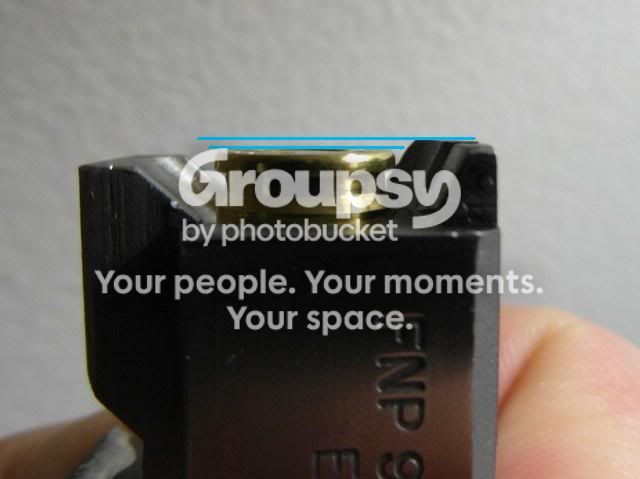
It's hard to be sure from one picture, but it does look to me like the base of the case is visibly below the square rear face of the hood extention. It's possible that is normal, but it makes me wonder if the aftermarket barrel isn't chambered a bit too deep.
I'd be tempted to manually hold a cartridge in the chamber while inserting a near full bore diameter rod in the barrel, and measure the depth from tip to crown. Then I'd install that barrel in the slide and press it into the breech face and remeasure.
For rifles, you can get go/no go headspacing gauges. If there's one for the 9mm, I'd be curious to see if your gun would close on the no go gauge.
Last edited:






















