I'd just like to mention that I do these very often and as a result, I am not very good at them. I do not claim to be practical or tactical, but just an enthusiast who loves shooting and the gear associated with it.
With that said, lets get to the product that I was very excited to see.
Other than the fact that these are Canadian made, I like the elastic carriers over plastic and/or aluminum for these reasons in no particular order:
Low profile: as you remove the shells, the elastics go flat reducing it's profile
Economical: priced at $14-$20 you could buy three for the price of one aluminum side saddle
Weight: they are much lighter than plastic or aluminum carriers
Versatility: almost unlimited mounting options, be creative as you want.
The Carriers:
P.1
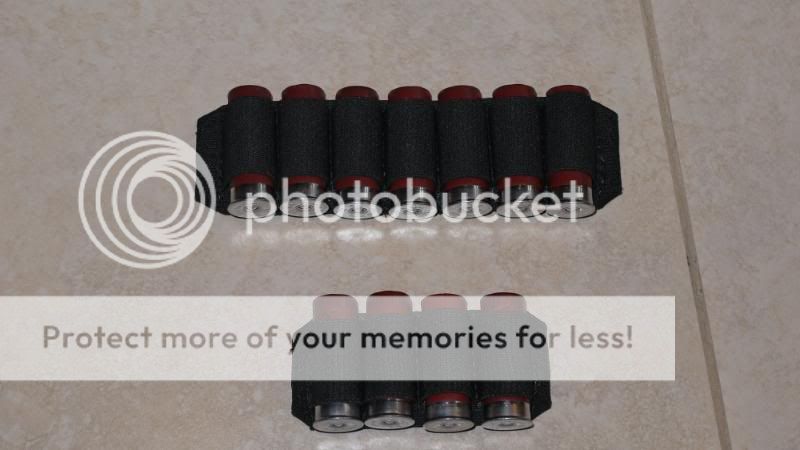
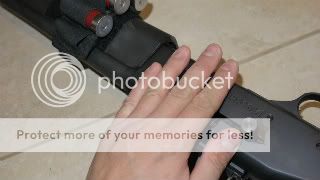
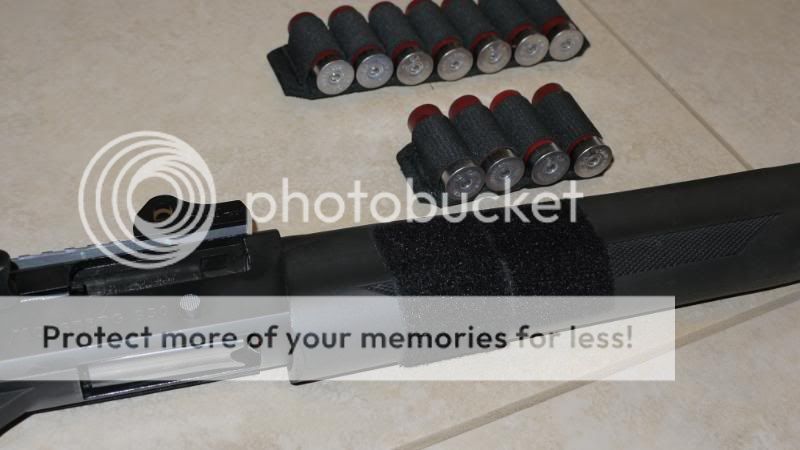
I had decided to go with a 4 and 7 shell holders for reason I will outline below. The carriers themselves are sturdy, the elastic will almost cover a 2 3/4" shell, and the backing is stiff, but not so much that it would limit where you would want to mount it.
P.2
P.3
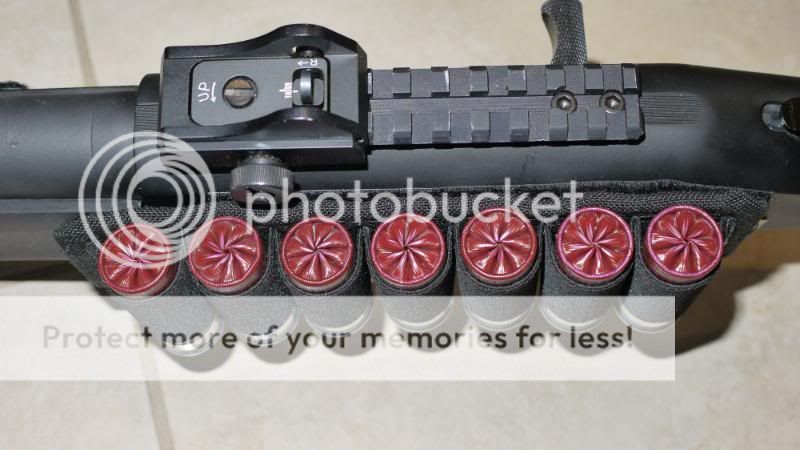
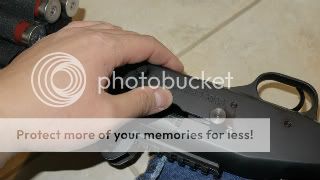
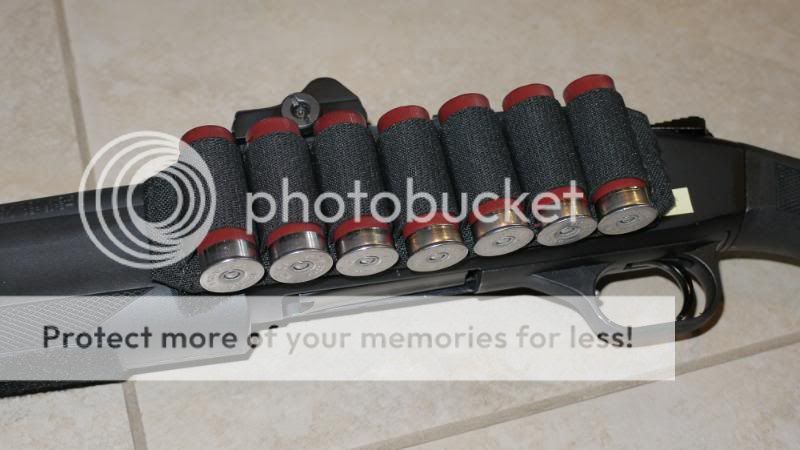
I wanted to mount the 7 shell carrier in the traditional location on the side of the receiver. Unfortunately, it was abit long... Fortunately, this did not prove to be an issue. I cut the "fuzzy side" of the velcro around the trigger assembly pins and serial number and cut a small rectangle to stick on the forend for good measure.
P.4
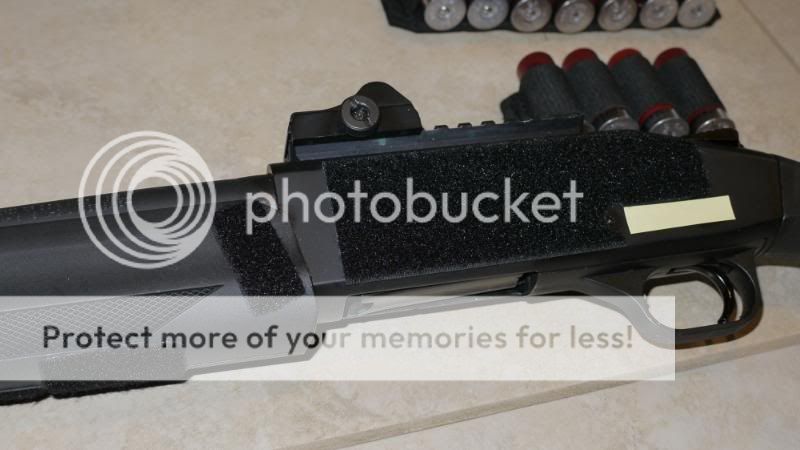
Despite it's appearances, it is very secure. The carrier grabs the "fuzzy side" very well and can only be removed by a deliberate action.
P.5
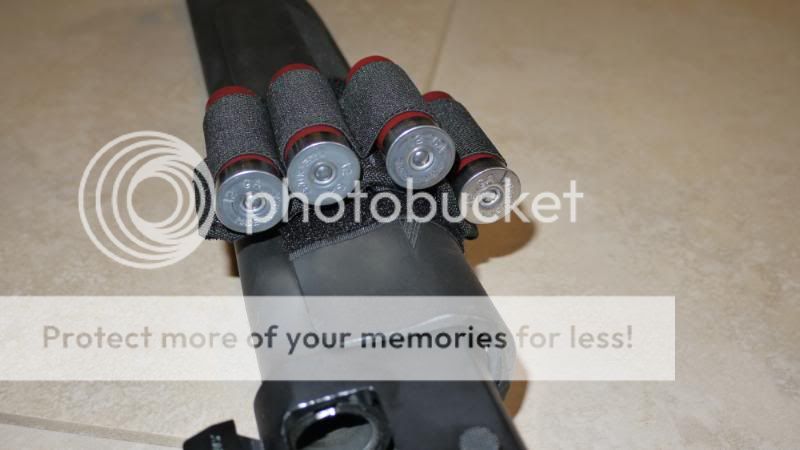
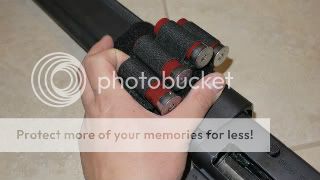
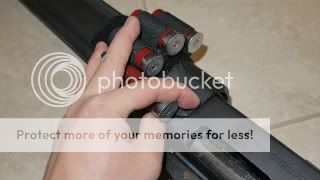
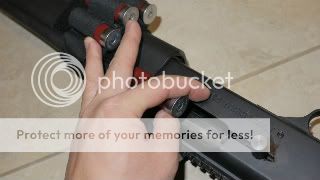
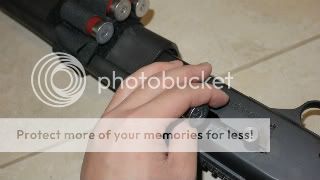
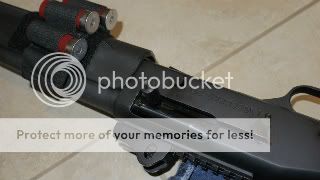
For the 4 round carrier, I went a little creative and mounted it "vertically" on the forend. This way, when I shoot to lock, I have quick access to a few shells roughly along the same plane as the ejection port (see what I mean in "reference 2" at the end of this review). I was able to do this by wrapping two strips of the "fuzzy side" of the velcro on the forend to allow some adjustability.
P.6
P.7
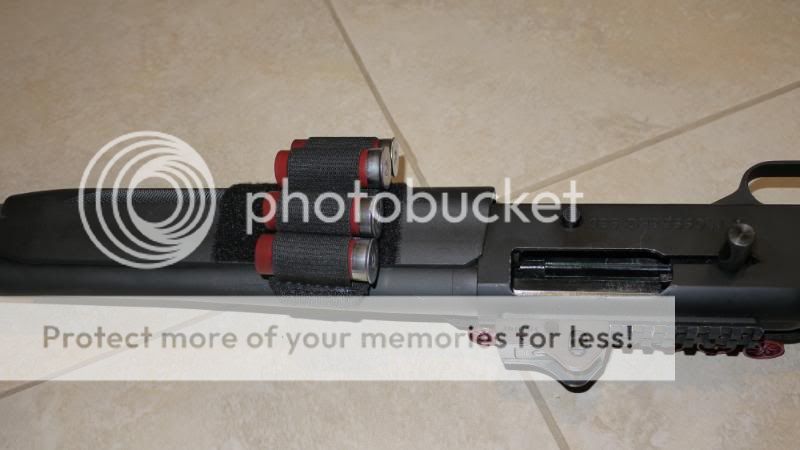
I am quite pleased at how it turned out and I have not had any issues of it falling off.
Overall, I am very happy with the way the D.S.C.'s perform, well past what I was expecting as alot of people I know suggested that the velcro would let go under heavy fire. I can report that neither the 4 shell carrier, nor the 7 shell carrier fell off or came loose during intense shooting as I will prove with this following video.
"Rolling Thunder" is a stage where there are 6 steel targets and a team of 6 shooters(in the case of the video, 5 shooters and that's me at the end there, shooter number 5). Shooter 1 shoots steel target 1, shooter 2 shoots steel target 1, shooter 3 shoots steel target 3, etc. until the last shooter shoots target 1 then calls "out." Now Shooter 1 shoots steel 1 and 2, shooter 2 shoots steel 1 and 2, shooter 3 shoots steel 1 and 2, etc. The targets increase and so does the stress untill everyone is shooting at all 6 steel targets. It is quite challenging (and ridiculously fun) I had a few misses, but whatever

In this vid, I am running the exact configuration as shown in P.2 and P.5. I purposely left them fully loaded during my shoot to test and ultimately prove that these will not let go under heavy fire. There is no music to accompany this video, but it gets the point across.
[youtube]iXF-I3GfwI0[/youtube]
Summary:
There you have it. A great Canadian product at a great price, who would've thunk it?. I hope that this proved somewhat informative to someone at sometime and thanks for reading
References:
Reference 1: Shotgun Configuration
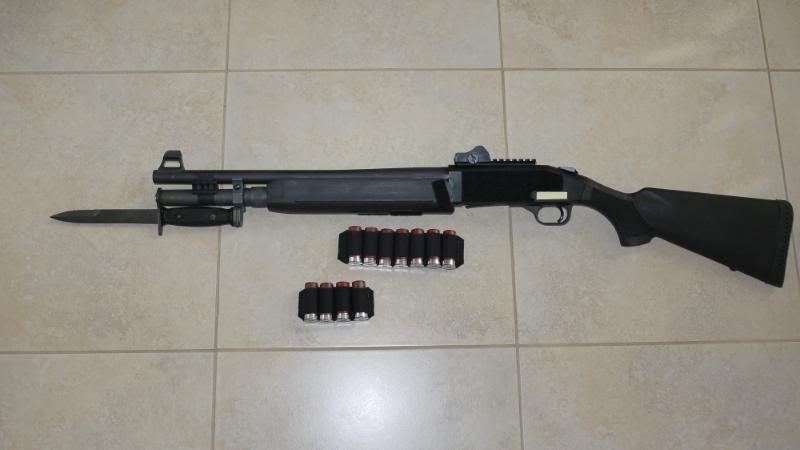
-Base gun: Mossberg 930 SPX (which is still proving to be the most reliable at these shoots... yea, I'm talking to you Benelli M4 and Remington 1187
)-Stock forend trimmed back to make more clearance for reloading (see P.8 below)
-USGI M7 Bayonet
-S&J Hardware 4 and 7 shot D.S.C. carriers
-S&J Hardware +2 extentension kit properly plugged to 5 rounds
-S&J Hardware Railed barrel clamp
-S&J Hardware Bayonet mount (1/2 mount as the full one will not fit)
-S&J Hardware Jumbo charging handle
-S&J Hardware Jumbo safety
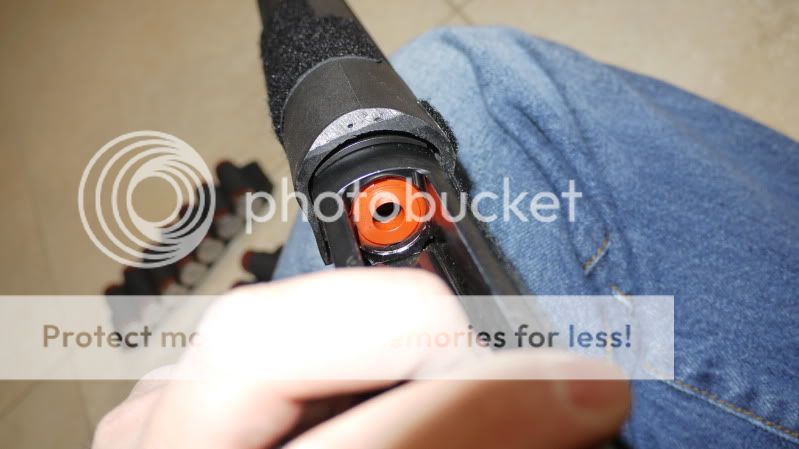
-S&J Hardware "mossberg 12 ga" delrin follower I've dubbed it "The doughnut" (as shown in P.8 below)
P.8
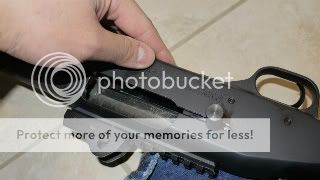
Reference 2: Reloading along the same plane
I am not sure what this method is called, so someone feel free to chime in if they know the technique. Here is what I mean in a step by step illustration (shell taken out before closing bolt for safety):