












































You are using an out of date browser. It may not display this or other websites correctly.
You should upgrade or use an alternative browser.
You should upgrade or use an alternative browser.
#10 percussion caps for muff pistol
- Thread starter danyboy
- Start date

Any dealer that sells Remington #11's should be able to order #10's in for you but that isn't your problem. The #10's are about the same inside diameter but are longer which won't help.
Sounds like a weak hammer strike or improper fit of the hammer,if the hammer comes down on the cap squarely and the spring is strong enough it should go off.
To beef up the spring you could wedge a piece of hard rubber in there to add strength to the hammer strike.
I am working on the gun in this picture and should have it shooting in the New Year:

Sounds like a weak hammer strike or improper fit of the hammer,if the hammer comes down on the cap squarely and the spring is strong enough it should go off.
To beef up the spring you could wedge a piece of hard rubber in there to add strength to the hammer strike.
I am working on the gun in this picture and should have it shooting in the New Year:
- Location
- vancouver island
#10 caps
have 500 or so in my inventory -depends on where you are for shipping. have found that nipples seem to erode on these older pieces and they are just a whisker too low for a firm strike by the hammer. a simple fix can be a small washer in brass shim-stock perhaps .0005 thou under the nipple( presuming you have it loosened). the hammer should just barely touch the nipple-not enough to mash it.
have 500 or so in my inventory -depends on where you are for shipping. have found that nipples seem to erode on these older pieces and they are just a whisker too low for a firm strike by the hammer. a simple fix can be a small washer in brass shim-stock perhaps .0005 thou under the nipple( presuming you have it loosened). the hammer should just barely touch the nipple-not enough to mash it.
I just thought of this and have used it on a revolver where the cylinder end play causes a weak hammer strike. A drop of Krazy Glue on the cap will extend it so the hammer can do it's job. It takes quite a while for the glue to set so it is best done the night before you shoot.
How about some pictures of your Muff pistol???
How about some pictures of your Muff pistol???
muff pistol
Glad to see I am not the only nut interested in cap and ball revolvers.
Skinny, supposed to be a slight diameter difference in #10 and #11 percussion caps. Found another nipple at gunsmith's yesterday but thread isn't the same. Managed to screw off the one on my gun. I'll try putting back the original nipple but not screw it all the way to see if I really need to either insert a washer to jack it up or stick some crazy glue in the hammer. I might also go with the rubber in the spring option.
Here are some pics of the gun:
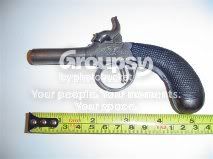
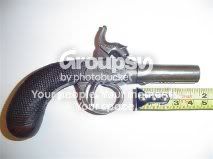
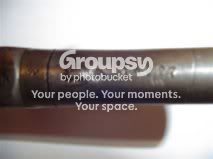
Glad to see I am not the only nut interested in cap and ball revolvers.
Skinny, supposed to be a slight diameter difference in #10 and #11 percussion caps. Found another nipple at gunsmith's yesterday but thread isn't the same. Managed to screw off the one on my gun. I'll try putting back the original nipple but not screw it all the way to see if I really need to either insert a washer to jack it up or stick some crazy glue in the hammer. I might also go with the rubber in the spring option.
Here are some pics of the gun:
The cap has to be seating solidly on the nipple. Is the #11 too small in diameter to seat all the way? Or is it too long to get the cap composition in contact with the nipple?
The geometry in a small lock like this is pretty tight, not too much room for adjustment. If you leave the nipple slightly unscrewed for length testing, make sure the front lip of the hammer nose clears a cap. Placing a washer under the nipple shoulder will reduce the amount of thread engagement. Make sure the nipple is seated soundly if a spacer is used. A blown nipple is serious.
Remove the nipple and carefully measure the diameter, thread pitch and thread length. Check dixiegun.com, trackofthewolf.com as see if there is anything that will work.
Might be necessary to have a nipple made.
The geometry in a small lock like this is pretty tight, not too much room for adjustment. If you leave the nipple slightly unscrewed for length testing, make sure the front lip of the hammer nose clears a cap. Placing a washer under the nipple shoulder will reduce the amount of thread engagement. Make sure the nipple is seated soundly if a spacer is used. A blown nipple is serious.
Remove the nipple and carefully measure the diameter, thread pitch and thread length. Check dixiegun.com, trackofthewolf.com as see if there is anything that will work.
Might be necessary to have a nipple made.
muff pistol
No the #11 cap seats a little loose on the nipple. I managed to fire one this morning. I realised the cap was also a little too long, making it hard for the hammer to fully compress the top of the cap completely. So, I filed the bottom part of the cap to make it shorter.
No the #11 cap seats a little loose on the nipple. I managed to fire one this morning. I realised the cap was also a little too long, making it hard for the hammer to fully compress the top of the cap completely. So, I filed the bottom part of the cap to make it shorter.
muff pistol
Apparently not, even when I pinch the cap, it won't fire. I went to a gunsmith today. He tried a 6X1mm thread nipple:it'll screw about half a turn only. The gun's threads seem smaller. I'll have to stop by this specialized bolt shop to check what my thread is exactely.
Seems as though the hammer doesn't hit square with the nipple. Spring is strong enough.
Bought this gun from a CGN member called Wally Willy and he assured me it worked fine with #11 caps and it doesn't. Hammer was cracked and I fixed it by bronze brazing it. First time I get scammed by a seller on this site. Watch this Wally Willy guy.
Apparently not, even when I pinch the cap, it won't fire. I went to a gunsmith today. He tried a 6X1mm thread nipple:it'll screw about half a turn only. The gun's threads seem smaller. I'll have to stop by this specialized bolt shop to check what my thread is exactely.
Seems as though the hammer doesn't hit square with the nipple. Spring is strong enough.
Bought this gun from a CGN member called Wally Willy and he assured me it worked fine with #11 caps and it doesn't. Hammer was cracked and I fixed it by bronze brazing it. First time I get scammed by a seller on this site. Watch this Wally Willy guy.
- Location
- vancouver island
muff pistol
the one i have uses 1/4 by 28 thread nipple but some of the early ones also used a 26 thread-so i am told. perhaps whitworth measure?
the one i have uses 1/4 by 28 thread nipple but some of the early ones also used a 26 thread-so i am told. perhaps whitworth measure?
Whitworth measure ? What the heck is this ? Some kind of a way to measure threads ( no of threads/inch or mm and diameter) ?
I measured the outside diameter of my gun's nipple: taper from .146" to
.162". O.D. of thread is .217". Nipple lengthfrom top of gun to tip of nipple is
.331".
I then measured an old #11 nipple given by a gun dealer: taper from .160" to .173" and length is .436" from gun to tip of nipple.
Pretty sure the original gun nipple is meant for either a #9 or #10 cap.
In the meantime, I realized the inside of the hammer was so worned out thau the surface hitting the cap isn't even. I just poured some epoxy to even out this surface and will try it out.
I measured the outside diameter of my gun's nipple: taper from .146" to
.162". O.D. of thread is .217". Nipple lengthfrom top of gun to tip of nipple is
.331".
I then measured an old #11 nipple given by a gun dealer: taper from .160" to .173" and length is .436" from gun to tip of nipple.
Pretty sure the original gun nipple is meant for either a #9 or #10 cap.
In the meantime, I realized the inside of the hammer was so worned out thau the surface hitting the cap isn't even. I just poured some epoxy to even out this surface and will try it out.
- Location
- vancouver island
#10 cap size
just did a sample from each size of cap. measured 3 each from new unused tins. #10 is .153 I.D. and .160 long. #11 is.160/161 I.D. and also .160 long. depth to firing compound in both is .115 -looks like you may have found your problem tho' and your fix is a good way to test out but will not last too long i think. regards
just did a sample from each size of cap. measured 3 each from new unused tins. #10 is .153 I.D. and .160 long. #11 is.160/161 I.D. and also .160 long. depth to firing compound in both is .115 -looks like you may have found your problem tho' and your fix is a good way to test out but will not last too long i think. regards

In the meantime, I realized the inside of the hammer was so worn out that the surface hitting the cap isn't even. I just poured some epoxy to even out this surface and will try it out.
I think a much longer lasting solution would be to clean out the rusted portion of the cavity and silver solder a small steel shoe in place. The high temperature 45% silver type of silver solder
cheers mooncoon
muff pistol #10 caps
I thought of that too. Problem is hammer was cracked when I got it and I bronze brazed it . I could always bronze braze the inside of it but wether I bronze or silver solder it, the material pretty much has to become red hot in order to do it.
I'll see how this cold BJ Welding works and if it lasts. It becomes pretty hard. I used it to weld a rear sight on my Mauser 71/84 years ago and it seems to hold all right.
When my wife wakes up, I'll try firing a #11 cap and see what happens. I could always try it out before she does but I'd have to sleep on the couch tonight and my bed is more confortable.
I thought of that too. Problem is hammer was cracked when I got it and I bronze brazed it . I could always bronze braze the inside of it but wether I bronze or silver solder it, the material pretty much has to become red hot in order to do it.
I'll see how this cold BJ Welding works and if it lasts. It becomes pretty hard. I used it to weld a rear sight on my Mauser 71/84 years ago and it seems to hold all right.
When my wife wakes up, I'll try firing a #11 cap and see what happens. I could always try it out before she does but I'd have to sleep on the couch tonight and my bed is more confortable.
Try the Krazy Glue on the caps,one drop..let it set,another drop let it set then go to the range and try it out...if it doesn't work I was wrong but it might save you from getting things red or even yellow hot.
I have an antique revolver in which the cylinder end-play does not allow the hammer to hit the caps properly, the Krazy Glue on the caps transferred the hammer strike enough to have them go off. It is not a permanent solution but it did work.
muff pistol
I tried the pistol and it works fine. Not much power to it though. I was about 3 feet away from a 24" diameter , about 12" thick log and the ball didn't even penetrate the log. It made a hole about half the size of the ball and lightly bounced back.
I used 4.5 gr. of 'P' Pyrodex (FFFG equivalent), i.e. I just filed the powder hole you see when the barrel is unscrewed and that gives 4.5gr. of powder. I imagine I could have used more powder. May be I will next time. Don't see how this gun would have helped in self defense with so little power. It was more a psychologial backup than anything else. Mind you I used a Buckshot 00 pellet and a 100% cotton patch soaked in Duck fat.
#11 caps seem to do the job all right but I had some misfires; i.e. had to fire some of them more than once.
First experience ever with black powder and cleaning it wasn't as bad as I thought. Used dish soap and a brush and wiped everything dry afterwards.
I might try #10 caps to see if they work better.
Wonder if smokeless powder could be used along with black powder caps...
I tried the pistol and it works fine. Not much power to it though. I was about 3 feet away from a 24" diameter , about 12" thick log and the ball didn't even penetrate the log. It made a hole about half the size of the ball and lightly bounced back.
I used 4.5 gr. of 'P' Pyrodex (FFFG equivalent), i.e. I just filed the powder hole you see when the barrel is unscrewed and that gives 4.5gr. of powder. I imagine I could have used more powder. May be I will next time. Don't see how this gun would have helped in self defense with so little power. It was more a psychologial backup than anything else. Mind you I used a Buckshot 00 pellet and a 100% cotton patch soaked in Duck fat.
#11 caps seem to do the job all right but I had some misfires; i.e. had to fire some of them more than once.
First experience ever with black powder and cleaning it wasn't as bad as I thought. Used dish soap and a brush and wiped everything dry afterwards.
I might try #10 caps to see if they work better.
Wonder if smokeless powder could be used along with black powder caps...
You need to find a ball that is about 10-15 thousandths of an inch smaller than the bore so that you can put a cloth patch over the end of the bore and ram the ball down with a rod. Push the ball in flush with the end of the barrel and cut the rest of the patch off with a razor knife. A bit of lube on the patch will make ramming it in easier.
Stick with black powder or BP substitutes,things could go sideways fast using smokeless.
The boot pistols were made in all kinds of calibres so finding the right size ball might be a challenge..00 Buckshot is .330 inches ...the pistol that I have is about a .44 cal.
Stick with black powder or BP substitutes,things could go sideways fast using smokeless.
The boot pistols were made in all kinds of calibres so finding the right size ball might be a challenge..00 Buckshot is .330 inches ...the pistol that I have is about a .44 cal.

I tried the pistol and it works fine. Not much power to it though. I was about 3 feet away from a 24" diameter , about 12" thick log and the ball didn't even penetrate the log. It made a hole about half the size of the ball and lightly bounced back.
I used 4.5 gr. of 'P' Pyrodex (FFFG equivalent), i.e. I just filed the powder hole you see when the barrel is unscrewed and that gives 4.5gr. of powder. I imagine I could have used more powder. May be I will next time. Don't see how this gun would have helped in self defense with so little power. It was more a psychologial backup than anything else. Mind you I used a Buckshot 00 pellet and a 100% cotton patch soaked in Duck fat.
#11 caps seem to do the job all right but I had some misfires; i.e. had to fire some of them more than once.
First experience ever with black powder and cleaning it wasn't as bad as I thought. Used dish soap and a brush and wiped everything dry afterwards.
I might try #10 caps to see if they work better.
Wonder if smokeless powder could be used along with black powder caps...
First off, I'd avoid smokeless in this situation. Partly that's because I don't have the knowledge, partially because any of the boot pistols I've come across don't seem to be quite the kind of guns I'd want to accidentally proof test 130 years into their lifespan

One thing I have come across is twist off barrel boot pistols (yours looked to be one, didn't see if you mentioned it, but that little lug under the barrel suggests it) is that they're often meant, or at least able to with great success, shoot oversized balls (we're talking slightly over bore diameter, nothing extreme). The reason for this suggested to me was that with the barrel twisted off and ball seated over the powder, you could get a good little pressure spike with black powder as it squeezed the ball into the bore.
Then again, I've never seen much evidence to say these guns were meant for more than wounding an attacker while trying to run away. At a time when even a scratch could end up in an amputation without anesthetic or slow death, it was still probably a decent deterrant.






















