K31 and the 7.5x55 - Wherein lies the accuracy?

H Wally

CGN Ultra frequent flyer
Super GunNutz
Rating - 100%
193   0   0
Have been bouncing this around for a little while, and have yet to come to a conclusion.

Is the 7.5x55 an inherently accurate rd, like many of the low recoil high ballistic coefficient 6 to 7mm rounds, or is it the superior quality and current condition of the K31's that we have on hand that is to credit for K31s' amazing accuracy?

So far I'm inclined to credit the rifles. I say this because everything you look at on them screams quality, and the bore's usually look nicer than new factory guns. Stands to reason that while most milsurps are heavily worn, beat up, have shrunken wood and a varied diet of ammo and bore sizes, the K31 would shoot better simply because it was better made and then better cared for.

The fact is though, most 7.5x55 ammo, be it reloads, factory, or surplus GP11 shoots well too.... I can definitely understand the GP11 being accurate, but factory and even decent reloads offer lots of variables... too many most of the time to allow for lucky shooting... this suggests that the cartridge is inherently accurate.

Unfortunately, I have yet to come across another rifle in this caliber, so I can't examine whether the cartridge is capable of performing when fired from another gun. I'm interested to hear what others have to say. For my part I'm deciding on which one gun/caliber to shoot for the summer, and while the k31 is darn accurate, it's a heavy beast to carry come hunting season.
 
I love my K31, and K11 for that matter. I think the straight pull action might have a strong influence. It keeps the bullet in alignment from feed, to fire.
Very fast, and more ergonimcaly linear than traditional bolt action recievers.

The quality is there for sure, and the condition. I lucked out getting one with an almost untouched bore. Very close to original spec.
The K11 is superior in quality of finish, but the K31 is a better shooter.
It is nice having both, but now I wish I would have bought two cases of ammo instead of one.

Damm!
 
Okay, H. Wally, time to be honest (I can do that when pressed, you know!): I have no first-hand knowledge whatsoever of the K-31.

However, I do know a bit about the old 1889-based actions, currently having a couple in 7.5 and another in .30-30. All, of course, have 3-groove barrels with wide grooves and fairly-wide lands. The original '89 action was l o o o o o n g and it was heavy and it was rear-locking. Those two massive locking-lugs were almost the size of a John Deere tractor and they were machined pretty much to the proverbial "Swiss-watch" standards of perfection.

With that length, the actions should have been springy, but they also were massive enough to counter some of this springiness. And they were accurate, too. When I am shooting an 1897 iron-sight military rifle and it is performing almost like a new scoped sporter, I say there is nothing basically wrong with the thing.

Over the years, the action got shorter as redesign followed redesign. The locking-lugs migrated from the back end of the locking-sleeve to the front and, on the final version, that long bolt-shank finally disappeared and left the locking-lugs, just as massive and beautifully-made as ever, locking-up RIGHT behind the chamber. So you ended up with a truly massive, very short action with an incredibly-strong lockup, right behind the cartridge. This is almost a recipe for accuracy all by itself; the Ross is similar. The Swiss added to this by keeping the action very solid and with a lot of meat on its bones. Check out the latest bench-rest actions and you can see much of this in them. The Swiss put it into an Army rifle.

Now here is a point: that old '89 action was springy just on account of its great length. The '96 was he first improvement, the 1911 the second and the '31 the third and last. Each one was less springy than the one before, which normally means more potential accuracy from the design of the RIFLE.

Now you look at the ammunition. The cartridge was designed by Major Rubin, who also was responsible for the major part of the design of another fine old long-range cartridge: the .303. The two rounds share a lot more than a designer; they also share a lot of characteristics, characteristics which fit them eminently for accurate shooting. Both are, by present standards, too large for their performance; by no standard can you possibly call either one "high intensity". Indeed, the Cordite loadings of the .303 were considerably UNDER the pressure of the BLACK POWDER loading. The TEXT BOOK OF SMALL ARMS - 1909 gives the following chamber pressures:

.303 Mark VI: 15.5 ILT
7.5 Swiss: 17.1 ILT
7.65 Turkish: 19.7 ILT
.30M-1906: 19.78 ILT
7x57 Spanish: 22.3 ILT
3-line Russian (214 bullet): 17.47 ILT
7.9 German (227 bullet): 21 ILT
7.92 German (154 S type): 17.5 ILT

In each case, ILT stands for Imperial Long Tons of pressure, per square inch. 1 ILT = 2240 lbs.

And we find a few anomalies. The superbly-accurate 7x57 had a built-in pressure handicap which was cured by the comparatively heavy barrels of the rifles. The low-pressure 154-grain S-load of the German rifle was never regarded as much of a long-range cartridge but, at shorter ranges, it shone. It was handicapped by the high base-drag of the S bullet. I have tested original bullets with powder duplicating the original, and the 100-yard performance was quite amazing.

The .303, in 1910, came out at 18.5 ILT with the 174-grain Mark VII bullet. This was NOT the most accurate loading possible; it was about 10% (in velocity) higher than the by-test most accurate load which the Royal Laboratories had been able to build, or close to 20% higher in pressure. Drop the .303 by about 10% in velocity and you WILL be amazed at what your groups look like. But Britain regularly used rifle-fire at much greater ranges than most other countries (partly for lack of expensive machine-guns) and the Army was trained to the highest standards of any world-class military. They took the extra range made possible by the new ammunition and made up for its small shortcomings with superb training and rapid fire.

The Swiss, on the other hand, stayed with their BIG, old casing which allowed them to KEEP their pressures low.... and enjoyed the advantages which it gave them.

And here I digress, possibly. I spent 25 years shooting with a very good friend who reloaded ALL of his ammunition... and did not even own a powder measure. Gavin Tait used a cat-food tin, a silver spoon and a tiny bit of creased paper; with those, and his RCBS 505, he loaded some of the most accurate ammunition ever seen in this part of the world. He hunted for the pot because he spent most of his life needing to hunt for the pot. And he was almost completely colour-blind: he HAD to make a 1-shot kill because he could not track a wounded animal without seeing it. And he regarded wounding an animal as a sin against the God Who had created it. Add these factors together and you had a man who could see a deer at 760 yards, fire his single round and go and get the pickup truck to load the deer aboard, secure in the knowledge that the animal had not even known that it was in danger.

His recipe for success was simple: keep your rifle clean and your screws, ALL of them, tight. Hunting season lasts ONE round, so you practise, Practise, PRACTISE until you KNOW that you can put that ONE round precisely where you want it to go. And you load the most CONSISTENT ammunition it is possible to load.

And there is wisdom in that last sentence. We loaded many loads for a lot of rifles in 25 years and the one thing which stuck out, plain as paint, was this: CONSISTENCY in your ammunition is FAR more important than having a "pet load". The British got consistency in their loading by staying with Cordite; the Swiss got consistency by tightening-up tolerances all along the line and in every department.

The rifle barrel and action twist about and sometimes compress and always vibrate with every single shot. If you can keep the rifle vibrating and twisting about in PRECISELY the same manner with every shot, the bullets SHOULD all go to the same place. You get this precisely-the-same vibration pattern by making your ammunition CONSISTENT and you minimise the motion by keeping your pressures low. Cases must be the same weight, therefore volume, primers must be the same and seated the same, powder must be the same charge to a 1/20 of a grain, slugs must all be out of the same box or, at very least, the same Lot number, seating must be the same..... and the bullets should be seated just a hair from touching the lands. And you keep your pressures reasonable; the American infatuation with 65,000psi loads and even hotter is a recipe for inconsistent vibration patterns, bullet-stripping and just about any other horrid thing you might think on.

Put ammunition made to THOSE standards through a solid rifle with an action like a bank-vault (which includes Schmitt-Rubins, especially the K-31..... and it includes Rosses as well) and you HAVE to get results.

I apologise for the sermon, but it is hard to put 25 years of experimenting onto a keyboard, and do it in less than 40 hours, without a bit of sermonising!

Hope this helps.
.

 
Sir - in spite of Smellie's valuable and knowledgeable words on the subject [I've copied the post for my file, BTW], one thing has been studiously overlooked in the responses.

The design and manufacture of the actual GP11 cartridge itself.

Smellie touched on the 'big ol' case' - it is, in fact, around the same capacity as the venerable .30-06, although that service bullet usually weighs around 180gr or so. The GP11 bullet weighs 174gr, but was, from it's very inception, of such an outstanding shape and form - ballistically - that it takes a very modern design like a SMK with a long ogive to come near it in terms of ballistic coefficient - one of the reasons why actual exact duplication of the cartridger eludes many reloaders, including me.

One of the bettter known contributors on swissrifles.com pulled ten rounds randomly a couple of years back and found - if I'm not mistook - that ALL ten powder loads were within 0.1gr of each other, and that all the bullets were within ~1 grain of each other. This is military ammunition of truly match grade, although there IS a Swiss match grade that is even better.

As for soft-recoiling, well, Sir, I take my hat off to you. Any cartridge that launches a 175gr bullet at 2650 fps from a bog-standard military rifle is going to smart if you don't hang on, and the K31 is no exception there. I dare say that Carlos will be along in a minute to comment - a real gravel belly if ever there was one - and both he and I have collected sore shoulders uncounted over the years from prone shooting.

As for whether or not the 7.5x55 Swiss is accurate in any other gun, have a look at the 300m ISSU competitions in Switzerland, where all manner of upper-level target rifles from Haemmerli, Tanner, Gruenig & Elmiger, SIG and many others post scores that can only be described as perfect, differing literally by thousandths of an inch in count-back - ALL shooting either ordinary GP11 or the match stuff.

If I were allowed to have another rifle of any kind - it would be in 7.5x55 Swiss - a cartridge I've been lucky enought to have begun shooting when I was just 14 years old - 52 years ago.

tac
www.swissrifles.com
 
Great sermon Smellie. You fellows never have to apologise for writing vast volumes of wonderful knowledge for those of us that haven't got the experience that you have acquired. CGN is becoming like church for many of us...amen. : )
 
Ask and you shall receive - thanks for the great posts Smellie and tacfoley! That pretty much explains everything I was wondering :p Now to get back to making my reloads more accurate! :D
 
I've been wondering what the short throat of the K31 has to do with it. Most military loads do not come close to reaching the lands in their respective rifles. With the short throat of the K31 and a heavish bullet you pretty much have to be at the lands.

I recently bought a Swiss Products clamp on scope mount and put on a Bushnell fixed 10. tried to do load development, but each load shot as good as the last. .8"-1.1" 5 shot groups at 100m. I'm amazed at that accuracy from a service rifle.
 
I'm just getting into the K31 and the 7.5x55. Great info here.

Here's hoping we get some more GP11 so I ca actually shoot without having to reload just yet :)

The main importer/distributor of the stuff here in UK surprised us all at the 2010 Bisley Trafalgar meet - where most of us buy our annual stocks of surplus ammunition - by casually dropping into the conversation as we went to collect the stuff that he'd had to put up his prices by almost a third. It is now cheaper to buy PPU than milsurp. Funny enough, he was STILL selling '79 vintage ammunition, and not the '82 that most of your guys are seeing, I'm told.

As there were five of us buying 700 rounds each, his lost sales were not inconsiderable, especially as we 'spread the joy' around our Swiss-schtuff shooting pals.

tac
 
As a K31 owner I can't say enough about it. With issued iron sights, stock rifle I'm getting 1" to 1.5" groups with 5 shots @ 100yds. All this with my untuned handloads.
There's a lot of refinement in this rifle and usually sits in the winners circle at Vintage matches.
 
Since we are sharing a pile of great info on the K31 and 7.5x55 cartridge, does anyone have detailed dimensions of the 174gr bullet used in the GP-11 ammo? Or perhaps some good macro photos of a pulled bullet?


Mark
 
Yeah, I'll likely be getting the PPU. I find it's been awesome in the 7.62x54r and .30-06

But I've heard all the talk about GP11 being excellent quality.

In my experience [K11 and a K31] the PPU stuff shoots around 200-225 fps slower than GP11.

GP11, not only in my opinion, but in most others who shoot the stuff along with all their other guns, is very probably the finest standard specification military ammunition ever made.

tac
 
HATCHER says that the US bought a large number of 7.5mm BT projectiles from the Swiss for experimental purposes, this in 1918. At that time, the Americans were having a LOT of trouble with the M-1917 Browning MG. Not only were frames breaking, but the guns just could not make the maximum range which the smart guys had calculated.... but had not measured. Base drag was killing them, so they tried the best low-drag bullet being made: the Swiss. Instantly, problems solved.

The subsequent US bullet M-1, 173 grains, is based strongly on this Swiss projectile. This M-1 bullet is the current bullet being loaded into Lake City M-118 7.62 NATO ammunition.

And Lake City DOES sell bullets. Only problem is getting them out of one Free Country and into another Free Country.

After all, they are just SO dangerous. You COULD hurt your toe if you dropped a box of them!

Too bad we ever got rid of the Mediaeval idea of Fool-killing! It just allows the Fools to breed..... and then they all get Government jobs because they are too incompetent to do anything else!

(That is a LAMENT, not a Recommendation, BTW!)
.
 
In my experience [K11 and a K31] the PPU stuff shoots around 200-225 fps slower than GP11.

GP11, not only in my opinion, but in most others who shoot the stuff along with all their other guns, is very probably the finest standard specification military ammunition ever made.

tac

Well, hopefully we see some more GP11 again soon! *and* it's not too expensive.

I have seen PPU results and they aren't as tight as the GP11 when compared side by side.

I figure I'll buy the PPU and reload.
 
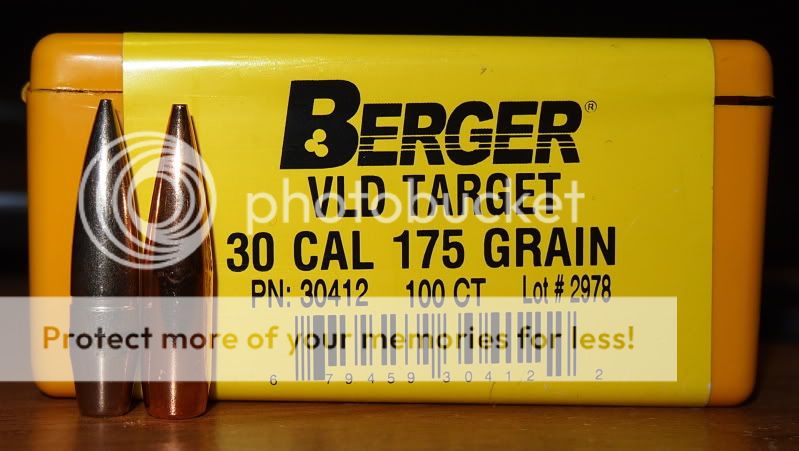
GP11 bullet on left, Berger VLD on right.
P2210238.jpg


Gp11 is great. The Berger kills the X-ring.
 
I love my K31, and K11 for that matter. I think the straight pull action might have a strong influence. It keeps the bullet in alignment from feed, to fire.
Very fast, and more ergonimcaly linear than traditional bolt action recievers.
...

This doesn't make sense to me. The bolt on the K31 doesn't pick the bullet out of the magazine any differently than a bolt action, and while unseen in the K31, both rotate at the end of the stroke to engage the lugs. Difference is, the K31 requires it to be done quickly, and the brass must be at least F/L sized, as the straight-pull has no camming action. A bolt action on the other hand, can be cycled as quickly or as slowly as desired, and can chamber a maximum dimensioned (read neck-sized) cartridge.

That having been said, my K31 is the most accurate Milsurp I have ever shot, and that's with a rear sight that's several inches from my eye, and not of the "peep" variety I usually favour (as in the Garand, LE No4, P14, etc.). The GP11 is great ammo, but I reload and can replicate its accuracy with several bullets and powders - the 168 gr Hornady BT over IMR4064 being my present choice. So..... it's not the ammo either.

I have to think that it's accurate primarily because the stock design is conducive to great accuracy, and so many come here with excellent barrels. This is simply a finely made firearm.
 
What my friend Gavin Tait found in his many years of shooting, much of it at long ranges, is that the Sierra company turns out some very accurate bullets. They cost a little more than Hornady or Speer (about 5%) but rather a great deal less than Bergers. And Sierras are available almost everywhere there is a decent gun shop, while Bergers have only recenly become available in many places and still are not universal.

Sierra makes a line they call MatchKing and I can attest (having been present while the ammunition was being loaded) that these have won many matches at CFB Shilo, often in the hands of farmers and oilmen who were shooting against the Army snipers, the RCMP SWAT team instructors and even celebrated shots brought in from England to demonstrate a certain very expensive (and very accurate) dedicated sniping system. Gavin Tait himself gave up competition shooting at about 72, at which time his asbestosis was getting the better of him, but he provided rifles and ammunition for a number of shooters who continued to compete. And he used Sierra MatchKings for nearly all of his competition rounds.

Sierra MatchKings available in most places would include:
.308-135 Number 2123, which possibly could help the SKS crowd

and these which could be of benefit to the 7.5x55 crowd as well as the 7.62NATO/.30-'06/.300WinMag shooters:
.308-175 Number 2275, a HPBT
.308-180 Number 2220, another HPBT
.308-190 Number 2210, HPBT yet again

For those with a really decent Ross or a 7.65 Mauser, they make:
Number 2315, a .311-174HPBTM

and for the 8mm crowd there is the:
.323-200 HPBT Number 2415

Personally, I load for my Lee-Enfields with their cheaper line, which, fortunately, is flat-based. The Sierra 180 Pro-Hunter is a SP flatbase bullet which has done rather well in several of my Lee-Enfields, P-'14s and a couple of Rosses, at least by my standards. It is Number 2310 and, if you do everything else right, it can turn in 100-yard groups with bullets overlapping. That's allright from a century-old iron-sight military rifle, even if it is a Ross. The P-14 has a scope; it just makes one hole, a bit ragged. The Lithgow 1918 puts them in half an inch, the absolutely-untouched NRF into an inch.

Some of these might be of use to overseas loaders.

In this country, we are fortunate because we benefit from their ubiquity. At the same time, perhaps we do not appreciate them quite as much as we should.

Hope this helps.
.

 
Back
Top Bottom