K31 and the 7.5x55 - Wherein lies the accuracy?

I have to think that it's accurate primarily because the stock design is conducive to great accuracy, and so many come here with excellent barrels. This is simply a finely made firearm.
Agreed. Stock triggers are also crisp after takeup, actions are shimmed and cartridge case design also helps.
They remind me of National Match grade M14's without the semi-auto function and price ticket.
 
Personally, I load for my Lee-Enfields with their cheaper line, which, fortunately, is flat-based. The Sierra 180 Pro-Hunter is a SP flatbase bullet which has done rather well in several of my Lee-Enfields, P-'14s and a couple of Rosses, at least by my standards. It is Number 2310 and, if you do everything else right, it can turn in 100-yard groups with bullets overlapping. That's allright from a century-old iron-sight military rifle, even if it is a Ross. The P-14 has a scope; it just makes one hole, a bit ragged. The Lithgow 1918 puts them in half an inch, the absolutely-untouched NRF into an inch.

Some of these might be of use to overseas loaders.

In this country, we are fortunate because we benefit from their ubiquity. At the same time, perhaps we do not appreciate them quite as much as we should.

Hope this helps.
.

We do have a ubiquity on our hands here. I have had many 303's that shot well, within 1 MOA. But they were in the same or better condition as the K31's we have today and I was using match grade ammo based on MkVII specs. We are fortunate to have the K31, a high quality rifle with high quality ammo = supreme accuracy.

An interesting article from Chuck Hawks "The Top Infantry Rifles of the 20th Century"
(ht tp://www.chuckhawks.com/top_infantry_rifles.htm)

"Since its design (up to the K31) leaves part of the case head unsupported, it is not as strong as the Mauser 98 bolt action and does not handle escaping gas from a blown primer or burst case well. Thus it is not a good rifle for the reloader or recreational shooter. For that reason, Schmidt Rubin actions are not popular candidates for conversion into high class sporting rifles. However, they are extremely well made and strong enough to operate reliably with virgin military ammunition.”

“Switzerland remained neutral in both the First and Second World Wars, so no "wartime production" short cuts were ever taken with Schmidt Rubin rifles. There are no inferior Schmidt Rubin rifles floating around to degrade the type's reputation."

I wonder how the 1911 infantry rifles would have fared in the trenches?
 
We do have a ubiquity on our hands here. I have had many 303's that shot well, within 1 MOA. But they were in the same or better condition as the K31's we have today and I was using match grade ammo based on MkVII specs. We are fortunate to have the K31, a high quality rifle with high quality ammo = supreme accuracy.

An interesting article from Chuck Hawks "The Top Infantry Rifles of the 20th Century"
(ht tp://www.chuckhawks.com/top_infantry_rifles.htm)

"Since its design (up to the K31) leaves part of the case head unsupported, it is not as strong as the Mauser 98 bolt action and does not handle escaping gas from a blown primer or burst case well. Thus it is not a good rifle for the reloader or recreational shooter. For that reason, Schmidt Rubin actions are not popular candidates for conversion into high class sporting rifles. However, they are extremely well made and strong enough to operate reliably with virgin military ammunition.”

“Switzerland remained neutral in both the First and Second World Wars, so no "wartime production" short cuts were ever taken with Schmidt Rubin rifles. There are no inferior Schmidt Rubin rifles floating around to degrade the type's reputation."

I wonder how the 1911 infantry rifles would have fared in the trenches?

Anyone ever hear complaints against the Steyr M95 straight-pull in the trenches? I haven't.

Bad out of spec ammo will foul up any action designed on tighter tolerances.
 
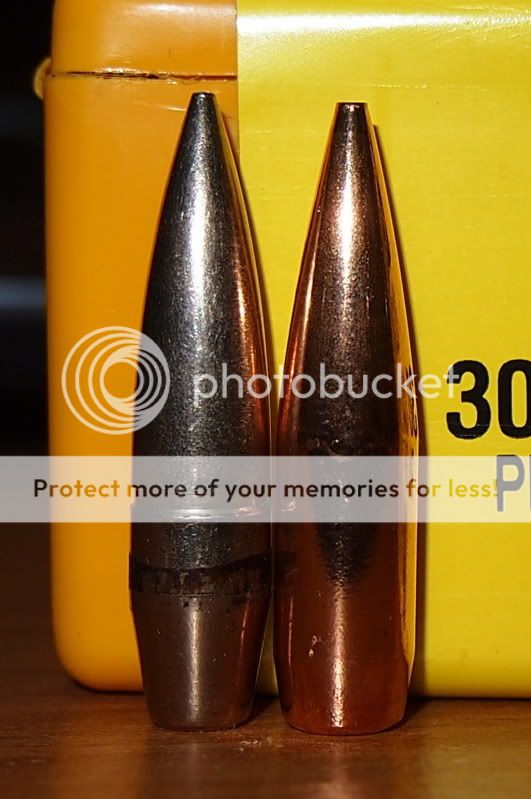
Close up
P2210238closeup.jpg


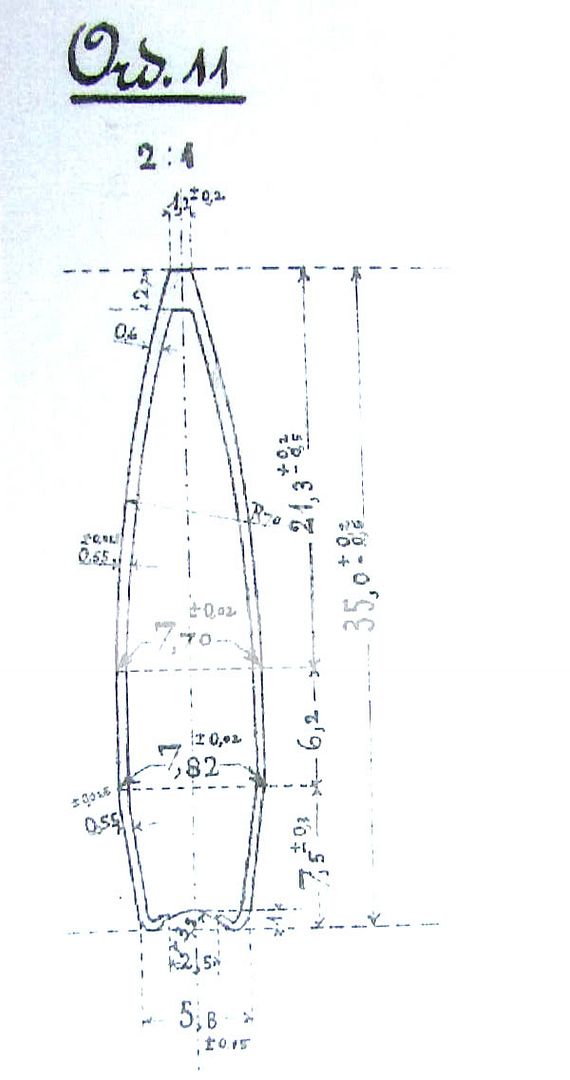
GP11 bullets tapers all the way to the edge of the boat tail.
No parallel shank on it.
In front of case mouth bullet diameter is .306"±.
At the boat tail it is .308"±
 
Now, that is VERY interesting!

The Brits turned out 1,000 SMLEs each in 1906 and 1907 with tapered bores. The bore was tapered from the chamber for about a third of its length, down to a parallel section at the front end. The barrels then were rifled to a CONSTANT diameter as measured from the centre of the bore. Looking in the chamber with the bore oily, the entire leade looks washed-out; dry the bore and the lands appear sharp and you can see the taper. This would have given much the same effect on the range. The idea worked, but the taper-bored barrels were too expensive for mass production, so they fell by the wayside. Most of them were removed during later FTRs, some were scrapped and they are pretty thin on the ground today. There IS one in the Pattern Room and it is in really nice shape, as one would expect. The one on my Navy Mark I*** is getting tired now, so I haven't shot it for some time.

I can see the purpose of the parallel bore-riding section of the commercial bullet, but I wonder what it would do to pressures and barrel temperatures. I am thinking about bore erosion and possible short barrel life. Anyone care to fill me in?
.
 
I'm not smellie, the person you are referring to, but my wife might say I am and accept that as an apt adjective at times. :)

For bore and rifling taper:
http://theswissriflesdotcommessageboard.yuku.com/reply/4176/Bore-Specs-for-7-5-Rifles#reply-4176

Better accuracy as bore tightens towards muzzle.
Increase in bore size towards muzzle, as caused by bad cleaning technique destroys accuracy more than regular shooting.

As for boat tails, lowers drag and increase effective range of projectiles.
VLD stands for Very Low Drag. Very important in long range gunnery in small arms for rifles and especially for machine guns. Useful in long range artillery too.

http://theswissriflesdotcommessageb...31-and-the-GP11-bullet-trajectory#reply-20867
 
You know, DIOPTER, after a while, folks can see right through you!

Life is MUCH too short not to laugh.

Markdev, they drilled, bored and reamed the barrels parallel the whole length, as in regular practice, then, of course, they polished them. THEN they ran in a tapered reamer which reamed the breech end of the barrel, for about a third of its length, into what amounted to a FUNNEL. So you had a semi-finished barrel which had a diameter between .301 and .303 at the muzzle end and a diameter of about .310 at the BREECH end, right where the Leade would be after it was chambered. Then they polished them again and finally rifled them to a constant theoretical diameter (because they were using 5 grooves) of.311 to .312.

The theory was that the base of the bullet would start to set-up (expand) as it left the casing, then enter this funnel-shaped part of the barel. The bullet would SEAL the bore perfectly AND it would "take" the rifling gradually and be squeezed down to its exit diameter gently and with less deformation than being just jammed in suddenly. The idea was to get more velocity AND better accuracy at the same time. That was a pretty good trick, for these two usually work at loggerheads with each other.

According to what I was able to find out, it worked as planned, but with a couple of setbacks. They were still using Cordite Mark I at that time and it was just about the all-time champ for bore erosion: VERY hot stuff indeed. The LEADES wore quickly because the rifling there was very SHALLOW and the very low lands were being vapourised and blown out the muzzle faster than they had reckoned upon. They DID get an increase in accuracy and velocity when the barrels were new, but this fell off as the experimental barrels simply wore out faster than would parallel rifling in a parallel bore.

Everything in engineering is a trade-off, and this is one improvement which cost more than it would be worth if adopted formally for all the rifles. For one thing, rifles would need new barrels at least TWICE as often, perhaps more often yet. It was a great idea; it just didn't pay, especially in a time in which the Army wasn't even being supplied with enough money for training ammunition.

THIS came home in a nasty way in 1914 when it was told to the Government that the Artillery had no ammunition for the WAR..... because they had shot most of their War Reserve off in training during the prevous several years and there wasn't even enough left to train the men then under instruction, much less the men who were to fight or fighting already. A LOT of PBI died during the next 2 years because of that Government stinginess. The Shell Scandal supposedly took until 1915 to sort out, but sufficient artillery ammunition STILL was not in the hands of the Canadians at the time of the first attack at Regina Trench (October 1, 1916). Much as I love my Navy Mark I*** with the tapered bore, I am happy that she didn't contribute to THAT mess.

Hope this helps.
.
 
Back
Top Bottom