WWII, captured and used

drache

BANNED
CGN Ultra frequent flyer
BANNED
Rating - 98.2%
54   1   0
Does anyone have pictures showing equipment captured and used by another nation. I know that Germans loved to use guns from other nations if they got the chance.

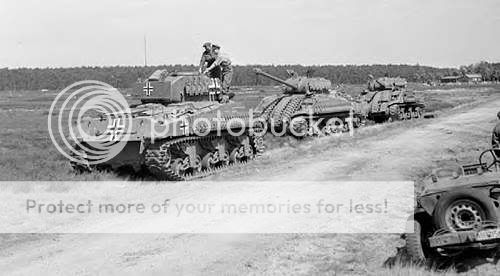
I was just listening to a Sherman Tank Commander from Patton's 4th talk about how he came upon a Sherman tank that had the American Stars painted over with the German Cross and was in a column with two german tanks.

He destroyed all three.
 
See "Hitler's Great Panzer Heist, Germany's Foreign Armor in Action, 1939-45" by Anthony Tucker-Jones. It describes and has photos of a range of Brit, French, Czech, Russian, and US armored vehicles which were captured and used by the Germans.
 
German Sherman
firefly-031.jpg


Edit:
See "Hitler's Great Panzer Heist, Germany's Foreign Armor in Action, 1939-45" by Anthony Tucker-Jones.
I've never seen that before, thanks!
 
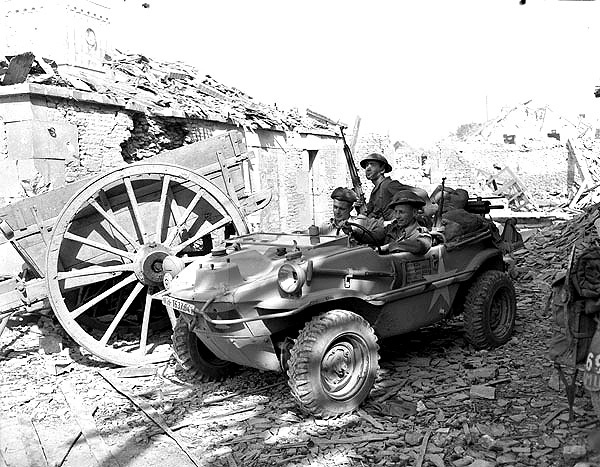
I think the Germans used every Jeep they could find. I was watching a documentry that said the Universal or Bren gun carriers were used by the Axis troops.
The German Sherman looks interesting, the Sherman in the middle looks like a Firefly (17 pounder), or American M4A3 with a (76mm).
 
Russians used German artillery and other heavy equipment in very large numbers.There use to be Russian site with a lot of pictures of it-I'll post it when I find it.
 
person10.jpg

-Personnel of the South Saskatchewan Regiment in captured German 'Schwimmwagen' amphibious car of the Wehrmacht. August 11, 1944, Rocquancourt, France.


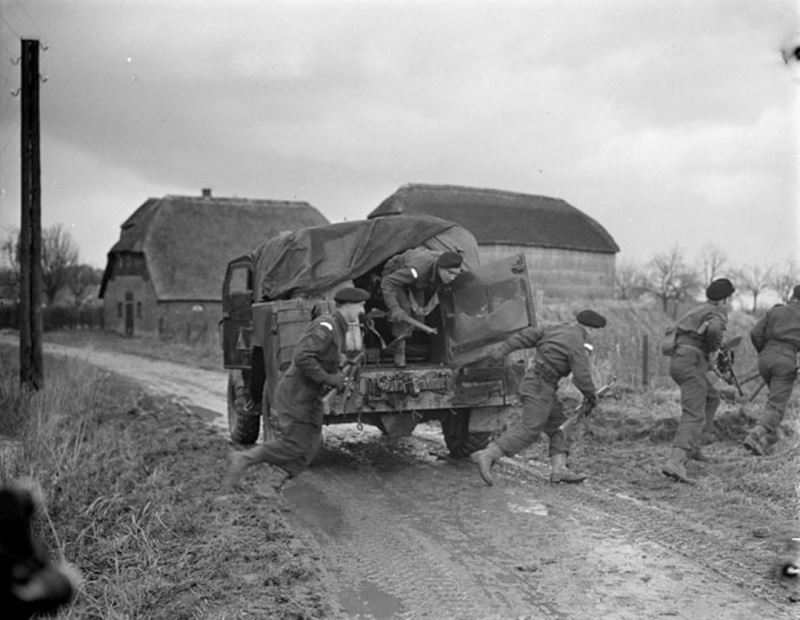
a1775910.jpg

-Soldier in the center is carrying a GEW 43.
 
German Sherman
firefly-031.jpg


Edit: I've never seen that before, thanks!


The use of spare track sections as reactive armor is interesting.

I knew a fellow that was a driver in a "Tiger" and they were always surprised at how poor the armor was on Allied tanks, especially the Shermans.

His comment about his allied counterparts was that they were very good tank drivers and were well disciplined. Their biggest weakness was their equipment. The operators of the Shermans were a credit to all tankers.

He was in three different types of tanks, from 1936 to 1945. The early model he was in was inferior to the Sherman. He then went into a PKWIV with a 75mm gun. He thought it was a good battle tank but underpowered to weight and very uncomfortable.

His real love, was the Tiger, with its 88mm gun. He said he felt invulnerable inside its belly.

It was fast, powerful and carried a punch that was effective way beyond the range of anything the Allies had to throw at them.

He said when he lost his last tank (Tiger) they ran out of fuel and just took their food/personal weapons, coats and walked away from it. They didn't even try to burn it or blow it up. He said they had nothing to burn it with and nothing left to blow it up with, so they left it for the stragglers coming up, that may or may not have fuel to get it running again or burn it. He never saw it again and ended up in an infantry unit for a couple of weeks, until the Canadian units caught up to them and their whole unit surrendered.

They had ammunition but no food or decent clothing left and hadn't been supplied since they left the tank behind. Nothing around them but Allied units and equipment. They had two choices, die fighting or go to a POW camp.

They purposely waited for a Canadian or US unit, because they were rumored to have better food, cigarettes and shelter. The other Allies, were also pis-ed at them and wouldn't always accept surrender. They had all heard of the German commander that shot the Canadian prisoners but took a chance anyway.

Horst ended up in a POW camp in Alberta. He loved it. He loved the ranches and open land.

He was born in Vienna and had only been out of the city after he joined the Army.

I was at his funeral last spring. He died a few years after his wife. He was 90 years old.

Horst, never had any children. He refused to bring them into such a violent world.

In truth, his wife was barren. They loved kids.

I'm way off topic here but his comments on Canadian troops and the differences between their equipment is pertinent. The story is true as far as I know and it all sounds like a lot of similar stories from similar people.
 
Germans loved captured guns because they could actually get ammo for them!

"Hooray! A truckload of ammo boys!! Wait a minute... It's all 7mm! Good think we all have 8mm mausers and mp-40s :mad: Keep usin those Mosins!"
 
...I knew a fellow that was a driver in a "Tiger" and they were always surprised at how poor the armor was on Allied tanks, especially the Shermans....

Wonderful story!

Here's a recent obit from The Telegraph (who have a great Obituaries section, especially military ones) on a Joe Ekins, who not only faced but knocked out three Tiger tanks in one day:

Joe Ekins, who has died aged 88, ambushed and knocked out four German tanks, including three Tigers, in a day and was said to have fired the shot that killed a German panzer ace.

On August 1944, during the breakout from the Caen salient, Ekins was serving with the 1st Northamptonshire Yeomanry (1 NY). He was the gunner of a Firefly tank, a Sherman equipped with a British 17-pounder. These were more manoeuvrable than the German Tigers but less well protected. The latter, with their heavy armour and 88mm guns, were the most feared weapons in Normandy and, a few weeks earlier, a lone Tiger was reported to have destroyed 14 Allied tanks in as many minutes.

After a night move, a troop of 1 NY’s tanks was leaguered in an orchard near St Aignan-de-Cramesnil, a few miles inside German-held territory. The following morning, the Germans counter-attacked. For Ekins, it was his first action.

He saw three Tiger tanks advancing across open farmland near the road from Caen to Falaise. He opened fire and got off two shots at a range of about 800 yards and knocked out one of them. As the other two Tigers rapidly traversed their guns, his Firefly reversed into cover but an answering shot smashed the heavy steel turret lid, injuring the tank commander, who staggered out.

The troop leader ran to the tank and guided the driver to a new firing position under some apple trees. At the next shot from Ekins, the turret of the second Tiger exploded. The remaining Tiger might have had a damaged periscope, for it was circling as it tried to escape.

Ekins loosed two more shots and this tank, too, started to burn. In 12 minutes, Ekins had destroyed three Tigers. Later, he destroyed another tank, reported to be a Panzer IV, at a distance of about 1,200 yards. His own tank was then hit. There was a loud bang, a cloud of sparks, the crew scrambled out and, in Ekins’s words, “we ran like hell.”

It was later claimed that with his third tank “kill” Ekins had brought about the death of the German tank ace Michael Wittmann, a veteran of the Russian front credited with the destruction of 138 tanks and 132 anti-tank guns. Several other units were the subject of similar claims. Among them was the Sherbrooke Fusiliers Regiment, which had a squadron in the area.

Joseph William Ekins was born at Riseley, Bedfordshire, on July 15 1923 and educated at Riseley School. He enlisted in 1 NY in 1940 and took part in the D-Day landings in Normandy.

Ekins’s “tally” of four “kills” was, by any standard, a remarkable feat of gunnery, but he received no recognition for it. Indeed, he never even fired another round because he was then given the job of wireless operator.

The claim that he fired the shot that killed Wittmann has been reinforced by recent research, but he sought no glory for himself as a result. Nor did he express any regrets about killing Wittmann, if indeed he had done so, noting that the German tank ace “was in someone else’s country without being asked” and had got what he deserved.

In 1945 Ekins was invalided out of the Army with diphtheria and became a shoe worker. He rose to be a manager of several factories and was a designer and lecturer. He was also a partner in a business promoting the use of computers. Technology was very important to him and he continued to make full use of it right up to the time of his death.

In 1988 he retired and settled in at Rushden, Northamptonshire. He was a holder of the Black Belt at judo and was a regional chairman of the British Judo Association. He was awarded the Queen’s Jubilee Medal for services to sport.

Joe Ekins married, in 1946, Stella (Gwen) Swain. She predeceased him, as did a daughter, and he is survived by their son.

:) Stuart
 
Actually current research credits "witmann" to a Canadian tank unit who were behind a stone wall quite close to

Would that be the group referred to in the article?
Among them was the Sherbrooke Fusiliers Regiment, which had a squadron in the area.
I imagine that any celebrated kill (cf Baron von Richtofen) will be subject to a lot of controversy and in the heat of battle it may be hard to tell who fired what. Still, three Tigers in 12 minutes isn't bad, even if one of them wasn't Wittman's.

:) Stuart
 
As one by one the vets pass on the responsibility falls to us to carry on their memory and share it with the next generation. Thanks for sharing.


 
Back
Top Bottom