I've posted this here before but I'll repost and see if this helps
I wrote this up awhile ago and posted it on a couple of forums. I thought I had put it here but somehow I missed that, so I'll throw it up now. There are a couple of things I'll add to this but I think I'll make another whole post about it.
So here goes!
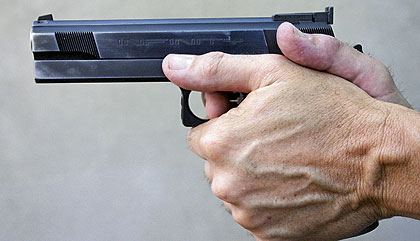
Lets start with the grip, with the strong hand grip the pistol/revolver as high as possible. With a pistol you want the beavertail/tang at the rear to be right down in the web of your hand. The wrist needs to be right behind the grip. If you were shooting it one handed the forearm, wrist and pistol would form a straight line, in a two hand hold the forearm will be canted a bit to the side but the wrist will remain directly behind the pistol. The middle finger should be right tight up to the trigger guard, you will notice that on most newer 1911's this area is relieved and on competition guns we will hawg even more material out here if we can. the fingers should wrap around squarely and be able to get a good purchase on the left side grip (if shooting right handed, reverse this if not.) The trigger finger should be free to move and will contact the trigger somewhere on the first pad, where depends on the size of the shooters hand, the size of the gun and the need to pull the trigger directly to the rear. This can be found in dryfire, find out where your finger likes to be and you can pull the trigger without disturbing the sights. The thumb can rest on the safety, or rest at the top of the frame for now, unless I am shooting single handed I will usually leave it relaxed and high off the gun until my support hand mounts on the pistol and then it will rest on the base of the support thumb.The support hand now comes onto the pistol. The index finger will be right tight up under the trigger guard (some like it on the front of the trigger but for the most part this was a phase we went through because a small number of top shooters used it but most others found it didn't help, some notables are Chip McCormick, Jerry Barnhart, and Eric Grauffel ) the fingers will wrap around and overlap on the shooting hand. My left index ends up on the back of the lower portion of my right middle finger, I have a callous here from dry firing. The large pad at the base of my thumb will mount as high as possible on the left side grip. On a 1911 it will be right under the safety, on a Glock it will be just below the slide. The fingers of the right hand will be in the pocket made by the gap between the center of my left palm and the grip and the large pad at the bottom of the hand (below the pinkie finger) will be at the base of the grip. The heel of the left hand will be butted up against the heel of the right hand. You now have completely surrounded the grip on all sides with as much contact as possible. The right wrist is directly behind the pistol and the left hand is canted downwards roughly at 45 degrees. Both thumbs will be pointing towards the target, neither should bear on the gun. They should just be relaxed and pointing forwards.
The arms should be extended as far as you can without locking them. Locking the arms out will allow recoil to travel through the arms to your shoulders, keeping the unlocked will allow the arms to absorb some of the recoil. This is important, throughout the stance anything rigid will transmit recoil to the rest of the body. Both arms push forward giving the gun something to recoil against. The shoulders should be forward slightly and down. The torso should be leaning forward, the shoulders should be in front of your hips. I find I am leaning more aggressively these days, even with the Open guns and my .22s it helps return the gun from recoil. My torso and hips will be facing pretty much directly at the target I am shooting. Any movement to turn or get to the targets is done with the legs.
The legs should be bent, these days I am more aggressive here too, my stance is wide, with the left foot forward. The heel of the left foot is even with the toe of the right, perhaps slightly more forward. My weight is on the balls of my feet, I don't usually have to try to do this, the rest of the stance should cause this. If you find your weight is on your heels, you are likely too erect and leaning back. Even slight recoil will drive you back, either knocking you off balance or at the very least causing the gun to be slow to recover. You should be leaning progressively forward against the gun.
Now this stance is adaptable, by that I mean depending on the circumstances I can make it more or less aggressive. For fast close stuff I can lean in a bit more or if I'm shooting something that requires more accuracy and less speed I can stand more erect and reduce some of the stress on the body and shoot more relaxed. Also when shooting under or around ports, barricades etc. the basic parts of the stance don't change a whole lot and when they do the effect is in degrees. Overall it still works but it will be reduced. If I'm really kinked up behind cover, I will be leaning forward more and my arms will be bent more but I won't be off balance and recoil control will still be effective, just less.
Pat

















































 .
.























