












































You are using an out of date browser. It may not display this or other websites correctly.
You should upgrade or use an alternative browser.
You should upgrade or use an alternative browser.
Vz-58 11.75" .223 Malfunctions
- Thread starter Meph
- Start date


Update on trimming the mainspring - it works! I trimmed approximately 1.5" off the first time, and it began short-stroking about 30% of the time (compared to the original 100%). I then trimmed another inch and I had 3 stovepipes in about 100 rounds. I'm going to let the gun wear-in now, instead of cutting any more coils. Note: do not enlarge the gas port, as I was told that gas pressure is used only to unlock the action, NOT to operate the bolt. This is straight from Wolfgang at Wolverine.

Looks like mine is also casualty of this issue.
Took it to the range to sight in for the first time 2 weekends ago and I had 1 stovepipe out of 30 rounds.
Used it in a 3gun match last weekend and after running about another 20-30 rounds through it, I ran into a series of consistent FTFs and stovepipes.
I guess I'll clip the spring also and give that a try.
Cheers,
Peter
Took it to the range to sight in for the first time 2 weekends ago and I had 1 stovepipe out of 30 rounds.
Used it in a 3gun match last weekend and after running about another 20-30 rounds through it, I ran into a series of consistent FTFs and stovepipes.
I guess I'll clip the spring also and give that a try.
Cheers,
Peter

Would there still be problems if hotter 5.56 ammo was used (since the gun was actually designed for it)?
Good point!
You probably won't have the same issues with 5.56.
Cheers,
Peter

Sad to say this but I dis-agree with Wolfgang a 100% on this one.Update on trimming the mainspring - it works! I trimmed approximately 1.5" off the first time, and it began short-stroking about 30% of the time (compared to the original 100%). I then trimmed another inch and I had 3 stovepipes in about 100 rounds. I'm going to let the gun wear-in now, instead of cutting any more coils. Note: do not enlarge the gas port, as I was told that gas pressure is used only to unlock the action, NOT to operate the bolt. This is straight from Wolfgang at Wolverine.
I would have rather enlarged the gas port than farted around with the springs. I see were he is coming from but all that was needed was a few thou more to be opened up and you would have the best of both worlds. As a mater of fact I have proof of not having issues with my shorty that Dlask did for me because they enlarged the gas port to make up the lack of preasure in the barrel from it's shorter length. All the trimming of the springs will do is allow the metal parts to move freely and not corect the problem that is being caused from lack of force being applied to cycle the action. When one reduces the barrel bleed off preasure all one needs to do is increase the volume to restore proper clycling preasure.
But then again what do I know???

P0WERWAGON
CGN Ultra frequent flyer
- Location
- burnaby BC كافر
if you shorten a spring, you actually make it stiffer. there is less spring to do all the work needed. ever cut the coils to lower a car?
stormwolf18
Regular
- Location
- Terrebonne
.....ever cut the coils to lower a car?
Please dont ever do that ghetto mod on your car lol
I just realized today that prior to shooting I had stripped and cleaned the rifle, and when reassembling, didn't line up the receiver cover (which houses the springs) exactly. Everything fit and looked normal, however sometimes when cocking the rifle it would kind of stick and not feel smooth, and at times not go fully forward. Noticed that the receiver cover was very slightly out of place. Fixed it today an the action is smooth and normal again..
It seems like a VERY easy mistake to make and isn't really noticeable,I'm wondering if this is causing the problem. I won't be shooting again til Wednesday so we'll see if that's the issue.
If so I'll post pictures of what I'm talking about, since it's 430am and I'm probably making no sense.
It seems like a VERY easy mistake to make and isn't really noticeable,I'm wondering if this is causing the problem. I won't be shooting again til Wednesday so we'll see if that's the issue.
If so I'll post pictures of what I'm talking about, since it's 430am and I'm probably making no sense.
I took my VZ out to the range last weekend to quantify the problem a little better.
In mine, it definitely looks like the rifle is short stroking. I am getting FTEs and double load with the fired casing in the chamber and a fresh round jammed underneath it. This happened 4 times in 40 rounds.
Just to be sure, I checked the extractor to see if it was causing the FTEs, but it looks and functions fine.
I also checked the mags because I initially thought the stock VZ mags were causing the double loads as they are tight in the magwell thus maybe not seating properly (particularly the black opaque mags), so I installed the AR magell conversion and tried it with LAR mags but with the same results.
Then I tested a theory; I worked the bolt in order to replicate the malfunction and what I can ascertain is the bolt is extracting the fired casing but not recoiling far enough to eject it, yet far enough to push up a fresh round from the mag. When the bolt closes, it reloads the spent casing causing the fresh round to jam up against it or the bottom of the chamber.
Cheers,
Peter
In mine, it definitely looks like the rifle is short stroking. I am getting FTEs and double load with the fired casing in the chamber and a fresh round jammed underneath it. This happened 4 times in 40 rounds.
Just to be sure, I checked the extractor to see if it was causing the FTEs, but it looks and functions fine.
I also checked the mags because I initially thought the stock VZ mags were causing the double loads as they are tight in the magwell thus maybe not seating properly (particularly the black opaque mags), so I installed the AR magell conversion and tried it with LAR mags but with the same results.
Then I tested a theory; I worked the bolt in order to replicate the malfunction and what I can ascertain is the bolt is extracting the fired casing but not recoiling far enough to eject it, yet far enough to push up a fresh round from the mag. When the bolt closes, it reloads the spent casing causing the fresh round to jam up against it or the bottom of the chamber.
Cheers,
Peter
Last edited:
P0WERWAGON
CGN Ultra frequent flyer
- Location
- burnaby BC كافر
short stroking. not enough gas is pushing the load. gas block straight? loose? piston full size and not broken?
The piston and gas block look fine.
I guess "short stroking" may not be the best term?
The bolt is not cycling all the way as it should which makes sense if indeed it is the main spring causing the problem as others have said in this tread?
What do you think?
Cheers,
Peter
I guess "short stroking" may not be the best term?
The bolt is not cycling all the way as it should which makes sense if indeed it is the main spring causing the problem as others have said in this tread?
What do you think?
Cheers,
Peter
I believe that the cause of this problem is one of engineering.
The present set-up might very well be appropriate for a barrel length of the NR version. What is that, 19"? Regardless, I believe the problem is that the TIME that the gas is pushing on the piston is too short.
In a short-barreled unit, the bullet leaves the barrel in a shorter length of time than in the 19" barrels. Therefore, the TIME that the piston has a force applied to it is equally short.
Beyond a certain point, the barrel's gas-port size is irrelevant. I doubt if increasing the present size would solve the problem. However, if the port size AND piston diameter could BOTH be somehow increased, that might do the trick. Somehow making the bolt+carrier less massive (easier to push back) might also solve the problem, but there should be a far easier way to solve this seemingly-simple problem than either of the above.
(Maybe this is why there are few gas-operated handguns and, let's face it, this firearm is approaching the size of a large handgun.)
The spring must hopefully either be replaced with one that is designed for a gun with the shorter barrel, or, as others have pointed out, the spring must be made "easier" for the carrier+bolt to compress all the way back. The latter is easier said than done because if the spring is shortened, its "rate" also changes to one that may be inappropriate for optimal operation. (For example, maybe the altered spring rate will not allow normal, rapid, efficient function in the opposite direction, AFTER the bolt+carrier have been pushed all the way back and ejected the shell properly. Maybe the spring won't be able to push the next round in properly/fully.)
As soon as one begins to play with any spring in any device, one enters the rarefied atmosphere of spring science and this involves multiple variables such as wire diameter, spring diameter, material alloy, stiffness, tempering, etc., etc., etc., and this is definitely not an easy thing to understand, even for spring manufacturers.
Trial and error with all the variables and experimentation with actual physical models are probably much more important to the final spring that comes out of a production facility than any theoretical analysis. This difficulty in manufacturing and selecting the proper spring may very well be why this particular firearm is having this particular problem. (Maybe the tempering oven at the production facility wasn't quite the temperature it should have been on a particular production-run of springs. Maybe the spring in this firearm has a spring that's just a bit too difficult to compress.)
If I were going to try shortening the spring, first and foremost I'd have a spare OEM spring on hand and, before doing anything, try out that new spring to see if it works better than the old one. If it doesn't, I'd try progressively shortening only one spring, observe the result, etc. If it finally functions properly, fantastic. If some other problem crops up as the spring is shortened, I'd stop, install the other OEM spring and do absolutely nothing else until the manufacturer provides the appropriate spring or springs.
The present set-up might very well be appropriate for a barrel length of the NR version. What is that, 19"? Regardless, I believe the problem is that the TIME that the gas is pushing on the piston is too short.
In a short-barreled unit, the bullet leaves the barrel in a shorter length of time than in the 19" barrels. Therefore, the TIME that the piston has a force applied to it is equally short.
Beyond a certain point, the barrel's gas-port size is irrelevant. I doubt if increasing the present size would solve the problem. However, if the port size AND piston diameter could BOTH be somehow increased, that might do the trick. Somehow making the bolt+carrier less massive (easier to push back) might also solve the problem, but there should be a far easier way to solve this seemingly-simple problem than either of the above.
(Maybe this is why there are few gas-operated handguns and, let's face it, this firearm is approaching the size of a large handgun.)
The spring must hopefully either be replaced with one that is designed for a gun with the shorter barrel, or, as others have pointed out, the spring must be made "easier" for the carrier+bolt to compress all the way back. The latter is easier said than done because if the spring is shortened, its "rate" also changes to one that may be inappropriate for optimal operation. (For example, maybe the altered spring rate will not allow normal, rapid, efficient function in the opposite direction, AFTER the bolt+carrier have been pushed all the way back and ejected the shell properly. Maybe the spring won't be able to push the next round in properly/fully.)
As soon as one begins to play with any spring in any device, one enters the rarefied atmosphere of spring science and this involves multiple variables such as wire diameter, spring diameter, material alloy, stiffness, tempering, etc., etc., etc., and this is definitely not an easy thing to understand, even for spring manufacturers.
Trial and error with all the variables and experimentation with actual physical models are probably much more important to the final spring that comes out of a production facility than any theoretical analysis. This difficulty in manufacturing and selecting the proper spring may very well be why this particular firearm is having this particular problem. (Maybe the tempering oven at the production facility wasn't quite the temperature it should have been on a particular production-run of springs. Maybe the spring in this firearm has a spring that's just a bit too difficult to compress.)
If I were going to try shortening the spring, first and foremost I'd have a spare OEM spring on hand and, before doing anything, try out that new spring to see if it works better than the old one. If it doesn't, I'd try progressively shortening only one spring, observe the result, etc. If it finally functions properly, fantastic. If some other problem crops up as the spring is shortened, I'd stop, install the other OEM spring and do absolutely nothing else until the manufacturer provides the appropriate spring or springs.

- Location
- East of Home, West of the Rest
While the differences between gas performance in a 19 inch barrel and an 11.75 barrel are probably very different, the original system runs on a 15.5 inch barrel. Less than 4 inches compared to over 8 inches of controlled gas in the barrel.
I agree though that trial and error might be the only solution. Your theory makes sense as the 19s don't seem to have the cycling issue.
I agree though that trial and error might be the only solution. Your theory makes sense as the 19s don't seem to have the cycling issue.
P0WERWAGON
CGN Ultra frequent flyer
- Location
- burnaby BC كافر
The piston and gas block look fine.
I guess "short stroking" may not be the best term?
The bolt is not cycling all the way as it should which makes sense if indeed it is the main spring causing the problem as others have said in this tread?
What do you think?
Cheers,
Peter
that is the description for short stroking. not enough gas is able to do the work required. too little supply of gas, or too much mechanical resistance.
Yes quite possiblyI just realized today that prior to shooting I had stripped and cleaned the rifle, and when reassembling, didn't line up the receiver cover (which houses the springs) exactly. Everything fit and looked normal, however sometimes when cocking the rifle it would kind of stick and not feel smooth, and at times not go fully forward. Noticed that the receiver cover was very slightly out of place. Fixed it today an the action is smooth and normal again..
It seems like a VERY easy mistake to make and isn't really noticeable,I'm wondering if this is causing the problem. I won't be shooting again til Wednesday so we'll see if that's the issue.
If so I'll post pictures of what I'm talking about, since it's 430am and I'm probably making no sense.
Please check to ensure that your ejector tab still has the hook.I took my VZ out to the range last weekend to quantify the problem a little better.
In mine, it definitely looks like the rifle is short stroking. I am getting FTEs and double load with the fired casing in the chamber and a fresh round jammed underneath it. This happened 4 times in 40 rounds.
Just to be sure, I checked the extractor to see if it was causing the FTEs, but it looks and functions fine.
I also checked the mags because I initially thought the stock VZ mags were causing the double loads as they are tight in the magwell thus maybe not seating properly (particularly the black opaque mags), so I installed the AR magell conversion and tried it with LAR mags but with the same results.
Then I tested a theory; I worked the bolt in order to replicate the malfunction and what I can ascertain is the bolt is extracting the fired casing but not recoiling far enough to eject it, yet far enough to push up a fresh round from the mag. When the bolt closes, it reloads the spent casing causing the fresh round to jam up against it or the bottom of the chamber.
Cheers,
Peter
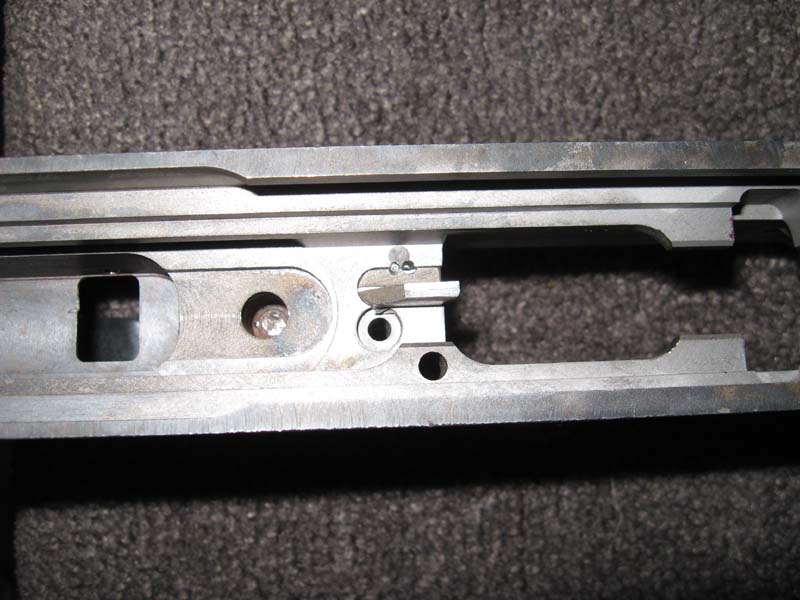

In correct please see next post of quote.I believe that the cause of this problem is one of engineering.
The present set-up might very well be appropriate for a barrel length of the NR version. What is that, 19"? Regardless, I believe the problem is that the TIME that the gas is pushing on the piston is too short.
In a short-barreled unit, the bullet leaves the barrel in a shorter length of time than in the 19" barrels. Therefore, the TIME that the piston has a force applied to it is equally short.
Beyond a certain point, the barrel's gas-port size is irrelevant. I doubt if increasing the present size would solve the problem. However, if the port size AND piston diameter could BOTH be somehow increased, that might do the trick. Somehow making the bolt+carrier less massive (easier to push back) might also solve the problem, but there should be a far easier way to solve this seemingly-simple problem than either of the above.
(Maybe this is why there are few gas-operated handguns and, let's face it, this firearm is approaching the size of a large handgun.)
The spring must hopefully either be replaced with one that is designed for a gun with the shorter barrel, or, as others have pointed out, the spring must be made "easier" for the carrier+bolt to compress all the way back. The latter is easier said than done because if the spring is shortened, its "rate" also changes to one that may be inappropriate for optimal operation. (For example, maybe the altered spring rate will not allow normal, rapid, efficient function in the opposite direction, AFTER the bolt+carrier have been pushed all the way back and ejected the shell properly. Maybe the spring won't be able to push the next round in properly/fully.)
As soon as one begins to play with any spring in any device, one enters the rarefied atmosphere of spring science and this involves multiple variables such as wire diameter, spring diameter, material alloy, stiffness, tempering, etc., etc., etc., and this is definitely not an easy thing to understand, even for spring manufacturers.
Trial and error with all the variables and experimentation with actual physical models are probably much more important to the final spring that comes out of a production facility than any theoretical analysis. This difficulty in manufacturing and selecting the proper spring may very well be why this particular firearm is having this particular problem. (Maybe the tempering oven at the production facility wasn't quite the temperature it should have been on a particular production-run of springs. Maybe the spring in this firearm has a spring that's just a bit too difficult to compress.)
If I were going to try shortening the spring, first and foremost I'd have a spare OEM spring on hand and, before doing anything, try out that new spring to see if it works better than the old one. If it doesn't, I'd try progressively shortening only one spring, observe the result, etc. If it finally functions properly, fantastic. If some other problem crops up as the spring is shortened, I'd stop, install the other OEM spring and do absolutely nothing else until the manufacturer provides the appropriate spring or springs.
Yes you are right. Althought the pressure bleeds of too quickley.While the differences between gas performance in a 19 inch barrel and an 11.75 barrel are probably very different, the original system runs on a 15.5 inch barrel. Less than 4 inches compared to over 8 inches of controlled gas in the barrel.
I agree though that trial and error might be the only solution. Your theory makes sense as the 19s don't seem to have the cycling issue.
that is the description for short stroking. not enough gas is able to do the work required. too little supply of gas, or too much mechanical resistance.
Thanks for the clarification, Powerwagon. This is the first malfunctioning firearm that I've owned so my firearm malfunction terminology is a bit lacking.
Satain,
Thanks for the tip. I will check the ejector tab, but I don't think it is the problem.
Cheers,
Peter
- Location
- East of Home, West of the Rest
I've had a few stoppages in one of my Vz 58s. I went to the range with MFS 55gr, 60gr TAP and 75gr TAP, and one of my rifles had multiple malfunctions that included failure to fire, failure to feed, failure to lock into battery and stovepipe/failure to eject.
Took mine to the range yesterday and got 45 rounds through it (was shooting other stuff as well so had to make sure the other guns weren't feeling left out). I was also getting stoppages, but only stovepipe/fail to eject. It happened four or five times, and each time the next round did get chambered. It would appear the the bolt was cyclying back far enough to pick up the other round, but not with enough force to kick the spent shell casing free. This was causing the shell casing to ride forward with the new round and bolt, getting caught in the breach.
Was shooting American Eagle 55 grain FMJ with a Dlask AKM Style Muzzle Brake.
Last edited:






















