
Now check your Max OAL, seat 3 rounds on the lands, seat 3 back .040, 3 more at .080 and 3 more @ .120 off the lands. 1 of these groups will shoot better then the rest, from there move the seating by .010 up and down to fine tune it. Then try the same loads with 3 or 4 different primers 1 of these will shoot better the others. Then load up 100 cases and have fun.













































You are using an out of date browser. It may not display this or other websites correctly.
You should upgrade or use an alternative browser.
You should upgrade or use an alternative browser.
first try at load development (more pics again)
- Thread starter aheppner
- Start date

neck sizing only then seating depth makes the most difference for me usually
I usually ( didnt with barnes tsx) do my loads starting at touching or tighter as that will cause the max pressure signs and give me my MAX load
that way I dont have to worry about pressure signs if I try them off the lands , If you do it the other way with a max load you have to possibly redo your powder loads again
I usually ( didnt with barnes tsx) do my loads starting at touching or tighter as that will cause the max pressure signs and give me my MAX load
that way I dont have to worry about pressure signs if I try them off the lands , If you do it the other way with a max load you have to possibly redo your powder loads again
SMK's are very jump tolerant. As long as each batch is the same they should group. POI may be slightly different. Start mixing in .010", .020", .030" etc off the lands the groups will open up because POI could be different.

i have been full length sizing my brass every time i reload with rcbs dies, would i benefit from neck sizing only (brass life) or should i be using more expensive "better quality" full length dies>
Yes. The only "expensive" die I have is a Forster micrometer seating die; it allows for precise seating depth and reduces runout to almost nothing. For re-sizing, your RCBS die is fine. I use RCBS for this as well.
shotgunjoe
CGN Regular
- Location
- winnipeg mb
Neck sizing does two things, propongs brass life and leaves the brass sized to your chamber, this helps cut down on case misalignment in the chamber.
There is a lot of debate about which neck dies are the best with a lot of people hyping the bushing type sold by redding and forster, if you have a custom chamber I can see these being the way to go but myself I like the Lee collet dies.
By the way, nice shooting.
There is a lot of debate about which neck dies are the best with a lot of people hyping the bushing type sold by redding and forster, if you have a custom chamber I can see these being the way to go but myself I like the Lee collet dies.
By the way, nice shooting.
i think i will get a neck only sizer, sounds like the way to go, ill have to go shoot the 100 rounds i just loaded first tho
i need the trigger time anyway, im gonna shoot 300 yard groups this time and see how that goes
thanks for the good advice
i cleaned the casings this time with corn media, worked well nice bright cases now.
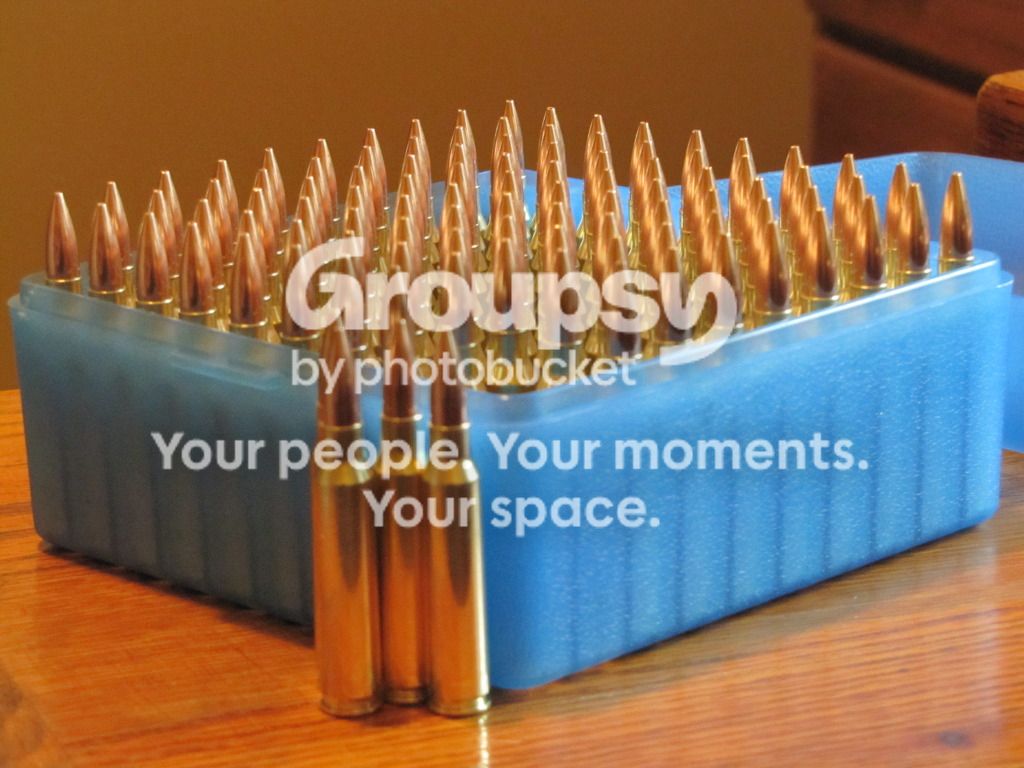
i need the trigger time anyway, im gonna shoot 300 yard groups this time and see how that goes
thanks for the good advice
i cleaned the casings this time with corn media, worked well nice bright cases now.
Perosnally, I don't think the group size has anything to do with your loads.
Don't get me wrong, your groups show other variations caused by other issues than your load development indicates.
Ganderite had a good suggestion about adding an extra half grain. The problem with small cases, is that depending on powder used, pressures escalate rapidly, even with small increases of any of the components.
I notice your scope doesn't have an AO adjustment. The ideal paralax adjustment may not be at the distance you are shooting.
From some of your groups, it looks like inconsistent shoulder/cheek weld placement or slight canting of the rifle are involved as well. Those high mounts don't help but are needed with that scope.
Are your crosshairs and target both sharply in focus at the same time????
How consistent is your trigger pull? Both your own finger and the trigger on the rifle.
Now for the biggie, how often are you cleaning out the jacket fouling?
There is the very odd exception but in most rifles, anything over 25 rounds will start to show spreading groups. Some will start to indicate fouling problems at far less. Even the best barrels will have this tendencey. I have one rifle that seems to be impervious to fouling. ONE, out of dozens. Maybe you have a lottery winner as well???
Neck resizing only is a very good idea but if your chamber is already large in the neck area it might not help. If this is the case, partial neck sizing might be a good idea.
Also, have you checked your loads for run out?
Another thing that may help, is to seat your bullets very close to the leade. Say .005 inch.
Many bench rest shooters, seat the bullets so that they are touching the leade.
Here is one more thing to consider. If the rifle was new off the shelf, it will need a break in period. The better groupings that you are getting as you go along, may be due to your barrel settling down and some of the rough spots smoothing out.
The dispersion shown on your targets, can mostly be accounted for by shooter error. Not much error there either. You need an experienced mentor to watch your technique.
That rifle behaves very well. That shows by how it groups all of the loads very close to center of target. If your technique, were more refined and consistant, your groups would all be tighter and each load would show slightly higher groups, if you use the same scope settings, with each increase in powder charge. Maybe, even some windage dispersion.
From what I can see there, that rifle is capable of sub 3/8in groups on a regular basis. If it has the 1-8 twist rate, it may even prefer heavier/longer bullets than you are using to stabilize them properly at 100meters.
As you saw from your 55 grain attempt, the twist rate is probably to fast for the bullet.
A real master of 223 shooting, is David Tubb. He uses a bolt action AR look alike system and loves to shoot off hand.
I witnessed him shooting a match and he shoots better offhand than most fellows do from the bench. He is abosolutely meticulous about his rifles and ammunition. He even figures out how much his leades will wear after a specific number of fired rounds and loads accordingly.
He told me that 90% of the shooters he competes against, not me, don't have consistent trigger habits and don't take their breathing into account. He wouldn't admit it but I suspect he even monitors his heartbeats.
DT, seems to have unlimited money to spend on his rifles/optics/ammo components.
He gets his components in huge batches, all from the same lot as well. Same goes for powder, cases, primers and bullets. He will test them out on a test rifle he has bolted to a bench, with a particular batch of barrels. If they don't perform quickly, the barrel is changed out and tested again. If it doesn't work the second time, at least to his standards, he won't bother to play around with components. He expects them to perform as advertized. If they don't, back to the supplier they go.
Every component supplier in the US, maybe even the world, would love to have David Tubb using their product. It's an endorsement made of gold.
One more quick bit to look for, although you are shooting very well, is light condition. Bright sunlight, reflecting off the ground, will cause elevation dispersion, as will mirage. At 100 yds, wind shouldn't be much of a problem but it can be if it's fast enough.
One thing about wind, it's the wind in the first 50-100 yards that puts most effect on your bullet out at longer ranges. Mostly. When shooting extreme distances, heavy winds are possible at any distance.
This can go on forever.
Nice rifle, nice shooting. You're very close to shooting to what the rifle/ammo is capable of.
Don't get me wrong, your groups show other variations caused by other issues than your load development indicates.
Ganderite had a good suggestion about adding an extra half grain. The problem with small cases, is that depending on powder used, pressures escalate rapidly, even with small increases of any of the components.
I notice your scope doesn't have an AO adjustment. The ideal paralax adjustment may not be at the distance you are shooting.
From some of your groups, it looks like inconsistent shoulder/cheek weld placement or slight canting of the rifle are involved as well. Those high mounts don't help but are needed with that scope.
Are your crosshairs and target both sharply in focus at the same time????
How consistent is your trigger pull? Both your own finger and the trigger on the rifle.
Now for the biggie, how often are you cleaning out the jacket fouling?
There is the very odd exception but in most rifles, anything over 25 rounds will start to show spreading groups. Some will start to indicate fouling problems at far less. Even the best barrels will have this tendencey. I have one rifle that seems to be impervious to fouling. ONE, out of dozens. Maybe you have a lottery winner as well???
Neck resizing only is a very good idea but if your chamber is already large in the neck area it might not help. If this is the case, partial neck sizing might be a good idea.
Also, have you checked your loads for run out?
Another thing that may help, is to seat your bullets very close to the leade. Say .005 inch.
Many bench rest shooters, seat the bullets so that they are touching the leade.
Here is one more thing to consider. If the rifle was new off the shelf, it will need a break in period. The better groupings that you are getting as you go along, may be due to your barrel settling down and some of the rough spots smoothing out.
The dispersion shown on your targets, can mostly be accounted for by shooter error. Not much error there either. You need an experienced mentor to watch your technique.
That rifle behaves very well. That shows by how it groups all of the loads very close to center of target. If your technique, were more refined and consistant, your groups would all be tighter and each load would show slightly higher groups, if you use the same scope settings, with each increase in powder charge. Maybe, even some windage dispersion.
From what I can see there, that rifle is capable of sub 3/8in groups on a regular basis. If it has the 1-8 twist rate, it may even prefer heavier/longer bullets than you are using to stabilize them properly at 100meters.
As you saw from your 55 grain attempt, the twist rate is probably to fast for the bullet.
A real master of 223 shooting, is David Tubb. He uses a bolt action AR look alike system and loves to shoot off hand.
I witnessed him shooting a match and he shoots better offhand than most fellows do from the bench. He is abosolutely meticulous about his rifles and ammunition. He even figures out how much his leades will wear after a specific number of fired rounds and loads accordingly.
He told me that 90% of the shooters he competes against, not me, don't have consistent trigger habits and don't take their breathing into account. He wouldn't admit it but I suspect he even monitors his heartbeats.
DT, seems to have unlimited money to spend on his rifles/optics/ammo components.
He gets his components in huge batches, all from the same lot as well. Same goes for powder, cases, primers and bullets. He will test them out on a test rifle he has bolted to a bench, with a particular batch of barrels. If they don't perform quickly, the barrel is changed out and tested again. If it doesn't work the second time, at least to his standards, he won't bother to play around with components. He expects them to perform as advertized. If they don't, back to the supplier they go.
Every component supplier in the US, maybe even the world, would love to have David Tubb using their product. It's an endorsement made of gold.
One more quick bit to look for, although you are shooting very well, is light condition. Bright sunlight, reflecting off the ground, will cause elevation dispersion, as will mirage. At 100 yds, wind shouldn't be much of a problem but it can be if it's fast enough.
One thing about wind, it's the wind in the first 50-100 yards that puts most effect on your bullet out at longer ranges. Mostly. When shooting extreme distances, heavy winds are possible at any distance.
This can go on forever.
Nice rifle, nice shooting. You're very close to shooting to what the rifle/ammo is capable of.
Perosnally, I don't think the group size has anything to do with your loads.
Don't get me wrong, your groups show other variations caused by other issues than your load development indicates.
Ganderite had a good suggestion about adding an extra half grain. The problem with small cases, is that depending on powder used, pressures escalate rapidly, even with small increases of any of the components.
I notice your scope doesn't have an AO adjustment. The ideal paralax adjustment may not be at the distance you are shooting.
From some of your groups, it looks like inconsistent shoulder/cheek weld placement or slight canting of the rifle are involved as well. Those high mounts don't help but are needed with that scope.
Are your crosshairs and target both sharply in focus at the same time????
How consistent is your trigger pull? Both your own finger and the trigger on the rifle.
Now for the biggie, how often are you cleaning out the jacket fouling?
There is the very odd exception but in most rifles, anything over 25 rounds will start to show spreading groups. Some will start to indicate fouling problems at far less. Even the best barrels will have this tendencey. I have one rifle that seems to be impervious to fouling. ONE, out of dozens. Maybe you have a lottery winner as well???
Neck resizing only is a very good idea but if your chamber is already large in the neck area it might not help. If this is the case, partial neck sizing might be a good idea.
Also, have you checked your loads for run out?
Another thing that may help, is to seat your bullets very close to the leade. Say .005 inch.
Many bench rest shooters, seat the bullets so that they are touching the leade.
Here is one more thing to consider. If the rifle was new off the shelf, it will need a break in period. The better groupings that you are getting as you go along, may be due to your barrel settling down and some of the rough spots smoothing out.
The dispersion shown on your targets, can mostly be accounted for by shooter error. Not much error there either. You need an experienced mentor to watch your technique.
That rifle behaves very well. That shows by how it groups all of the loads very close to center of target. If your technique, were more refined and consistant, your groups would all be tighter and each load would show slightly higher groups, if you use the same scope settings, with each increase in powder charge. Maybe, even some windage dispersion.
From what I can see there, that rifle is capable of sub 3/8in groups on a regular basis. If it has the 1-8 twist rate, it may even prefer heavier/longer bullets than you are using to stabilize them properly at 100meters.
As you saw from your 55 grain attempt, the twist rate is probably to fast for the bullet.
A real master of 223 shooting, is David Tubb. He uses a bolt action AR look alike system and loves to shoot off hand.
I witnessed him shooting a match and he shoots better offhand than most fellows do from the bench. He is abosolutely meticulous about his rifles and ammunition. He even figures out how much his leades will wear after a specific number of fired rounds and loads accordingly.
He told me that 90% of the shooters he competes against, not me, don't have consistent trigger habits and don't take their breathing into account. He wouldn't admit it but I suspect he even monitors his heartbeats.
DT, seems to have unlimited money to spend on his rifles/optics/ammo components.
He gets his components in huge batches, all from the same lot as well. Same goes for powder, cases, primers and bullets. He will test them out on a test rifle he has bolted to a bench, with a particular batch of barrels. If they don't perform quickly, the barrel is changed out and tested again. If it doesn't work the second time, at least to his standards, he won't bother to play around with components. He expects them to perform as advertized. If they don't, back to the supplier they go.
Every component supplier in the US, maybe even the world, would love to have David Tubb using their product. It's an endorsement made of gold.
One more quick bit to look for, although you are shooting very well, is light condition. Bright sunlight, reflecting off the ground, will cause elevation dispersion, as will mirage. At 100 yds, wind shouldn't be much of a problem but it can be if it's fast enough.
One thing about wind, it's the wind in the first 50-100 yards that puts most effect on your bullet out at longer ranges. Mostly. When shooting extreme distances, heavy winds are possible at any distance.
This can go on forever.
Nice rifle, nice shooting. You're very close to shooting to what the rifle/ammo is capable of.
thanks for the interest, im not sure where to start with a response
my rifle is a 1 in7 twist, im going to try some 80 gr a-max next
my scope does have a parallax adjustment,
the savage target triggers seem pretty consistent i have it set to 1.5lbs right now but i might lower it to 6 oz soon ,
i know some of my flyers are just pilot error but that's why stop changing my load for now to just concentrate on my shooting technique,
yes ,my cross hairs are in focus and the target, but at 300m there was quite a bit of mirage on 30 power so i shot at 20 instead, it was a hot sunny day
from what iv been told about the wind, its not the first 100 m that effects it the most its the last 100m because the bullet is going slower (bullet spends more time in the air downrange) and the BC changes at slower speeds
i have cleaned my rifle once since i got it, iv put 119 rounds through it, i cant see the fouling changing my groups that much at this point
as far as run out is concerned, i don't have a dial indicator to check my run out but like one of the other guys suggested i get a Forster seating die, ill probably try that
i think i covered most of that






















