Tumbling Cast Bullets

sobo4303

CGN frequent flyer
Rating - 100%
37   0   0
Further to my previous thread, I an working up a load for my Marlin 30-30 (Microgrove) with 165 cast (no GC) and Unique.

At 100 yards...pretty good, reasonably tight. At 300 yards, the bullet is tumbling like crazy. No pressure signs and not leading.

I noted tumbling at 9.7 gr of Unique. Was pretty good at 100 yards, but at 300...wow...it is nuts and all over the place.

The rifle is new and new barrel. The factory stuff is very accurate at 100 yds.

I slugged the barrel and the bore is 0.309", which is the same OD as my bullets. I'm thinking I may be sending them out too fast, but without a chrony, it's hard to tell.

Any ideas?
 
Last edited:
id hesitate to guess that your sending them out to slow and past 100 they are starting to de-stablize and tumble, from my experiance if your pushing a bullet to fast the either explode befor reaching the target , or will keyhole at any distance.

if your not leading and have no pressure signs i would try bumping the charge up in small incriments and see if the bullets will stay stable out at distance
 
Where to start................

Your load is what is called a "plinking" load, unique is often used to for that, good for beer cans at 100 yards. I also agree if anything you are sending them out to slow, but you cant get them going to fast with Unique anyways. Its time to bite the bullet and get your hands on a powder that will get you above 2000 feet per second in velocity if you dislike the tumbling. I really really doubt you you are getting more then 1600 fps with that load.

At 300 yards you are really pushing the capabilities of a 30-30 in a lever gun with flat or blunt tipped bullets anyways, especially with a round loaded with Unique which is less then ideal.

Gas checks, your going to want to use them if you push your bullet faster, I dont know if you have a lubesizer or you are just tumble lubing them. Another option if you want velocity but no gas check is to paper patch your bullets.

There is no harm in your bullet being 0.001 bigger then your bore, in fact it probably does more good.
 
The Marlin line of rifles with the Microgroove bores need a few extra tricks in some cases to shoot well with cast lead bullets,they are a little more intolerant of undersized bullets. The lands and grooves are both very shallow and don't grip/engrave the bullets as well. Jacketed bullets are not a problem and don't have the same accuracy issues as cast lead.

You generally want you cast lead bullets to be between .001 and .02 over groove dia. of your bore thats especially important with the microgroove rifles so the bullet fills the grooves fully and give the bullet a better grip on the shallow rifling an stabilizes it much better. A .310 to .311 cast bullet in a Marlin Microgroove 30-30 rifle is not uncommon.

You also want your bullets to be on the hard side of the BHN scale hard cast lead is a good thing with cast lead bullet if your not going to gas check them. A gas check being harder than lead is also very helpful it adding grip to the bullet when used with the microgroove bores as well as allowing you to push the bullet at or near factory MV if desired.

You should be at around 1400 fps.or slightly less at the muzzle by my calculations with your current load of 9.5 grs. Unique I think your issue is more of a bullet stabilizing issue. I usually keep my low end plinker and small game loads 8.0 grs. Red Dot and Lee .310 170 gr. RNFP TL with gas check left off at 100 yds. or less.

Good article on Microgroove bores and cast bullets.
http://www.lasc.us/FryxellMarlin-MicroGroove.htm
 
Further to my previous thread, I an working up a load for my Marlin 30-30 (Microgrove) with 165 cast (no GC) and Unique.

At 100 yards...pretty good, reasonably tight. At 300 yards, the bullet is tumbling like crazy. No pressure signs and not leading.

I noted tumbling at 9.7 gr of Unique. Was pretty good at 100 yards, but at 300...wow...it is nuts and all over the place.

The rifle is new and new barrel. The factory stuff is very accurate at 100 yds.

I slugged the barrel and the bore is 0.309", which is the same OD as my bullets. I'm thinking I may be sending them out too fast, but without a chrony, it's hard to tell.

Any ideas?

Yes. Bullet travelling much too slow.

The old original Lyman book on cast bullets, shows a 165 grain cast in 30-30 with Unique, as 10 grains being minimum, with a velocity of only 1340 fps.
They show 15 grains as maximum, at a velocity of 1780.
 
Wow...thank H. I have the new Lyman and they don't have the 165, but show the 170 as 10.6 max. With the 150 gr...8.7 is the max.

I'll try some work ups.

Maybe even try a different powder. Thanks guys.
 
Wow...thank H. I have the new Lyman and they don't have the 165, but show the 170 as 10.6 max. With the 150 gr...8.7 is the max.

I'll try some work ups.

Maybe even try a different powder. Thanks guys.

Here is a copy of part of the 30-30 information, from the original Lyman cast loading book.
You by all means, should have a gas check bullet of about 170 grains, to get higher velocities from the cast bullets.
July2012001.jpg
 
The bullets I am using purchased. I am not set up for my own. They have a hardness of 25m no gas checks.

The Lyman #4 manual shows with 10.6 gr of Unique, the C.U.P. pressure to be 36,000 with a 170 fr bullet.

I know that C.U.P, is not the same as PSI, but using loads above 10.6 would I start to exceed the allowable pressures of the Marlin 336? H4831 or anybody else...have you pushed out cast loads at those rates with Unique?

Or do I need to lower expectations and stay within the new guide pressures and be happy with 100 yards for the cast loads? I want to try those higher Unique loads, but the logical side of me is a bit reluctant.
 
Shooters have been using the loading data in that old, original Lyman cast book, for well over a half century. I don't think even one rifle has ever been damaged by over pressure, from following the information in that book.
Is there something different about your Marlin?
When I used cast bullets in a 30-30 Winchester Model 94, I used the 311291 bullet, but loaded it to full 30-30 velocity of jacketed bullets. I think it was 3031 I was using, but several other common pwders, such as 4198, 4895, or 4320, will also achieve the full velocity that 30-30 jacketed bullets have.
You will note in the figures I sent you, 15 grains of Unique, with 165 gr bullet, only gave a velocity of 1780. This is getting to top velocity for a flat base bullet, such as yours.
In short, Unique is too fast a powder to get full velocity figures in a 30-30.
 
You will note in the figures I sent you, 15 grains of Unique, with 165 gr bullet, only gave a velocity of 1780. This is getting to top velocity for a flat base bullet, such as yours.
In short, Unique is too fast a powder to get full velocity figures in a 30-30.

That's exactly what I was thinking too. It worked great for the closer ranges. The rifle is a new Marlin, so it has the infamous micro-grooving. With those jacketed bullets (particularly the 125 grainers) that thing is scarey accurate.

I kinda figured that manual you had has lasted the test of time and I am going to work up some loads based on the manual. I am also going to try a couple of slower burning powders to compare. I will take my camera to the range and post the results when they get good.

Thank you for your insights and the data from your manual.
 
I bumped up the powder load of powder Unique - 11, 13, 14 gr each and Rl-7 at 19 and 20 gr (1,500 fps and 1,600 fps).

The groupings got worst - in fact huge at 100 yards. I had the target board covered in white paper and the spread at 1,500 fps was insane at about 56" (could only find two of the four shots).

I loaded up some Hornady 100 gr bullets and shot them at 300 yards for giggles (2,700 fps). Had nice big white target board to shoot at and with open sights was a respectable 7.5"

While there, I found one of the bullets I was lobbing at the 9.7 gr the previous day. Must have skipped in the soft grass.

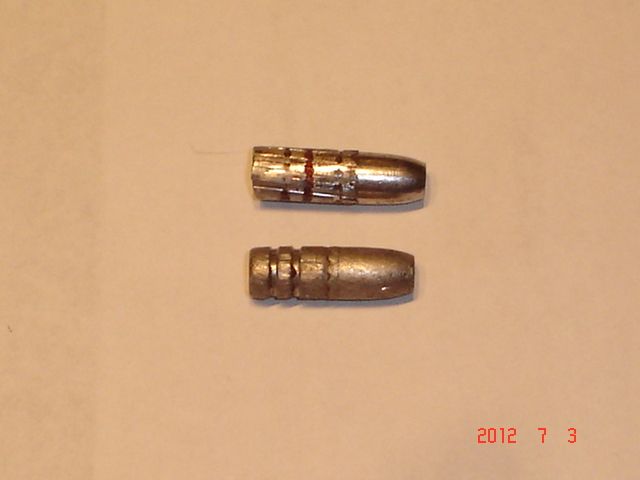
The picture below shows the bullet I slugged through the barrel and the bottom one is the one I found. Strikingly absent are the microgrooves. This thing was going too fast through the barrel, not enough OD on the lead (0.309") and did not catch much rifling.

Bullet.jpg


I may as well have been lobbing a musket ball. I am going to try the same load (10 gr Unique on my .308) which is about the same velocity at about 1,300 or so.
 
Sizing your bullets .001-.002" larger may help. "IF" the as cast diameter is equal to or greater than .311".

If you bump up Your velocities when you have a poor fit, accuracy suffers big time!
A gas check will allow you to reach higher pressures/velocity only if your cast bullet to bore fit is sufficient.

There are MANY ways to boost your performance with cast bullets. Micro groove rifling "limits", but not eliminates your options.

A harder alloy may help, but you need to be sure to apply enough bullet lube, and pressure to obturate the bullet base during the initial acceleration process.

If you cast a harder alloy, test the same powders/charges that worked for the softer lead and work up untill you see an accuracy failure again. Chances are that you will
Get a small Amount of velocity increase before the bullet/powder combo fails again.

One thing I have done in the past is choose a slower burn rate powder. This may help the bullet get a "softer" start. Of course this is all moot if you cant size the bullet .001-.002" larger than bore dia.

With micro groove rifling I would suggest .002" larger than bore dia.

Good luck with your loading! It is allot of fun!
 
Last edited:

Oops, looks like you have loaded your flat base bullet too hot!
I would say the gas blew right by it, even altering the shape of it.
When cast bullets pattern, instead of shooting a descent group, it is almost always a sign of too much pressure.
I once did quite a bit of experimenting with cast bullets in a bolt action 30-06. I was trying to see how heavy I could get them loaded and still have fair, like hunting, accuracy.
I had a mold for gas check bullet and I used pure linotype metal for pouring. They were all gas checked, some were sized, some were shot as cast, considerabelly larger than bore.
I would keep increasing the powder until I got bad flyers, then reduce. This was in the winter time at a range with a lot of snow and I was the only one at the range shooting cast bullets. In the spring, after the snow had melted, I could pick up many of my shot bullets, in perfect condition.
Quite the odd bullet, obviously the ones that were the flyers, had a groove cut the entire length of the bullet, on the side of the bullet. The groove was nearly the size of the wood on a kitchen match.
It was easy to see that the powder charge had blown this rut out of the bullet, even though they were linotype bullets with a copper gas check!
I did not have a chronograph, so don't know how fast they were going.
 
The load was the low range prescribed by the manual and some of the internet chatter. The hotter stuff I loaded yesterday was a waste of breath. No leading, just a waste.

The loads I used for the bullet shown was the same I used in the Henry rifle (the bad headspace one) which would hit the gongs without an issue.

Now that I look deeper into the matter, most folks seem to agree that the OD of the cast bullet should be in the .311" diameter, not .309 like mine. I'm thinking that I am going to have to buy a rifle with nice thick rifling grooves (just like my Marlin 1894C) which tosses out the little 158 grainers at 1,200 without an issue.

I gotta say though, that micro-groove can sure toss out those jacketed bullets.

I have some Hornady 100 grainers and wow...is that thing ever accurate at 300 yards!
 
The load was the low range prescribed by the manual and some of the internet chatter. The hotter stuff I loaded yesterday was a waste of breath. No leading, just a waste.

The loads I used for the bullet shown was the same I used in the Henry rifle (the bad headspace one) which would hit the gongs without an issue.

Now that I look deeper into the matter, most folks seem to agree that the OD of the cast bullet should be in the .311" diameter, not .309 like mine. I'm thinking that I am going to have to buy a rifle with nice thick rifling grooves (just like my Marlin 1894C) which tosses out the little 158 grainers at 1,200 without an issue.

I gotta say though, that micro-groove can sure toss out those jacketed bullets.

I have some Hornady 100 grainers and wow...is that thing ever accurate at 300 yards!

Both my Marlin micro groove rifles, 1894 44mag and 1895 45/70, prefer cast 0.002 over bore diameter. I know they aren't the same as yours but I am going about 1400fps with no gas checks and ALOX lubed with no major leading after about 2-300rds.
 
Back
Top Bottom