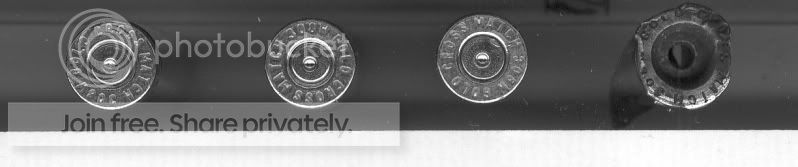
Reading pressure from the primer can be tricky. This pic shows what can be expected with equal increments in powder weights when one moves from safe to dangerously excessive pressure and reflects successive single grain increments in a .308.
If you are working up loads in very bright light conditions, you might miss subtle warning signs. Its wise to consider more than just the primer flattening or watch for extractor marks on the case head; the web diameter should be checked before and after each shot, with a .001" increase in the web diameter of previously fired brass a warning to stop. The pressure signs associated with the round on the extreme right was less than subtle.
Seating depth can effect pressure, seated deep you reduce powder capacity, which increases pressure particularly with compressed loads, but seating long enough to jam the bullet into the lands also increases pressure. A critical measurement is the case length; if the case is long enough to extend into the lead, pressure can spike dramatically so stay within the recommended "trim to" case length.
Don't make assumptions that can get you into trouble. The pressure spike which occurred in the above picture, was from a charge of VV N550. Everything I read about this powder suggested that I could expect fantastic velocity increases over powders of a similar burning rate. So my head wasn't in the right place when I began working up those loads. There's no free lunch in this business, and frankly I knew better. The top load I now use with N550 gives me the same velocity as W-760 does, and that's not bad.
Compressed loads can be another trap. Normal increments can result dangerous pressures once you've reached the point that your load is compressed. You can even observe pressure spikes from the normal variances in the tolerances of case capacity and bullet weight, so compressed loads don't provide much of margin of error compared to a load that uses less than 100% loading density.
If you don't use a chronograph when working up loads, get one. If your velocity exceeds the book velocity, it might be a warning that you're in dangerous territory, regardless of what the powder charge is. In some cases, a velocity plateau might occur. This is where you after observing a steady 40 fps increase per powder increment for example, the last increment results in only a 15-20 fps increase. If you observe a velocity plateau, don't disregard it, but don't consider the lack of a velocity plateau a sure sign that its safe to continue. Observe any and all warnings of high pressure.

















































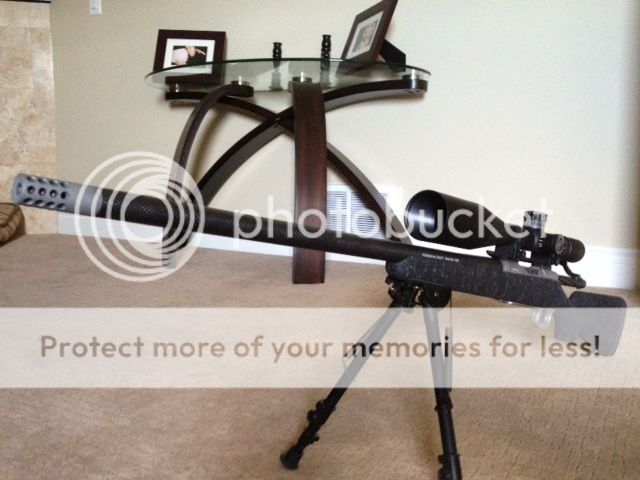


 I have seen a lot of the newer manu. rifles do that, i have the same opinion as the other guys. Firing pin is to small for the hole. Kind of like my, oh better not go there.