












































Justin Black
Member
- Location
- Grande Prairie, Alberta
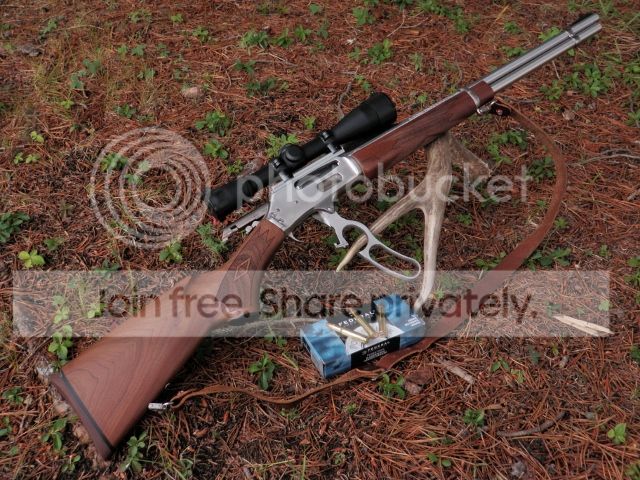
There has been quite a few posts dealing with Marlins as of late, and many of them have little if anything good to say about the rifles in general. The vast majority of the quality issues have been attributed to the purchase of Marlin Firearms by Remington. These issues include poor fit/finish, sharp edges, jamming, failures to extract spent casings, coarse actions, and inferior accuracy (compared to pre-Remington rifles). In light of this I decided to perform a basic/no frills comparison between a pre-Remington model 336SS and my current Remlin model 336SS.
A Short History
When I turned 18 (eight years ago) and received my PAL, the very first rifle I purchased was a Marlin model 336SS in .30-30 for $800 (ish) dollars. This was before the sale of Marlin to Remington. I used that rifle exclusively for the next four years (iron sights), took around eight deer with it, and it performed flawlessly without exception. I sold that rifle when I was 23 for reasons I can neither remember nor understand. Needless to say it was a decision I have regretted ever since.
After starting a new (and higher paying) job last September, I found myself with some surplus funds. I decided to use this new found bounty to rectify my earlier mistake, and quickly purchased myself another model 336SS in .30-30 for about $600 (ish) dollars. I didn’t hunt much with the rifle that season, as I didn’t feel as familiar with it as I would have liked. I also decided to forgo the iron sights and mounted a Weaver 6x38 scope on the rifle.
Now I hadn’t been keeping up with the gun gossip for the past few years, so you can imagine my surprise when I learned that my rifle was an accursed Remlin! After reading all the negative posts about the current crop of Marlins, I began to fear that the old friend I thought I had purchased might be a scoundrel in disguise.
The Test
The rifle had only fired 60 rounds by that point, and while I hadn’t experienced and issues yet, I wondered if that would be the case in the years to come. So instead of waiting to see if the rifle was a lemon, I decided to try and make it act up. With that goal in mind I purchased what would usually be several years’ worth of ammo for me (240 rounds), and fired them all off in a span of 3 months. I figured if the rifle didn’t malfunction after 300 rounds, I could reasonably assume that it would perform as advertised for the remainder of our union. For the test I shot the standard 150 grain loads from Remington, Winchester, and Federal, with the Federal accounting for the majority of shots fired, including the last 10 used in the accuracy test. I did not use any of the newer Lever Evolution rounds during my test (too damn expensive), but I wonder if the rifle might not have been able to group better with these rounds compared to the usual round nosed bullets.
Except for the final 10 rounds fired, I didn’t shoot with pure accuracy in mind. Instead I shot the rifle from all positions (prone, kneeling, offhand, etc.), at targets from 200 yards down to 50. Most firing sequences were 6 shots with some cooling allowed between reloading. Other times I simply fired as many rounds as I could in a short a time as I could, with the highest number of consecutive shots without break being 36 (6 reloads). For the final 10 rounds I decided to test the relative accuracy of the rifle. To do this I fired 3 groups of 3 at a distance of eighty yards (first shot fired as a fouler), with 2 minute cooling breaks as the minimum between shots. All shots were taken from a prone position, with the rifle resting on a sleeping pad and pillow. I waited to do this until the winds were a constant 5 kmph or less (according to the anemometer).
The Results
As a one-time owner of a pre-Remington 336SS and current owner of a Remlin 336SS, I feel as though I am somewhat qualified to compare the aesthetic differences between the two rifles. Though it has been 3 years since I sold the first rifle, I spent a great deal of time handling, shooting, cleaning and otherwise admiring it, and that sort of familiarity does not fade quickly with time.
Firstly I will comment on fit and finish. In this regard the pre-Remington Marlin was definitely the better. My current Remlin does have gaps (not overly large but there none the less) where wood meets metal, and these were not apparent with my original 336SS.
As far as wood finish goes, there is no appreciable difference between the two, and I am happy to note that the checkering is as crisp and sharp as was found on the original 336SS. The steel however came with several scuffs and tiny rust patches. This may have been the result of poor storage and handling by the distributor, but in any case this was not found on the original 336SS. The Remlin also had sharper (and sometimes slightly jagged) edges compared to the original 336SS.
The actions of both rifles were a bit stiff out of the box, but both loosened up after a bit of use. Neither rifle jammed or failed to extract a case, but both would occasionally have difficulties loading if “babied”. A firmer cycle of the lever eliminated this in both cases.
Now as far as accuracy goes, my original 336SS was never taken to a shooting range, and I never once tried to find out how tight it would group. Back then I would usually practice by shooting at a paper plate from any and all positions, and as long as the bullets hit the plate I was a happy man. Due to this I can’t make a fair accuracy comparison between the two rifles.
Yet as one can see from the photos below, the Remlin ain’t no slouch when it comes to punching paper. While the groups might not seem that impressive to some, we still must factor in shooter error and shooting conditions.
First of all I am no marksman. My yearly average for shots fired goes somewhere between 40 to 60 rounds a year. Usually I’ll buy two to three boxes of ammunition right after hunting season, use one or two boxes for practice/varmints, and save the last one for deer season. Secondly the conditions in which this test was performed could at best be described as rudimentary. While the rest I used was firm and stable, it was by no means rock solid. I have no doubt that a skilled shooter in more controlled conditions would have been able to wring out tighter groups.
Group #1

Group #2

Group #3

Overall Results

Summary
Now for the record, I did not undertake this comparison to try and prove wrong any individual who has been dissatisfied with their Remlin. I only did this to ease my own concerns about my rifle, and to let those people who are considering purchasing a Remlin know, that the newer crop of rifles are not all bad. I can’t make any guarantees that my experience will be the same as theirs, but I for one do not regret my purchase. Thank you for reading.
























