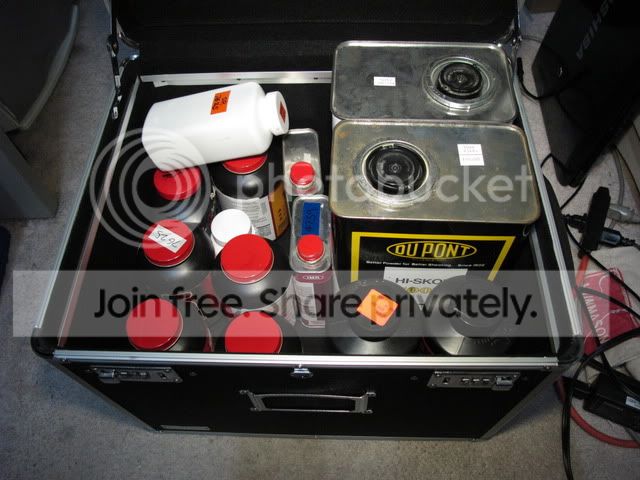
Primer/powder storage box

I use one of these things.

http:// www.staples.ca/ENG/Catalog/cat_sku.asp?CatIds=&webid=638856&affixedcode=WW

Hopefully that link works.

Found these at staples. They are a study wooden box with combo locks built onto them. They aren't 3/4" but they aren't flimsy either. They are large enough to store many 1lb bottles and even 4lb jugs. At least the jugs I've had.

Other then that. My reloading bench is a large wooden ikea desk. I just lock the powder I use most often in the drawer.

For primers I have this sturdy little metal lock box up on a shelf. It takes a pad lock, I use a master combo lock, and I keep the keys to my other reloading locks inside of it with a keyring stuck to the lid with a magnet.
It's not air tight to it could vent if it had to, and it's thick enough metal, if the primers did go off, it could completely contain it.
I trust it.
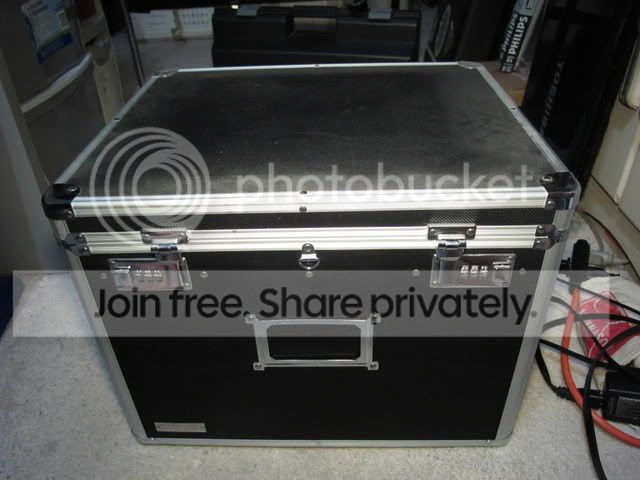
 
My "Magic Box."

IMG_0308.jpg


IMG_0310.jpg
 
the problem with plastic containers is the ability to build a static charge and two plastic containers (since most power comes in a plastic bottle of sorts) could possibly spark upon placing inside (could possibly, chances are slim to none but there is a chance) so that is probably the reasoning for wood as the spark could be caused by any ferrous metal container as well, so that is probably their reasoning behind specifying wood.

metal will also direct heat into the container in case of fire, plastic will melt
 
Please quote the section in the Regs or Act where it states that the box has to be wood and/or 0.75" thick.

That was trying to go from memory. As I stated I couldn't find the link, but I see it has been posted a couple of times and now have it bookmarked again.
 
That was trying to go from memory. As I stated I couldn't find the link, but I see it has been posted a couple of times and now have it bookmarked again.

There is no link in this thread to where the Regs or Act require wood or 3/4".

Powder is generally transported and stored in plastic containers or cardboard inside a plastic bag.

Reloading tools are generally made from plastic - scales, powder drops, auto measures...

Two or more plastic containers inside a box any different than plastic container inside plastic box?

Containers that cannot be moved more likely to be in violation of the regs (see regs in bold above) - either have a container (moveable) or store / magazine (immoveable)...

Regardless, lot of discussion not based in law.
 
It's not about containing the contents. Primers going off inside any container are not going to turn into lethal projectiles....
Primers going off anywhere aren't going to turn into lethal projectiles


Brass fittings also have the advantage of having a lower melting point than ferrous ones, so in addition to not conducting heat into the container or potentially causing a spark,

Copper and brass don't conduct the heat of a fire ?!?!?
Srsly, where did you get that idea? Copper is the second most effective conductor of heat, next to silver, which is #1. Iron is quite a ways down the list.

And your door hinges have ferrous parts.
 
Typed faster than thought........

Was trying to say that "in addition to not conducting heat into the container for as long (as ferrous ones -sic-)"

My door hinges are also about ~1/2" offset from the face of the box. I know you don't see it in the pics. I built it like that so that there would be more room for gasses to escape. While they may be made of ferrous material, they are not holding the doors flush to the rest of the container either.
 
My "Magic Box."

IMG_0308.jpg


IMG_0310.jpg


You are a firefighters worst nightmare! If you aren't going to store your powder properly at least label it properly! DANGER! EXPLOSIVES!

With the investment people make in reloading equipment, supplies, firearms... I don't understand why so many(some of my friends included) won't spend $50 extra and go to Home Depot, buy a sheet of plywood, a couple of hinges, some screws and a hasp to store their supplies properly. Make a half day project out of it. $hit, if your that cheap go to a nearby construction site and ask for the material, they'll probably tell you to go and look through the garbage bin but its free.

Sorry about the rant but so many people only think about themselves and not all of the "what if" situations, after all if nobodies houses are catching fire, why do we have a fire department?

Sorry again for the rant, maybe my wifes PMS is getting to me.:)
 
If you read the backgrounders from powder manufactures and NRCAN, the primary concern is venting / ability to release pressure (weak wall seems & joints specified) to avoid explosion - without pressure buildup it burns, with pressure buildup it explodes...

There in lies the benefit of a plastic container in that it can burst / rupture easily and vent rather than buildup pressure and explode.
 
You are a firefighters worst nightmare! If you aren't going to store your powder properly at least label it properly! DANGER! EXPLOSIVES!

How long have you been a firefighter? I was one for 15 years. And I'd be happy with that box.
A firefighter's worst nightmare is that hidden tank(s) of propane.
Unless you're sitting on that box when it ignites, in street clothes, it's not going to kill anyone.
 
How long have you been a firefighter? I was one for 15 years. And I'd be happy with that box.

Regardless of the thickness-of-the-wood-to-be-used topic of conversation, that box does not meet federal regulations. Do firefighters use federal guidelines or others when it comes to determining safe storage of propellants?
 
the problem with plastic containers is the ability to build a static charge and two plastic containers (since most power comes in a plastic bottle of sorts) could possibly spark upon placing inside (could possibly, chances are slim to none but there is a chance) so that is probably the reasoning for wood as the spark could be caused by any ferrous metal container as well, so that is probably their reasoning behind specifying wood.

metal will also direct heat into the container in case of fire, plastic will melt

Some info on static electricity that may interest you.;)

http://www.ctmuzzleloaders.com/ctml_experiments/sparks/sparks.html
 
Do firefighters use federal guidelines or others when it comes to determining safe storage of propellants?

Firefighters don't determine the safe storage of propellants, firefighters fight fires.
In the 15 years I had in the department, I don't ever recall even hearing about a firefighter for our, or any of the neighbouring departments being asked about "safe storage of propellants".

And except for the markings/signage, which I'm sure that he is going to apply any day now point me to a regulation that his box violates. Remember to read the reg carefully, because the regulation contains a number of non-binding recommendations/guidelines/suggestions.
 
There is no link in this thread to where the Regs or Act require wood or 3/4".


Explosives Regulations (C.R.C., c. 599)

Full Document:

HTMLFull Document: Explosives Regulations |
XMLFull Document: Explosives Regulations [307 KB] |
PDFFull Document: Explosives Regulations [636 KB]

Regulations are current to 2012-06-27 and last amended on 2009-06-01.

136. In this Part, “suitable receptacle” means a substantial box or substantial container,

(a) that may be placed inside a building that is not itself adapted for the keeping of explosives;

(b) the location of which is not changed from that prescribed by an inspector or under provincial or municipal law;

(c) that is kept away from goods of an inflammable nature; and

(d) that is of easy access for removal in case of fire.

137. In regard to any receptacle, the following provisions shall be observed:

(a) it shall be provided with a closely fitting lid secured by a lock, and hinges and fastenings, preferably of copper or brass, and otherwise closed and secured so as to prevent unauthorized persons having access thereto, and shall be kept locked except when required to be open for receipt or removal of explosives, or other necessary purpose;

(b) it shall be exclusively used for the keeping of explosives;

(c) it shall be made of wood, copper or other suitable material;

(d) the interior of the receptacle and all fittings therein shall be so constructed, covered or lined as to prevent the exposure of any iron or steel, or of any hard or gritty surface, or the entry, detaching, or accumulating of grit, iron, steel or similar substance;

(e) the interior of the receptacle shall be kept scrupulously clean; and

(f) the receptacle shall have the word “EXPLOSIVES” conspicuously displayed thereon on a contrasting background.


Argue with them,not me, but you are correct about the 3/4" thing.
 
Explosives Regulations (C.R.C., c. 599)

Full Document:

HTMLFull Document: Explosives Regulations |
XMLFull Document: Explosives Regulations [307 KB] |
PDFFull Document: Explosives Regulations [636 KB]

Regulations are current to 2012-06-27 and last amended on 2009-06-01.

136. In this Part, “suitable receptacle” means a substantial box or substantial container,

(a) that may be placed inside a building that is not itself adapted for the keeping of explosives;

(b) the location of which is not changed from that prescribed by an inspector or under provincial or municipal law;

(c) that is kept away from goods of an inflammable nature; and

(d) that is of easy access for removal in case of fire.

137. In regard to any receptacle, the following provisions shall be observed:

(a) it shall be provided with a closely fitting lid secured by a lock, and hinges and fastenings, preferably of copper or brass, and otherwise closed and secured so as to prevent unauthorized persons having access thereto, and shall be kept locked except when required to be open for receipt or removal of explosives, or other necessary purpose;

(b) it shall be exclusively used for the keeping of explosives;

(c) it shall be made of wood, copper or other suitable material;

(d) the interior of the receptacle and all fittings therein shall be so constructed, covered or lined as to prevent the exposure of any iron or steel, or of any hard or gritty surface, or the entry, detaching, or accumulating of grit, iron, steel or similar substance;

(e) the interior of the receptacle shall be kept scrupulously clean; and

(f) the receptacle shall have the word “EXPLOSIVES” conspicuously displayed thereon on a contrasting background.


Argue with them,not me, but you are correct about the 3/4" thing.

Not arguing about a single thing just hoping to be educated as to why ~30 posts suggest that wood 3/4" is required. The regs you posted are the same I posted and there is simply no requirement for wood and/or 3/4" thickness...

So apart from pictures of some fine wood working and two containers that may not meet the regs (cannot be moved, contain all sorts of metal fittings), there is still not one posts that proves post #5 in error - plastic tool box from Crappy Tire, mark it with the word "EXPLOSIVES" and robert is your dad's brother - regs not nearly as onerous as may seem.
 
I'm not a firefighter nor have every been but my neighbor/friend is and he said he would appreciate knowing(and its the law!) if there were explosives in a building that they be labeled so they know where to pay extra attention, and not assume there is an amplifier or equalizer in the case.

So what if there were 2 cases with over 20 lbs of gunpowder in each, it's still no big deal. And who mentioned propane tanks anyway? Whats a cubevan full of ammonium nitrate?
 
...And who mentioned propane tanks anyway? Whats a cubevan full of ammonium nitrate?
I mentioned propane tanks as a response to Melnibonean calling the box of powder a "firefighters worst nightmare". So I explained what a firefighter's nightmare really was,(the hidden propane) and how that box absolutely was not a nightmare (unless you were sitting on it while wearing street clothes when it ignited).
And a cube van full of ammonia nitrate? It's nothing. Even a van full of ANFO is not a big deal, it'll burn vigorously and be damned hard to extinguish.
Heck even 80% dynamite, PETN det-cord, TNT and C-4 all just burn
 
I mentioned propane tanks as a response to Melnibonean calling the box of powder a "firefighters worst nightmare".

Wasn't me. That was ivo.

You are a firefighters worst nightmare!


Firefighters don't determine the safe storage of propellants, firefighters fight fires.
In the 15 years I had in the department, I don't ever recall even hearing about a firefighter for our, or any of the neighbouring departments being asked about "safe storage of propellants".

In my neck of the woods, it happens all the time if it's requested. Could that be because not every region in the country works the same as yours? My insurance company asked for FD ok before continuing to insure my home after I informed them of me storing reloading components, and I had the boys show up and inspect my set up (with a written report. The chief is also my neighbour, so that helped too :D).


Remember to read the reg carefully, because the regulation contains a number of non-binding recommendations/guidelines/suggestions.

As a firefighter, I think that's not really responsible of you to infer that if storage regs for powders are non-binding, they shouldn't be followed. Even if this whole discussion shows that there's no reg that says we can't store powder jugs wrapped in gas soaked rags inside air tight thin metal containers, doesn't mean that (in the interest of prudence and safety) we should. I understand you can have a personal opinion of that, but since you've already id-ed yourself as a firefighter, shouldn't MORE safety be the thrust of your comments, versus "they're-not-that-bad-if-they-go-off-and-besides-no-rule-says-I-have-to"?. I'm paraphrasing of course. If I misunderstood what you meant to say in all these posts, I apologize.


Not arguing about a single thing just hoping to be educated as to why ~30 posts suggest that wood 3/4" is required.

http://www.cdnshootingsports.org/legal_info_for_reloaders.html

This lawyer for the CSSA also quotes that requirement, stating it' s based on the Explosive's Act. I'm not a lawyer, but it would seem to me that if it's written down in some official "Act", then contravening it might not be a good idea.

If he's lying, I'm out $50 in wood. So what? Have we become so anal that we won't do anything, including things that can only be safer, SIMPLY because there's no reg forcing us to? That just shows that we need the nanny state to regulate us, because we won't do anything ourselves unless there is a law thrown in our face compelling us to.
 
Back
Top Bottom