What would you do

cwalker765

New member
EE Expired
Rating - 0%
0   0   0
Location
bc
So, Id like to lead off with the following statement, I'm about as un-knowledgeable about firearms as you can get.
I have shot a few guns here and there, but that's about the extent of it.
I am however slightly drawn to the whole "prepper" community/mindset. I am NOT however someone who feels the need to stockpile 5yrs worth of freeze dried food or build a bomb shelter in the back yard.
I like the idea of being able to up and leave, and go "live in the bush" if there were NO other choice. Put it this way, id rather prep knowledge/guns/traps/survival tools over freeze dried food/HAM radios/solar arrays that kinda stuff.

Now, to my question.
If you could have one rifle, to go "live in the bush with" for an extended period of time, what would it be?
What would you change on said riffle. Scope/barrell/ect

Looking for something that's cheap for both gun and ammo/reliable/accurate. I know there's no "perfect" gun out there, but there's gotta be one that's close.

I'm at the understanding a .22 could take down deer with a well placed shot?

This will prolly get some funny reactions here on a firearms forum, but I ask that question above cause at one point I was looking at just getting a med/high power .22 air rifle for the simplicity of it all. (no licencing needed, go to walmart/online and buy one) hell, ammo's even cheaper the 22LR ;) BUT, even with a "upgrade kit" to one of the walmart air rifles(upped the velocity higher then the regs allowed. Legal in the states not in canada basically, altho still able to be bought from a canadian company, go figure.) , small and medium game could be had no problem, large game was gonna be a problem. Not to mention if the need for self defence ever arose, .22 pellet wouldnt do much to stop a determined individual.

Still on the fence as to which way to go, but if I can stop procrastinating and make some call and get my PAL... id much rather own a firearm over a airgun any day.

Side note, If a guy had some criminal charges from back in the day, could that be grounds to not issue a PAL. Live in B.C if that makes a difference. Also, the charges were not firearm related at all.
 
Last edited:
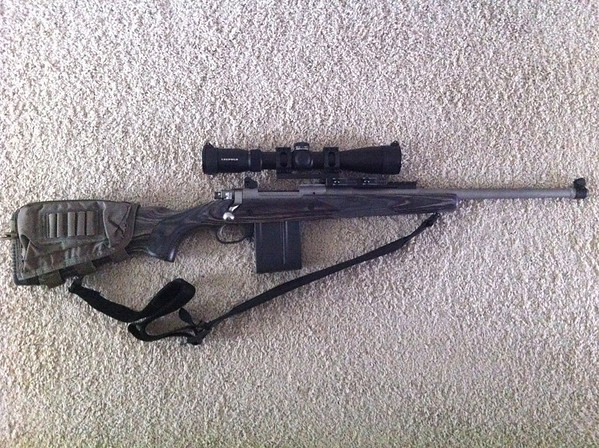
My Ruger Gunsight Scout. .308, 10 round magazine, I can use lightened 'youth' loads (low powder) shooting 00 buck shot or small pistol .30 cal bullets in place of a .22 cal. OR Hammond Game Getters in place of a .22lr.

Rugged, reliable, versatile, scoped & back up iron ghost ring sights if scope has issues. It will drop anything in North american with a well placed shot.

(but thats just MY choice).

i-3wFH7XH-M.jpg


[youtube]xTrWAr4hLBA[/youtube]
 
If I could have just one gun to have with me in the bush I'd grab my marlin 915 YN. Small, light, simple, cheap bolt action .22. Sit 20 yards off a game trail and give a deer a headshot, it'll fall down.No point in shooting big game in a survival situation anyway unless its cold out and you aren't on the move.
 
Side note, If a guy had some criminal charges from back in the day, could that be grounds to not issue a PAL. Live in B.C if that makes a difference. Also, the charges were not firearm related at all.

Depends on the charges, and it aint none of my business anyways.

Consider a flintlock if you want something that goes boom, no FAC required.
 
I can't remember his name, but there was a British adventurer in the early part of the 20th century who headed up north with a partner and a young cousin carrying three 303 rifles and not one shotgun counting on intercepting a herd of caribou for their winter's meat.

They missed the migration and despite being surrounded by ptamigan, starved to death.

Why? No shotgun.

You are right though, there are probably many more things to worry about havin gin your possession than a gun in a survival situation, but this being a gun nut site and not a "how to start a fire with a flint" site, we are of course obsessed with talking about guns.

I don't personally have one, but in that hypothetical situation, I might be persuaded to get a 22 magnum/20 gauge over under Savage or somehting similar if I was limited to one gun.
 
Either a model 94 30-30 or a 20 gauge shotgun with both shotshells and slugs. The latter would be a little easier to feed myself with due to small game. I once had an old break action centerfire rifle that would also use 410 shells, I can't remember the exact caliber, 44 or 40 something, that also would have been a good survival firearm for putting meat on the spit.


So in all reality a savage 30-30 over 20 gauge would be the perfect do-it-all survivalist gun, good thing I don't have a need for one!
 
A .22 and a 12g shotgun would be my immediate choice. Like kyle700 said, if you're actually living in the bush then you won't be shooting deer sized game, as you won't be able to consume all the meat before it goes bad, unless you have lots of salt and the knowledge to cure meat. A .22 will alow you to take any small or medium game without any meat damage. A 12g will allow you to take birds in flight as well as large game if you needed and defend againt predators. Both .22's and 12g guns can be very inexpensive. Also ammunition for both is extremely cheap, aside from buying a few slugs for the 12g. Welcome to the forum BTW. There is also a wilderness survival forum that you should check out, lots of topics on preparing for disaster. If I was going to add a centrefire rifle to the mix it'd be a handly little 30-30 trapper
 
Last edited:

For rural life it would be my 30/30 H&R Handi rifle.
I'd like to buy one in .308 survivor form someday.

For more semi urban it would be my SKS.

Grouse can be hunted with a rock and I'm pretty accurate with a staff sling. ;)
 
In a pure survival situation a shotgun is a poor choice due to the weight of the ammunition; 500 rounds of .22 LR can be carried with the similar bulk and weight of 25 shotshells. The .22 has a longer lethal range than any shotgun, loaded for small game, which may or may not make much difference depending on your circumstances. So doing the math, you can survive 20X longer with a .22 than you can with the shotgun. If you find it necessary to kill a large animal, that stretches the utility of the .22, which is typically a rabbit or a ptarmigan gun, far beyond its terminal effectiveness or it maximum practical range. Just because there have been reports of large game killed with a .22, don't assume you can do it. A small bore centerfire rifle has the advantage of having the power to anchor a large animal with one or two well placed hits, and can do so usually out to 300 yards if the shooter is competent.

A defensive situation can be resolved with a shotgun, but again the weight of the ammo is restrictive, where you might still easily carry 100 rounds of small bore centerfire rifle ammo, and handle defensive problems just as neatly. I've heard it said that a .22 magnum rimfire is the best answer for the survival firearm, but here the problem is the destructiveness of the bullet on the small game typically shot for food, and its marginal at best for shooting large game; the .22 magnum is a fox cartridge. Still, if one can shoot carefully, you might not cause excessive damage to your camp food, particularly if you can find non-expanding ammo. My choice of cartridge for a survival scenario is a .223 case with a bullet from .224" to .264" diameter. A cartridge that can't be purchased in the store, but that can be made at home is called a wildcat. This would include things like a 6mm-223 or a 6.5mm-223, in a survival scenarion this poses no disadvantage as there is no store from which to buy your ammo anyway. As long as you have components, you have ammo.

Around here, geese can provide much of one's food, from mid April till mid October. But geese encountered on tundra or out on a lake, might not allow you to close within 200 yards. If you are hungry, don't count on being patient enough to make a successful stalk, chances are you'll risk a marginal long shot with what ever gun you have. Two hundred yards represents an unlikely marginal shot with a .22, but an easy one with a small bore centerfire rifle, which assures you'll eat. The small bore centerfire rifle should be built on a small repeating action, a CZ 527 or an older Brno equivalent, bedded in a quality fiberglass stock, and topped with a small low power scope comes to mind. If there is even a remote chance of needing the rifle for defensive purposes, it should be a repeating action. I've carried a number of single shot firearms, both shotgun and rifle, for protection work, and I won't do it again, provided I have a choice.

The small bore centerfire rifle should only be considered if its ammunition is handloaded. You can handload small game and big game loads that are immediately distinguishable from one another due to the different bullets chosen for each. Additionally, handloading in the field with simple tools allows you to have components available for hundreds, or even thousands of rounds, with comparatively few brass cases. If the rifle sight is easily adjustable, or has multiple aiming points, the differences in trajectory between the two rounds is not an insurmountable problem. Likewise, firearm weight can pose serious limitations, and the idea of packing around two guns, unless one is a handgun, is problematic. But here again, the rimfire rifle is lighter than either a centerfire rifle or a shotgun, and the shotgun is typically heavier than a light weight centerfire rifle. If you are not prepared to go the handloading route, and the purpose of the gun is primarily to feed you, a good quality .22 long rifle is the right answer.

Regardless of the gun you choose, it won't do you any good if you can't hit anything with it. Get your gun, sight it in, then practice until you can make hits on small targets over the ranges you intend to shoot for food. Once you think you have it all figured out, spend a few days in the back country and see if you're as slick as you think you are when shooting from field expedient positions at live targets. Then you can get back to the range, and practice in the areas where you've found yourself to be deficient.
 
Side note, If a guy had some criminal charges from back in the day, could that be grounds to not issue a PAL. Live in B.C if that makes a difference. Also, the charges were not firearm related at all.[/QUOTE]

I think it depends on how long ago and if you ever had or have a firearms ban. I'm just thinking that is one of the questions on the application. Hope this helps all you can do is try right.
Cheers
Geoff
 
Boomer, you took quite a few words out of my mouth. But I would probably go with a .22 Magnum as there are lots of good ammo options that are light and easy to carry. Examples are CCI's Maxi-Mag in both jacketed SP and TMJ (FMJ), Federal's 50gr JHP and 40gr FMJ etc. At 50 yards those rounds have almost double the energy and almost 50% more momentum than a regular .22 LR has at the muzzle. At the 200 yards mark (goose example) it still has just about as much jam as a regular .22 LR does at the muzzle. That is certainly enough for a goose. Also, the cheap, readily available ammo and mild report means it won't take long to get enough practice in to make a fellow proficient. Another note is a .22 Magnum can be had in a very light, compact firearm.

You don't have to mess around with handloading either - you just throw 3 boxes (150 rounds) in your pack and you can go....
 
Boomer, you took quite a few words out of my mouth. But I would probably go with a .22 Magnum as there are lots of good ammo options that are light and easy to carry. Examples are CCI's Maxi-Mag in both jacketed SP and TMJ (FMJ), Federal's 50gr JHP and 40gr FMJ etc. At 50 yards those rounds have almost double the energy and almost 50% more momentum than a regular .22 LR has at the muzzle. At the 200 yards mark (goose example) it still has just about as much jam as a regular .22 LR does at the muzzle. That is certainly enough for a goose. Also, the cheap, readily available ammo and mild report means it won't take long to get enough practice in to make a fellow proficient. Another note is a .22 Magnum can be had in a very light, compact firearm.

You don't have to mess around with handloading either - you just throw 3 boxes (150 rounds) in your pack and you can go....

I don't have one, so I haven't paid attention to the ammo options for the .22 magnum. But if its destructiveness on small game is addressed by using FMJs, the .22 magnum might well be nipping at the heals of a small bore centerfire for the fellow who needs a survival gun, but doesn't want to handload. In terms of usefulness, the .22 magnum has a major advantage in terms of weight and bulk of both ammo and rifle.
 
to cwalker 765 Just to add to this thread,one of the popular rifles used onthe east coast by the ,locals for small game and for caribou was the 222. small cartrige,loaded right has range,accuracy,and power,also lots of rounds,small wieght. As for record,been there done that,have rpal and passport . But if assault or violence probably would mean difficulty,to obtain. Good luck.
 
I should point out that my example and choice of a .22 Magnum is intended in case of emergency/neccessity, as shooting big game with a rim-fire is illegal.
 
For me, no rifle. A 12 ga shotgun. You can kill anything in North America with it. There are no shortage of choices for ammunition from small game birdshot loads to 1 oz. slugs that will take the sails out of any large animal within 100 yards. And the ammunition wont break the bank! If it were going to be a survival gun for being in the bush with? As much as I hate tupperware guns I would find something with a synthetic stock and forend. Does not need to be fancy, just tough and reliable. A good brand name pump gun would be my choice.
 
There is no disputing a shotgun will kill....but as pointed out by Boomer, the shells are very heavy and bulky. That is a serious disadvantage if having to move around - especially over long distances.
 
Back
Top Bottom