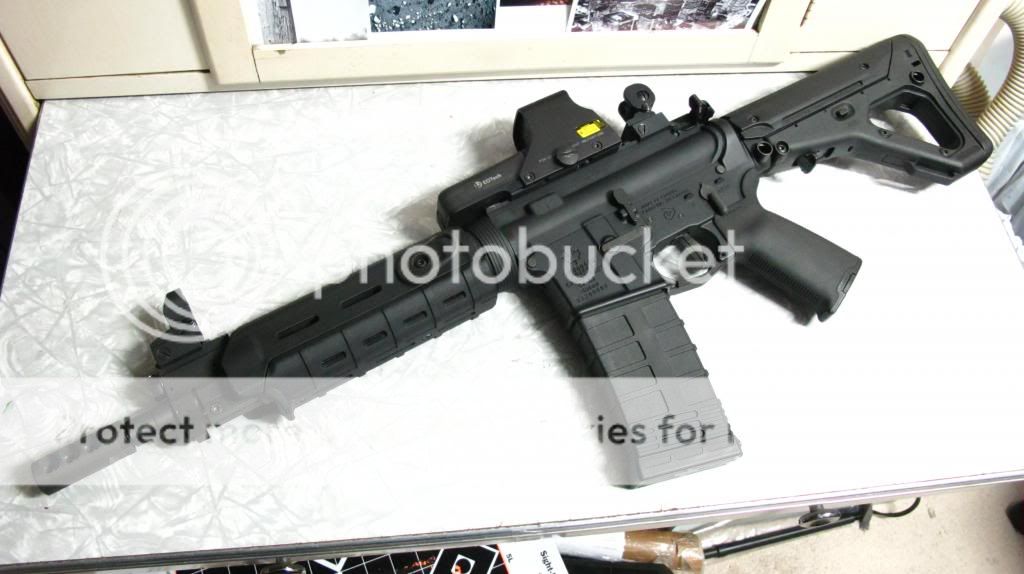
Gas vs piston

wolfsblood

New member
EE Expired
Rating - 100%
8   0   0
So I searched and looked over the last 200 threads. All I've been reading about the difference is piston keeps it cleaner. That's the main difference.
I'm looking at the core15 to be specific. So in a short description... Gas or piston. All I'm doing is punching holes In paper so far and not crazy knowledgable but wanting to learn more. Will also be my first AR if that helps. Thank you.
 
The CORE gas ones look cooler, IMHO. The guys at Wanstalls told me that the gas one is preferable (not sure on what criteria) but that they are both good. If I was buying a CORE15, I would go with the gas.
 
The CORE gas ones look cooler, IMHO. The guys at Wanstalls told me that the gas one is preferable (not sure on what criteria) but that they are both good. If I was buying a CORE15, I would go with the gas.

Maybe I'm blind but I don't see a difference in looks? But I'm also just looking at pictures. I'm thinking of going with the gas. I don't want to develop bad habits with not cleaning my guns as often as they should be...
 
The general consensus is that gas (DI) ARs tend to be a bit more accurate than the piston ones - this has also been my experience (16inch Adams Arms piston vs 16 inch Stag and 16 inch Colt DI guns).

That being said the piston guns are easier to clean - especially if you're anal about cleanliness.
 
You doo not need to clean an AR on a regular basis. Only once it starts jamming. All it should need is to be run wet.
 
Unless your barrel length is under 10" I wouldnt go gas piston, extra weight and cost or if you are going to play in the sandbox. DI tried and true, juste keep it clean and lubed
 
DI is better because it has more common parts.
Imagine if one of your parts on the piston breaks, you will have hard time finding a replacement. It is easy to fix DI parts.
 
There are basically 4 good reasons to get a piston gun:
  1. use of shorter than 14" barrel
  2. use of non-standard ammo
  3. extensive use of full auto (no a big issue in Canada ;) )
  4. use of suppressor (also not a big issue in Canada... )

If you shooting standard ammo (M193 and M855) out of a 14", 16" or 20" barrel, DI has almost no downsides.

Alex
 
I own a CORE 15 Piston. I have no complaints with about 800rds down range not one ff or fe. I get 1" groups at 50 yards and my best @ 100 is 3" but I blame that on a red dot that is 2MOA. That is using bulk federal "black box". It is the only ammo I have used for it so I have no idea what it is capable of with match ammo.

After a day at the range or a couple hundred rounds it's still perfectly clean inside

I should add that I'm a newb to AR's as well, the CORE15 is my first and only AR

Bottom line - would I recommend one YES
would I buy one again YES
 
they both have their benefits. for range work in Canada, there really are no down sides to a gas system. Its cheaper to buy, lighter, more parts available and yes more accurate. I prefer pistons
 
Hmm, well I run both, and this is my 2 cents.

I have a CMMG conversion kit, so I've been able to compare both systems on the same rifle.
I will note, that if you're going to run a conversion, timing becomes somewhat more complicated and there are more things to consider for proper operation then there is with DI.
Bolt lug round off seemed to be more a problem for me then carrier tilt.

If you are buying a ready made Piston rifle like the Core15, then all those details, I would assume, should be taken care of for you, and you do not have to worry about them.

I've run the piston with both 11.5" and 16" barrels.
On the 16", it ate everything I've fed it.
One the 11.5" the lack of back pressure has made it more temperamental, preferring gassier or hotter loads to cycle.
I reload, so this is something I think about. If you are shooting factory, you need not concern yourself with this, as even the weakest runt ammo, like MFS steel, cycled the 11.5" piston just fine.


Weight, indeed the piston system made my rifle more "top heavy". On paper it doesn't seem like much, but in practice, you can feel it. A DI AR with a standard profile barrel has barely any weight past the front of the receiver, making it feel lighter then it is. Once you add the weight of a piston system, it changes the balance and can make it feel a lot more heavier then the DI then it actually is.

Cleanliness:

What you have to consider here, is what are you shooting and how much ?
If you're going to shoot dirty crap ammo, then it almost completely circumvents the clean running effect of piston.
I put 100 rounds of MFS steel thru' my 11.5" Piston Carbine, the stuff is so dirty, the blowback alone soiled the receiver as if I had fired 100 rounds of quality ammo thru' a DI rifle.
I still had to clean it out. On the other hand, if it is indeed that dirty, imagine how much worse it'd be with DI. I've never fired 100 rounds of MFS thru' a DI carbine so I have no idea.

Another thing to consider is, how often do you clean it.
Indeed, the piston system run cleaner in the receiver, but the piston system itself gets soiled adding another step to your rifles cleaning regiment.

In a DI system I clean the barrel and chamber, take the BCG down, and clean it, wipe out the receiver, re lube, and I'm done.

In the Piston system, it gets the same respect, I clean the barrel and chamber, take the BCG down and clean it, wipe out the receiver, re lube, but I'm not done, I still have to pull the piston out, clean it, clean out the piston tube, and the piston bolt.

So, both systems get the same attention, because remember, your receiver, and bolt is still going to get dirty from blowback, and brass shavings, so it will still need cleaning at some point. It also may get cleaned simply to re apply fresh lube.

So with the DI system you are pulling more fouling our of certain areas, and with the Piston you pull that fouling out of other areas, but in the end, you've added an extra cleaning step with the piston system. My piston gun actually takes me LONGER to clean then the DI system.

Furthermore, I clean after every range session. My Rifles Always go back into my safe, clean, with fresh oil, and ready to fire.
My range session typically are only about 100 rounds.
I find that DI fouling after 100 rounds of my clean burning reloads really isn't that big a deal. I can remove most fouling in short order and I don't have the extra step cleaning the piston.

What benefits you see as far as cleaning go, really come down to what kind of ammo you shoot, and how much you shoot between cleanings.
For the maintnence murphy target shooter, I could see a good piston system being as long faring as the Ol' Dirty Fal, but if you show your high end rifle the respect it deserves as I do, then a piston adds more work only to be balanced by the volume you shoot.


PARTS: The ace card of the debate.
I like to throw this argument completely out the window, for two reasons.

One, because I'm a casual target shooter with multiple AR systems.
Two, because I run a conversion system.

As a casual target shooter, which many of us here are, if my Piston gun goes down, I simply bring a different gun to the range, while I figure out what I need to do to fix the piston.
Fussing over parts is silly in this context.
The argument of parts only holds water if you are an Operator Operating in Operations, of a Competition shooter. Sure, I can't just run down to the local shop and pick up piston parts, but, if I take my gun that seriously, I can plan ahead.
And if you think about it, most of us can't get DI parts that quick anyway cause we mostly have to order online, the same as the Piston parts. For that reason, most AR owners have spare parts on hand. Treat your piston gun the same way, and there is no problem.

As a person who runs a Conversion Piston, a DI system IS my spare parts. If my piston goes down, I un bolt the piston assy', and bolt on a DI assy'. Easy peasy. I can do that in maybe 10 - 15 mins, and I won't miss out on any range time.

I will also point out, that one of the whole points of getting a piston system, is for the reliability to the effect that they are mush less likely to fail in such a way that you are in the need for any proprietary parts. The most likely parts to fail, like the extractor, are interchangeable with DI parts. And many Piston systems even use the same bolt.

When you think about it, there is not much that can go wrong with a piston. Not the system I have anyway.

And finally, accuracy:
What are you using this for ? To shoot groups ?
My piston is strapped to an 11.5" Carbine with a standard style handguard (as in not free floated). Accuracy is a moot point, as I would not be able to tell the difference in practice.

In theory, yes, a piston cannot be as accurate, as it can greater augment the barrels dynamics. For that reason, I can't think of any finely tuned OBR off the top of my head that runs a thumper.

Unless you are trying to shoot tight precision groups off a bench rest, I would not worry about this. A typical AR carbine is likely to give you 2moa. If it's giving you 3moa, it's doing what it's designed to do, and is still going to be more accurate then you are standing. Running a piston isn't going to mysteriously open groups up to minute of barn.


When I got my first AR, I bought into piston cause it's what I knew running other Semi Rifles for years. I'm slowly growing to love the DI system, but am still on the fence.
I will say, I'm in less of a rush to convert my DI's to Piston then I am to convert my Piston to DI, and the only real reason I'd move away from it, it due to the weight, and the fact that it will not cycle my most economical reloads.

Seems my 2 cents turned into a couple of bucks. Takes it for what it's worth, it's just my perspective having an intimate knowledge of both systems.


IMG_0585_zps22aeaf2f.jpg
 
Last edited:
I thoroughly approve and agree with Conte 's post, by far one of the most informative I have read on this subject.

However, I have a comment to make in regards to the parts availability argument. The argument is that parts are harder to find for piston guns than for DI guns. Sure, that's true and I agree with the point you made about planning ahead and having spare parts.


Moreover, I think the argument actually refers to the lack of parts commonality between each makers' piston gun. You'll notice that a DI gas tube from any particular maker will fit any other maker's gun. The DI system is conventional and most DI guns use the exact same parts and build them to the same specs. Of course, the argument could be made that some makers produce proprietary parts (gas blocks, etc) for their DI guns and I will concede that point.

On the other hand, where DI guns almost always use the same/interchangeable parts, piston guns do not. You'll notice that companies that produce piston guns generally have their own unique system that will not function with a different company's platform. In which case, your search for spare parts is narrowed down to a single maker, rather than a plethora of sources as we have seen in DI guns.

Once again, this won't matter to Johnny who fires 25 shots on a Saturday morning once a month at the range. I don't fire my AR's enough to break them either, but I would definitely find being limited to one source for parts obnoxious at the least.

As for the reliability issue, they are both trade offs. A definite weakness of DI is that it depends heavily on the quality of the powder being burnt. Then again, pistons only push the problems caused by wear, fouling, and heat (along with added parts and weight) further to the front of the rifle.
 
There is no doubt that piston ar15 parts are HARDER to get than the DI Ar15 parts. More people have the DI Ar15 and I can order most parts in Canada.
The only piston parts that I have seen being sold in Canada are the Adam arms piston system. If you have other piston systems, then how can you get parts in Canada? You probably have to wait for MONTHS to get piston parts that are not common in Canada.
 
yohann160;8216342 Once again said:
Yeah, well, that's pretty much the only basis of my parts argument.
Most of us are just hobbyists, that don't depend on out rifles. Anyone serious is either running DI, or planning ahead.
That being said, I throw the parts argument out simply because people use it as a reason not to buy a piston rifle, which is just silly.

Some people take a subject like this too seriously and pick it apart, but our AR's are novelties for the most part, and it's all for fun. If someone is interesting in going Piston, I encourage them to do so without worried about things like spare parts. Unless it's defective, it's likely to last a long time.
 
I can offer no more salient points than Conte... He about covered it!!!

If you want to look at it irrationally, the interchangeability of DI parts may serve you better after the zombie apocalypse!
 
I'd just like to make a little addition to the DI vs Piston arguement. Differences in Piston configuration does add a additional point to the arguement.

The wife and I both have piston guns - She's running a Adams Arms Midlength on her 14.5" FN barrel and I'm running a full PWS MK114.

The Adams Arms Piston System - like the CMMG, Ruger, LWRC and many others is a "Short stroke" system where the piston or connecting rod is not directly attached to the bolt carrier.

The upside - In practice this is a pretty versatile system and gives the benifits of a generally cleaner feed path during volume shooting. We've noticed that the lubrication tends to stay in the operational parts (Bolt, Carrier, upper reciever channel, charging handle) much better than a DI gun and indeed the gun runs much cooler at the upper reciever. It suprised us that after 300rds one day she was able to clean the bolt assembly and upper with just two sheets of Bounty (The quciker-picker-upper).

The downside -
Carrier tilt from the leverage of the bolt drive face (former Gas Key) getting wacked by the oprod.

The Primary Weapons Piston System - This is more an AK style system with the piston/oprod attached directly to the bolt carrier. Varients include the ADCOR Bear (and the AK47 of course :) )

The upside -
In addition to the features mentioned above (minus the Bounty) the additional mass of the drive assembly helps to improve reliability in much the same way running a heavy buffer does in a carbine. The system is very simple and robust - built like a brick poophouse (can't use the proper words here).

The downside - More mass felt during recoil: feels like about 5% increase in felt recoil.

The Industry Standard Direct Impringment System - Yep everyone shoots these!

The upside - Everyone shoots them! Parts Galore! More accurate since no moving parts affect the barrel (Although - I'd be willing to put my 14.5" PWS against any DI 14.5" and see if you notice the difference!)

The downside - Craps where it eats... Scraping carbon forever, filthy recievers, no bounty for you!


My summary and option
Get what you want and shoot the hell out of it! If you can justify a piston gun - go for it! If you can see no additional reasons for it - stick with DI!
 
Well... To add to this since I started it. I went with a DI core15. Should be here tomorrow. Wanstalls also has piston uppers for about 1000. Maybe in a bit I'll pick one of those up as well or just go for the whole piston package. I'm still very new to ARs so I felt I should learn the basics on the first system. Thanks everyone.
 
Back
Top Bottom