Coolio milsurp ammo

Smellie, have you seen the base of the base of one of the bullets you describe as;

“ONE of the ones with the points "ground off" looks very like a factory job. Turn it over and look at the base: it could be a Cordite Mark IV or (more likely) Mark V. These are the "Dum-Dum" series as made in Canada.”

The base would have to be solid to avoid leaving a jacket in the barrel.
I also seem to remember very old ads by companies advertising such ammunition as hunting ammunition.

What is the date on the ammunition you have. The earliest date I can make out would be 1905, but the bullet is unknown.

The Hague convention of 1899 banned Dum Dum bullets

“Declaration (IV,3) concerning Expanding Bullets. The Hague, 29 July 1899.”
 
Smellie, have you seen the base of the base of one of the bullets you describe as;

“ONE of the ones with the points "ground off" looks very like a factory job. Turn it over and look at the base: it could be a Cordite Mark IV or (more likely) Mark V. These are the "Dum-Dum" series as made in Canada.”

The base would have to be solid to avoid leaving a jacket in the barrel.
I also seem to remember very old ads by companies advertising such ammunition as hunting ammunition.

What is the date on the ammunition you have. The earliest date I can make out would be 1905, but the bullet is unknown.

The Hague convention of 1899 banned Dum Dum bullets

“Declaration (IV,3) concerning Expanding Bullets. The Hague, 29 July 1899.”

these where most likely 215gr FMJ round nose like i said before
 
Hi guys, so I've tried to find out some of this stuff for myself, and now just have more questions. :p

So here we go: does old ammo go bad (like old sandwiches)? And what causes the corrosion seen on some old cases, and primers? I've read on another forum that its a breakdown of the propellant (THAT part of the conversation just got way to confusing and contradicting...). One suggestion was that it was cupric acid or something that was releasing from the propellant, and ... then there were the opposing views on whether or not to shoot ammo that had a bit of corrosion...ok, what's "a bit"...I dunno.. [eyes rolling]

I've got some Dominion Arsenal (DA) .303 blanks, made in '44, but what does the "IM" mean? :)
 
these where most likely 215gr FMJ round nose like i said before

I did a little reading, and I think the dumdum bullets banned under this Declaration, were banned due to the "unnecessarily" extensive tissue damage caused by a rapidly expanding bullet (ie: exposed soft lead core/tip). Meanwhile, FMJ's sometimes presented the problem of tumbling as they passed through the wound track (some of them, under certain circumstances - don't ask me what), causing similarly extensive wounds instead of small wounds, due to this tumbling action, but they weren't banned by this nor AFAIK, any other similar convention.

So , the authors of the Hague Convention IV,3 of 1899 seemed to believe that bullet construction had the greatest influence on ballistic behavior through the wound track, whereas now we know that the kinetic energy (~300 joules for a typical large-bore infantry rifle vs. ~500 joules for a police pistol) has a significant influence on bullet impact characteristics. I also found it interesting that the 1899 Declaration didn't apply to police pistol bullets, nor to whoever was responding with armed force to a hostage or terrorist situation (read: dumdums OK). :)
 
When a bullet jacket is made, it is DRAWN from a solid piece.

Think of a mouthful of bubblegum for a minute. Remember when you were a kid you used to chew bubblegum and then put it on your left hand, with your index finger and thumb making a RING and hen you would poke your RIGHT index finger down into it? That is what DRAWING is in a machine-shop. Bullet jackets are DRAWN and, in order that the steel "finger" can be used more than once, they must be open at one end.

SPORTING bullets are designed to expand when they hit an animal. The have open or hollow POINTS and closed BASES. That is how the Dum Dum Mark III was made: open point, closed base. Dum Dum Mark IV and Mark V also had open points, these being punched but I do not know if they were drawn one direction or the other because they are WORTH too much to start taking the (very scarce) rounds apart. I suspect that they were drawn "normally" (open base) and then hollow-pointed rather carefully in order to prevent shoot-through. But THESE are what the Hague Convention banned for use against humans, although the Convention only applied to warfare when engaging a "civilised enemy". The Convention did not apply when you were fighting an "uncivilised enemy" not when both sides had announced their intention to conduct warfare OUTSIDE the restrictions of the Convention.

Normal MILITARY bullets are OPEN at the BASE and they are CLOSED at the TIP.

You have to have ONE end or the OTHER solid in order to prevent shoot-through completely, with 100% certainty. It IS possible to have a jacket open at both ends if the FILLER is hard enough that it will not squish out of the jacket. British bullet cores were 2% Antimony, which does have a satisfying hardening effect on lead.

As to bullets in British Service, in the .303 range the Ball bullet started as a 215-grain round-nosed type at least as early as the Black Powder Mark II of 1890 (oldest .303 I have) and this same bullet was used in Cordite Mark I, Cordite Mark II and Cordite Mark VI at respective velocities of 1860, 1960 and 2060 ft/sec. The 3 Dum-Dum Specials, the Marks III, IV and V (all banned by the Hague Convention) also used 215-grain round-nosed bullets. The Mark VII, introduced in 1910, used a 174-grain composite bult with a full-length jacket, open at the base, a 3-gain Aluminum plug up inside the nose (later Fibre or compressed Paper could be substituted) and a Core of 98 lead, 2 Antimony. With one small change (in the location of the Crimping Groove) this remained the standard .303 bulet to the end of Service use. There also was a Mark VIII bullet which wa supposed to be for the Vickers Gun but for which many Number 4 Rifles were appoved: 174-grain pointed bullet with a rebated boat-tail for longer ranges although starting out at only 2550 ft/sec (110 ft/sec faster than Mark VII specs).

Personally, I find ludicrous the idea that the .303 ever became "obsolete" and required replacement by the ultra-modern .308.The longrange sniping load for the 308 (7.62x51mm NATO) uses a 173-grain boat-tailed bullet at 2550 ft/sec, exactly the same as the obsolete .303 except that the .303 bullet was .6% moe massive and hence .6% more powerful, given that they were moving at identical velocities. And the .303 Mark VIII bullet was BETTER at long ranges. But NATO HAD to have the American development or else. Ho-hummm........

Headstamp on a genuine Dum Dum Mark V will be (if Canadian) D/!\C C V. ALL of the old-time ammo was marked on the CASING. A British Dum Dum Mark IV would be marked R/!\L C IV, again on the head of the cartrdge.


If ammunition is stored in conditions at all favourable, it does not deteriorate in reasonable time. With the old-time ammunition, though, what DID deteriorate was the Detonating Compound in the PRIMERS. The first primers used Mercury Fulminate as the shock-sensitive material which set off everything else. Mercury Fulminate primers deteriorate quickly and can start giving missfires and delayed ignition within 2 years of manufacture if stored poorly. And they go dead faster if they are stored somewhere hot. Kep them cool and they will last several years before showing their ugly side.

But the British were trying to make ammunition in Lndon (with its temperateclimate) and use it in places such as India, where it might be 110 above (F) on the coast and 40 below in the Himalayas on the same day. They didn't need "okay" or "good", they needed the bst that COULD be made. And so they came up with that big quarter-inch Berdan primer and a priming mixture based on Mercury Fulminate AND Potassium Chlorate. Yes: mercuric AND corrosive at the same time; one wrecks your brass, the other rusts your rifle. The Priming Cup had to be huge in order to accommodate the large amount of priming compound..... but it worked. Everywhere. And rather a shocking proportion of them will work 110 years after they were made, so do be careful. Modern primers are based on things such as lead azide, lead trinitroresocinate and other jawbreakers and they are NOT corrosive and they are NOT mercuric and we have no idea how long they will last because they have only been in use for the past 80 years. For all intents and purposes, their shelf-life is for all practical purposes infinite. I have primers here which I know ar 50 years old and they work fine. That's good enough for me.


As to the powder degrading, powder will do this in poor storage if it was not properly made in the first place. The British were always careful with their Cordite and it seems to work no matter how old. Yes, it WILL sweat pure nitroglycerine if it is very hot for too long..... but that nitroglycerine will be reabsorbed into the bodies of the Cordite sticks when it cools off. It is quite remarkably stable in this manner. Incidentally, I carry a .303 Cordite round with the bullet loosened in my First Aid kit. The sticks are a wonderful fire-starter, taking light perfectly even if soaking wet, and it is a source of nitroglycerine........ which just could be handy if you are going canoeing with someone with a heart condition who leaves their pills at home: nitroglycerine is nitroglycerine whether it is in tiny white pills or in golden-brown sticks.

And my fingers are VERY tired from this damned laptop keyboard.

Hope this helps.
 
I did a little reading, and I think the dumdum bullets banned under this Declaration, were banned due to the "unnecessarily" extensive tissue damage caused by a rapidly expanding bullet (ie: exposed soft lead core/tip). Meanwhile, FMJ's sometimes presented the problem of tumbling as they passed through the wound track (some of them, under certain circumstances - don't ask me what), causing similarly extensive wounds instead of small wounds, due to this tumbling action, but they weren't banned by this nor AFAIK, any other similar convention.

So , the authors of the Hague Convention IV,3 of 1899 seemed to believe that bullet construction had the greatest influence on ballistic behavior through the wound track, whereas now we know that the kinetic energy (~300 joules for a typical large-bore infantry rifle vs. ~500 joules for a police pistol) has a significant influence on bullet impact characteristics. I also found it interesting that the 1899 Declaration didn't apply to police pistol bullets, nor to whoever was responding with armed force to a hostage or terrorist situation (read: dumdums OK). :)

the only ones made to tumble where the mk7 they had paper pulp,wood pulp and aluminum in the nose so it was lighter then the rest of the bullet causing it to lose its stability when it hits a target but they still where a fmj so not banned the standard 5.56 round of today tumbles and fragments because of a weak spot aka the cannelure not banned

the penalty for having dum dum rounds in the early days after the ban(boer war) where not so kind
 
....I've got some Dominion Arsenal (DA) .303 blanks, made in '44, but what does the "IM" mean? :)

I suspect that you are reading this upside down and that the cases are actualy headstamped "WI", which indicates that the blanks were made from reject armour piercing W Mark I cases.

Regards
TonyE
 
Smellie - That is a very good overview of the evolution of the .303 Ball cartridge There are a couple of points I would like to add.

Although the bullets of the Powder Mark I and II, and Cordite Mark I, II and VI were all 215 grain round nosed, they were all different in detail. For example the bulets of the blackpowder rounds had no cannelure for crimping which was not introduced until the Cordite Mark I. Also, although the Ball Mark VI looks identical to the Ball Mark II, in fact the envelope is thinner than the Mark II to increase deformation.

The Mark III is actually open based and not drawn like a sporting bullet and has a cupro-nickel cup inserted in the nose. Since so few were made it seems the problem of core blow through did not arise. However, it did with the Ball Mark IV which had a pure lead core with a hole punched in the nose as you explained. That prompted the introduction of the Ball Mark V, which although still open based had a harder lead/antimony core and a wider envelope turn over at the base.

Despite their short service lives, the Ball Mark IV and V were quite widely made by RL and most of the British contractors. The IV and V were both made in Canada and the IV in New Zealand as well. It is interesting that you comment on their rarity in Canada, as here in the UK both are still fairly easy to find.

Whilst I accept the now popular interpretation of "Dum Dum", in terms of the serious study of the .303 inch round it is misleading to call the Marks III, IV and V rounds Dum Dums for two reasons. Firstly, they were never made at the Dum Dum Arsenal in India and secondly the genuine Dum Dum round was soft nosed and not hollow nosed (the Mark II Special). It owes its origins to the work of Bertie-Clay.

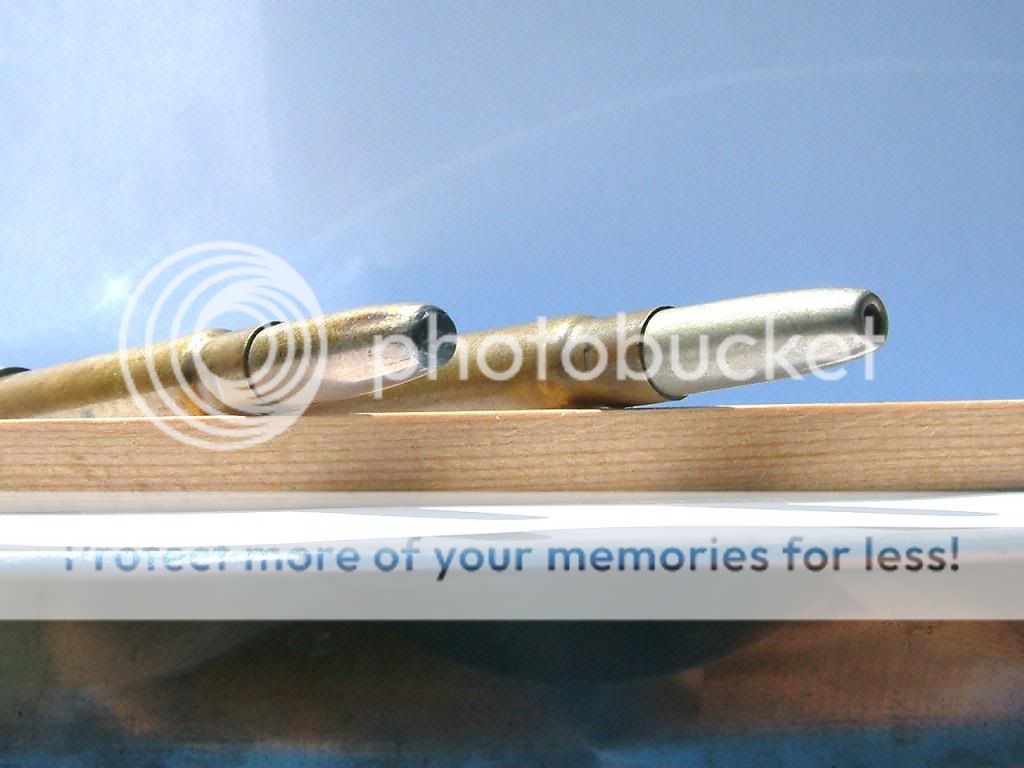
Picture shows my Dum Dum Mark II Special (headstamp D I) with Ball Mark IV for comparison.

I sympathise with you finding a Powder Ball Mark I. They are getting very hard to find and fetch a good price, currently about £125-£150 UK. I am fortunate that the two I have were acquired many years ago at far far less cost!

Regards
TonyE

Dscf0011-1_zps60603320.jpg
 
Back
Top Bottom