












































You are using an out of date browser. It may not display this or other websites correctly.
You should upgrade or use an alternative browser.
You should upgrade or use an alternative browser.
Unknown variant of the Sks? . . .
- Thread starter fat tony
- Start date



Those are type 63 rifle. Look like an SKS but they are not.They use a rotating bolt instead of tilting one.
Joce
Agreed Chinese Type 63 select fire rifle


fat tony
CGN Ultra frequent flyer
Wasn't there a full auto version of the SKS? I remember something being posted here about that, though my memory may be failing me in this case. Regardless, looks a lot different than my Russian refurbs. Nice find!
Other than hillbilly creations, Yooper John(google him) has some pictures of imported yugo sks's with stocks cut out for selector switches & detent plates bedded into the right side of the stock - not sure if they were 59/66's or regular 59's.
Here is the pic, I hope he does not hunt me down! - could not find a terms of use policy on his website!
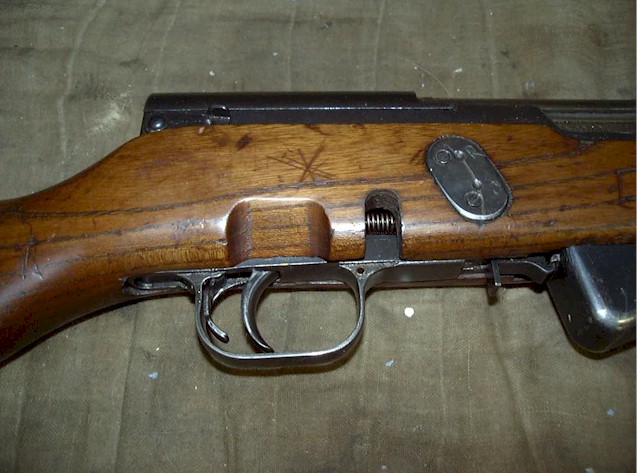
^Looks like an m59 as the 59/66's had heavy duty beerch stocks to take the brunt of grenade launching recoil.
Last edited:
Those are type 63 rifle. Look like an SKS but they are not.They use a rotating bolt instead of tilting one.
Joce
http://en.wikipedia.org/wiki/Type_63_assault_rifle
Grizz


Other than hillbilly creations, Yooper John(google him) has some pictures of imported yugo sks's with stocks cut out for selector switches & detent plates bedded into the right side of the stock - not sure if they were 59/66's or regular 59's.
Here is the pic, I hope he does not hunt me down! - could not find a terms of use policy on his website!
That's a cool pic! After a little more digging, it appears that there may have been a full auto version of the SKS during the prototype phase. I can't find any verifiable references, so it may be hogwash. The only info I have found so far that seems close to legitimate:
http://www.carbinesforcollectors.com/sks.htm
Excerpt:
In 1931 an entry was submitted by a new designer Sergej G. Simonov. He had begun his gunsmithing career in 1918 and had worked as part of Fedorov's team as a machinist before starting to develop his own design about 1925. A prototype was ready in 1926 but it was rejected for trial as it was considered inferior to existing prototypes from other designers. This first Simonov used a gas trap at the muzzle, similar in concept to the early production .30 M1 Garand Rifle of the late 1930's, and a gas piston with operating rod on the right side of the rifle. Simonov continued to work on a better design.
The new Simonov used a wedge block and gas piston to actuate the bolt carrier which lowered the wedge to unlock the bolt and the recoil return spring propelled the carrier forward camming the wedge upward from the receiver to lock the bolt for firing. This rifle was selective fire and introduced features which would develop into the 'definitive" Simonov design , the SKS45 . A 15 round detachable magazine was fitted. This new entry was considered to hold excellent potential and following trials a pre-production batch was ordered so that production engineering could be completed as soon as possible. Simonov was ordered to help organize production at Izhevsk beginning in 1934.
In September of 1934 a selective fire carbine version the AKSI was developed incorporating a shorter barrel and other refinements. It failed its trial in April 1935 and was rejected.
Further test continued in 1935 and 1936 pitting the Simonov rifle against the Tokarev rifle. The Simonov was considered the better rifle by the Defense Committee and Stalin authorized its production as the AVS 36, a selective fire rifle firing the powerful 7.62x53mmR cartridge. In 1937, 10, 280 rifles were made. It is reported that a few were tested in Spain by Soviet personnel in July 1937. Limited production continued in 1938 with 24, 401. A semi-auto only sniper rifle was made in very limited numbers. The Simonov was not considered by many to be ready for general issue. It was wildly inaccurate in full auto mode, parts breakage was at an unacceptable rate and these things became apparent to all during the Winter War with Finland in 1939. Production was halted in 1940 after only 65,800 rifles had been made.






















