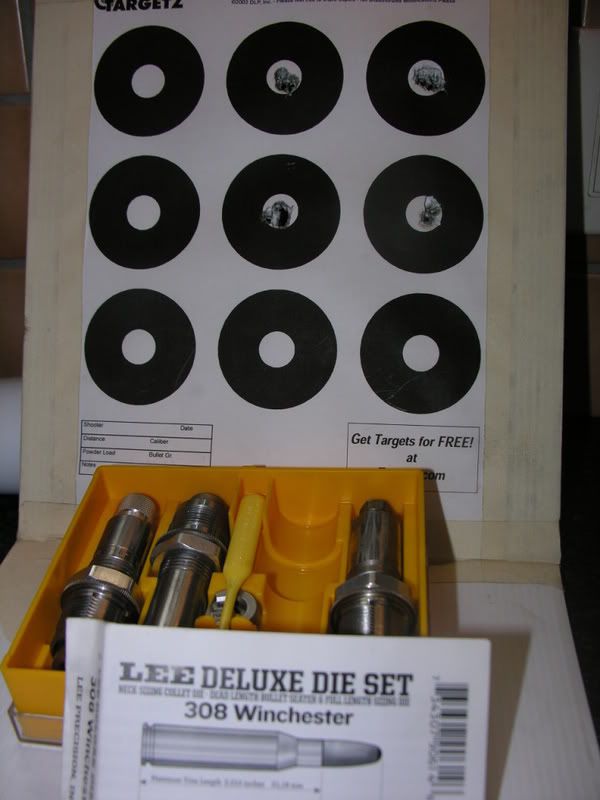
Trying to figure out Lee rifle dies

Great Crouton

Regular
Rating - 100%
1   0   0
Location
Calgary
I was browsing through Lee's website trying to figure out rifle dies, of which they offer many different sets for the same caliber. I'm trying to figure out what set best suits my needs. You guys have mentioned "fire formed brass" a number of times in other threads and to maintain fire formed brass, you want to re-size the neck only. On the Lee website it says these collets which re-size the neck only should be used in bolt action rifles and are not recommended for semi-auto or lever actions. Despite this, they do make neck only dies for things like 30-30 (pretty sure I saw .223 as well) which I found odd.

So for those of you that own .30-30s and/or .223, do you always do a full length re-size?

The rifles I want to reload for are .30-30, .303 and for my brothers .30-06. Could you recommend a set for each? I don't think the .303 or the 30-06 require a crimp although for reasons that are beyond me, I dig the crimp idea. Especially in bullets that have the canulures (sp?)

As always, thanks in advance. You guys have made the learing curve much easier.
 
Seems to me the deluxe rifle die set I have have the collet and standard die (don't own that caliber rifle anymore, haven't looked at the dies in a while). Get the factory crimp die, use it on bullets that have canelures, and everything will be fine.

You can also neck size using a standard die, just back off a tad until you see the whole neck get sized and stop short of the shoulder. Did that for .303 becouse it was a real brass eater.

Good luck.
 
There are single shots and bolt guns in 30-30 (e.g. Savage 219, Savage 340A) and many bolt guns in .223, so there is a market for neck sizing dies for those chamberings.

For bolt guns, I neck size only for target ammo, full length resize for hunting ammo. For pumps and levers I always full length resize. Haven't yet needed a factory crimp die. I do crimp FMJBT bullets at the cannelure, but you can use the regular seating die for that.
 
All the Lee sets are just composed of different assortments of their 4 main dies:
Full length resizing
Neck sizing
Bullet seating and roll crimping
Factory crimping

I prefer to have all 4 dies for a given calibre so I have all options open.

Crimping bullets is generally to make them more durable when handled roughly (hunting or combat usually). I crimp hunting ammo but not range ammo (whether plinking or precision). If ammo is handled roughly (like being kept loose in a pocket while walking through the woods) then the bullets can be pushed further into the cases increasing pressure or nudged out of the cases possibly causing feeding issues or chambering issues. When I crimp I always use the factory crimp dies as it saves crushed necks. To prevent the roll crimp on the bullet seating dies you just have to back it out a quarter turn or so from contact with the shell holder.

I've neck sized ammo for lever rifles without issues. I have had problems with my Norc M305 with neck sized cases so I always full length size for semi's now.
 
You can also neck size using a standard die, just back off a tad until you see the whole neck get sized and stop short of the shoulder. Did that for .303 becouse it was a real brass eater.

Good luck.

No you can't. A full length die comes in contact with the body long before the neck. As soon as you start pushing the body in, the shoulder starts to move forward. Lots of miss information about partial full length sizing on the net, but neck sizing only is is not.
 
I have a bolt action 223 and my father has a bolt action 30-30.

Regarding LEE dies: I have used many different kinds of dies. LEE dies are at the bottom of my list. I would not recommend them.
 
They don't recommend neck-sizing 30-30?

Hmmm...I think I DO neck size for my 30-30 lever action Marlin. I do like crimping too, and I crimp all my rifle bullets except the reduced loads.

I neck size for 303 too. But that's a given.
 
No you can't. A full length die comes in contact with the body long before the neck. As soon as you start pushing the body in, the shoulder starts to move forward. Lots of miss information about partial full length sizing on the net, but neck sizing only is is not.
MY FL dies (RCBS, Hornady, and Lee) touch the sides of the body but don't touch the shoulder until the last 1/16" or so before the shell holder contacts the die. Until it makes shoulder contact I have found no change to the shoulder. I have used FL dies to neck size many times with no change to shoulder dimensions. The cases still cause a firm bolt turn down as they are still fire formed from the shoulder down.

Regarding LEE dies: I have used many different kinds of dies. LEE dies are at the bottom of my list. I would not recommend them.
I find no difference with Lee dies for bullet seating, neck sizing, and factory crimp compared to RCBS or Hornady. I've never used premium or ultra premium dies but I don't have a need for them. My only issue with Lee dies is their full length sizing dies can put gouges in the shoulder from the lube escape hole if the shoulder is being moved more than normal (cartridge conversions and sometimes with 303 British and really loose chambers.) Lots of people voice dislike for Lee dies but others are able to easily load sub MOA ammo with them.
 
Last edited:
No you can't. A full length die comes in contact with the body long before the neck. As soon as you start pushing the body in, the shoulder starts to move forward. Lots of miss information about partial full length sizing on the net, but neck sizing only is is not.
Hello? Anybody home? Take a look at the case. Is it a straight cylinder? No, it is tapered. Therefore, as the reverse tapered die comes down, it is nowhere near the case mouth since the difference in case base and case mouth measurements are vast, agreed? Now, take the case out of the shellholder and colour it with a sharpie, put it back in the shell holder. Now, follow that die down until it touches something or some resistance is felt (after the primer is de-capped), STOP. Raise the die and you will see that the neck has scoring in the sharpie mark. Raise the case again, add a little more pressure until you just touch the shoulder. Check the case again, there are still no marks on the body of the case. Try it again and you will find that as you push the shoulder back, the die comes into contact with the case, starting the sizing of the rest of the case.
Unfortunately, many people see most actions as the entire act and fail to envision it as a complex series of minuscule events that can be stopped, quantified, measured. Just like firing a bullet. Pull the trigger and the result is a bullet out the barrel. But you can break that down into quantifiable events. Do the same here, just by changing the amount you move that press handle.
 
Hello? Anybody home? Take a look at the case. Is it a straight cylinder? No, it is tapered. Therefore, as the reverse tapered die comes down, it is nowhere near the case mouth since the difference in case base and case mouth measurements are vast, agreed? Now, take the case out of the shellholder and colour it with a sharpie, put it back in the shell holder. Now, follow that die down until it touches something or some resistance is felt (after the primer is de-capped), STOP. Raise the die and you will see that the neck has scoring in the sharpie mark. Raise the case again, add a little more pressure until you just touch the shoulder. Check the case again, there are still no marks on the body of the case. Try it again and you will find that as you push the shoulder back, the die comes into contact with the case, starting the sizing of the rest of the case.
Unfortunately, many people see most actions as the entire act and fail to envision it as a complex series of minuscule events that can be stopped, quantified, measured. Just like firing a bullet. Pull the trigger and the result is a bullet out the barrel. But you can break that down into quantifiable events. Do the same here, just by changing the amount you move that press handle.

Hello?? anybody with reading comprehension skills out there?? Where did I say the die hits the case mouth first? I said the die hits the body first before the neck.

I understand the concept of partial FL sizing (neck only with FL die), but my experience has been that it can be hit and miss. My guess is it depends on the case in question, the taper on the brass, the actual chamber dimensions, etc must all come into effect. As an example, when I sharpied a 270 win case and started to run it through my LEE FL die with the decapping pin removed, the die rubs the sharpie off the body of the case BEFORE the neck reached deep enough into the die. I know some modify their FL dies with a dremmel tool as to ensure there is no body contact, maybe this isn't an issue in most cases. In my experience, as witnessed, You cannot make a blanket statement that you can use a FL die for neck sizing only. I buy collet neck size only dies, and my bolts cam down without resistance.
 
I have a bolt action 223 and my father has a bolt action 30-30.

Regarding LEE dies: I have used many different kinds of dies. LEE dies are at the bottom of my list. I would not recommend them.
Neither would I. :bsFlag:
These dies suck
31-10-11.jpg
 
Nice shooting man! What range was that at?

St Jacques Le Mineur near Montreal 100Y dead calm that morning.
Savage 10BA 42.3gr of Varget in Lapua brass over a 180gr SMK ignited by a CCI BR-2 primer.
Bullet was seated 0.010" off the lands.
I still have 20 rounds loaded still from last fall. I can't wait for the snow to melt to get back out there.
Maybe I'll go this weekend if it's nice.

Since it's a bolt gun I neck size till I feel the cartridges it getting difficult to chamber, usually every 3rd loading, then I full length size pushing the shoulder back only 0.002"-0.003".
 
Back
Top Bottom