












































Can anyone identify this WWII pistol?

josquin

CGN Ultra frequent flyer
Super GunNutz
Rating - 100%
22   0   0
Location
Mission, B.C.
I came across this on Shootersforum. The comment from the OP is as follows:
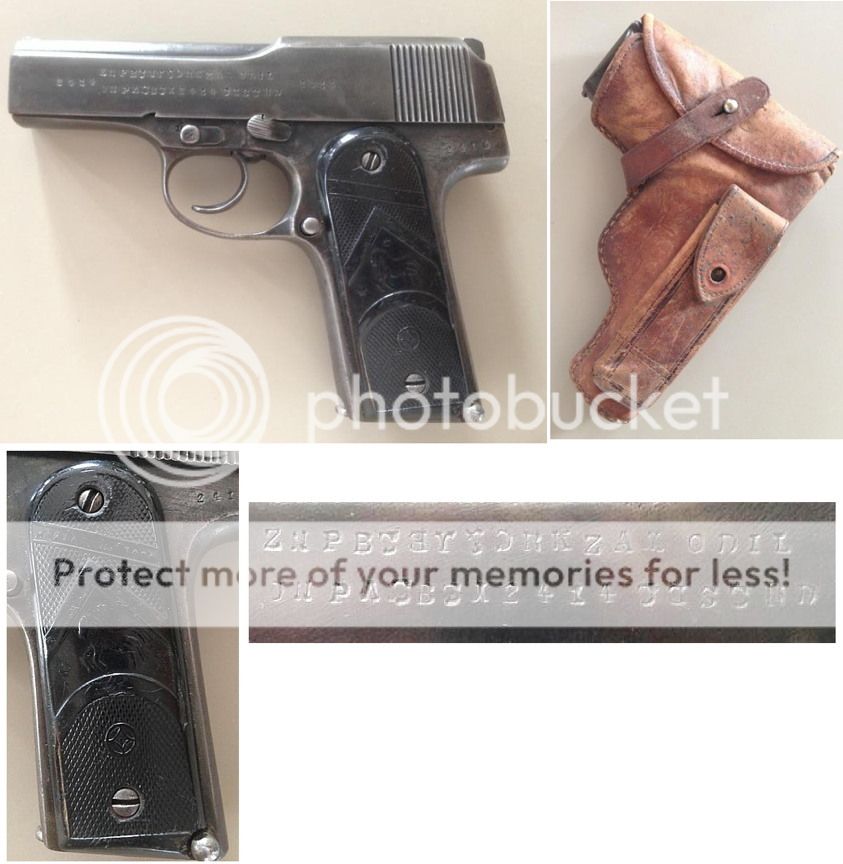
I'm looking to identify the pistol pictured. It looks very similar to some Tokarevs and some older Colt's but I can't seem to find an exact match. It's stamped with a language I haven't been able to identify either. The grips may not be original because the screws holding them on are not, so I hate to use them as the identifying feature. I have no origin info as my Grandfather has passed on. I just know it came back from his time over seas during WW2.

Mysterypistol_zps69f94fc8.jpg


The script is particularly interesting. It's not Russian (I asked my gf's mother, who is Russian) and even googled "languages that use Cyrillic alphabet" but couldn't find anything that matched. Not Greek either....

One comment on Shooter's forum was that it looked lilke a "Little Tom" (designed by Alois Tomiska), some of which were made in .32 ACP. The scalloped design of the slide is very similar but not the rest of the gun.
 
Last edited:
Maybe some version of a Menta or Beholla. There were quite a few small German pistol manufacturers around the turn of the century. Perhaps a copy or sold to some Balkan police or military that used the Cyrillic alphabet. (Serbia, Bulgaria etc.)
 
Maybe some version of a Menta or Beholla. There were quite a few small German pistol manufacturers around the turn of the century. Perhaps a copy or sold to some Balkan police or military that used the Cyrillic alphabet. (Serbia, Bulgaria etc.)

Those names are completely new to me! I checked the alphabets for Serbian, Macedonian, Bulgarian and Romani and none seems to contain the Z, N or reversed B. But the Balkan region sounds likely.

:) Stuart
 
Could that language be Basque(or Euskara)?

That looks like one of the millions of little sidearms the Spanish firearms industry made during WWI and II.
 
Could that language be Basque(or Euskara)?

That looks like one of the millions of little sidearms the Spanish firearms industry made during WWI and II.

Don't think so. Basque uses the Roman alphabet. The alphabet on this pistol seems to be made up of spare parts from several other languages (sort of a linguistic platypuss.)

:) Stuart
 
Looks like a Menta but the trigger is different as well as the grips.

Maybe some version of a Menta or Beholla. There were quite a few small German pistol manufacturers around the turn of the century. Perhaps a copy or sold to some Balkan police or military that used the Cyrillic alphabet. (Serbia, Bulgaria etc.)
 
A number of guns made in China between the wars are based on European designs and have random western looking letters for markings to fool non-speakers of the language. Could be one of those?
 
Need an enigma machine.

Pretty much. "Nyles" may have a good clue here; his comment reminded me of the "Khyber Pass" versions of the Martini rifles, which had some odd versions of "English" markings, stamped by people who didn't actually speak much English.

In the meantime, I decided to "think outside the box" and sent an e-mail to the Dept. of Slavic Studies at Brown University to see if any of their faculty might recognize the text.

:) Stuart
 
Gentlemen - this is not the Cyrillic alphabet, nor is it the Roman, but a mish-mash of both, along with Greek upper and lower case letters. A few of the Roman letters are upside down, as is the letter 'W', so I go along with Nyles 100%. True, the shape of the slide at the rear, that are redolent of Tomiska, but the trigger appears to be a double-action type although I'm likely to be wrong.

It is either a Khyber Pass special, or a Chinese 'not-quite-a-copy' of anything, like the VERY odd semi-broomhandles/Colt M1911 hybrids that turn up now and then.

My $0.02.

tac
 
Slide gibberish (for that is what it is) is there just to hide the serial number of the slide, which matches the number on the frame.

The forwardmost number on the slide appears to be an issue number.

This appears to be a WWI design, but has anyone noticed that it is DOUBLE-ACTION or certainly appears to be?

Double-actions were introduced in the 1930s.

I would REALLY like to get a better look at those grips. Mounted Knight generally suggests something by PIEPER; their trademark was a rollmark of the Chevalier Bayard, who murdered every man with a gun who he found. Called "le chevalier sans peur et sans remorse", he was finally killed with a gun: fitting. PIEPERS generally will have Liege proofmarks.

It's not in the Adolf Frank catalogue.

It is nothing adopted by any MAJOR military, so you have to look toward the smaller countries.

I realise that this is little help, but the more we know what it is NOT, the less blind alleys to run down in the dark.
 
WW2 partisans made their own weapons sometimes from scratch (think the Polish Bechowiec SMG) or modified another weapon for concealment (if I recall correctly there is a cut down Mosin Nagant or Mauser rifle in a Czech museum that Soviet partisans used as a pistol).

This could be anything that any insurgent, Khyber Pass or Balkan or Soviet, put together to kill the enemy. The slide is reminiscent of a Menta or Beholla; the frame and grips??? Need more, better, pics. What are the insignia and lettering on the grips. Are there any words on the frame like Feu, etc.

Or it might be, as suggested, an early pistol that is just unfamiliar.
 
Last edited:
Back
Top Bottom






















