
- Location
- West Quebec
There were a few bouqets of flowers, so someone either visited, or had them sent.
I just thought it was an interesting piece of WW2 history in my otherwise bland town.
Good research ... a small part of our untold history













































There were a few bouqets of flowers, so someone either visited, or had them sent.
I just thought it was an interesting piece of WW2 history in my otherwise bland town.
This account of Eisenhower's treatment of POW's really made me angry. I could understand this treatment of the SS, but the ordinary soldier that was drafted by his country, no. It was worse than Andersonville during the American civil war because Eisenhower had the food. It's ironic that this "champion of liberty" did to the POW's what Hitler did to the Jews. This stuff is still going on in Quantanimo.That depends on where the German POWs were. The ones who were in Russian camps very likely were worked to death or executed.
Hundreds of thousands of German soldiers died in US POW camps after the war ended.
http://whale.to/b/bacque1.html
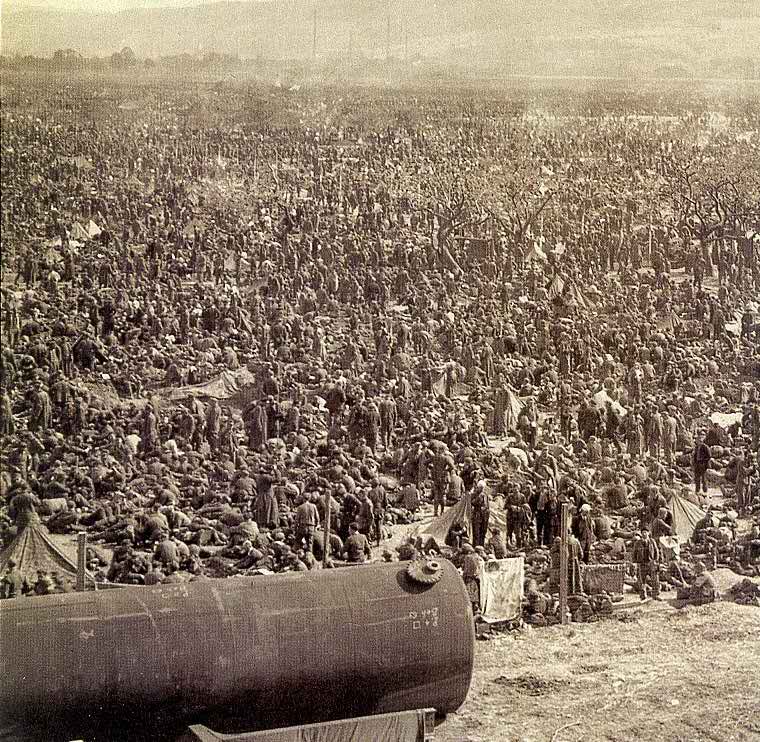

Academic reviewers question three major aspects of Bacque's work: his claims that there was no post-war food shortage in other European countries; Bacque's estimate of the number of German deaths; and the allegation that Eisenhower was deliberately vindictive. Bacque's critics note many of the German soldiers were sick and wounded at the time of their surrender, and say his work does not place the plight of the German prisoners within the context of the grim situation in Western Europe in 1945 and 1946.
Writing in the Canadian Historical Review, David Stafford called the book "a classic example of a worthwhile investigation marred by polemic and overstatement."[1] R.J. Rummell, a scholar of 20th-century atrocities, has written that "Bacque misread, misinterpreted, or ignored the relevant documents and that his mortality statistics are simply impossible.".[2] More recently, writing in the Encyclopedia of Prisoners of War and Internment, S. P. MacKenzie states, "That German prisoners were treated very badly in the months immediately after the war...is beyond dispute. All in all, however, Bacque's thesis and mortality figures cannot be taken as accurate".
This account of Eisenhower's treatment of POW's really made me angry. I could understand this treatment of the SS, but the ordinary soldier that was drafted by his country, no. It was worse than Andersonville during the American civil war because Eisenhower had the food. It's ironic that this "champion of liberty" did to the POW's what Hitler did to the Jews. This stuff is still going on in Quantanimo.
The POW who as executed was a German Jew who had managed to avoid detection. He was drafted. Toward the end of the war he deserted, and hid until the Allies liberated the area. He then surrendered himself. Put into a camp, he was detected, tried and shot with the cooperation of the Canadians.
I'm not too sure where you got this from, but I can say that this isn't quite the case. Two PoWs were murdered at the camp in Medicine Hat by fellow PoWs, all deemed to be pro-Nazis. Both of the PoWs were captured in North Africa and the Canadian guards had nothing to do with the murders. If you are interested, there's quite a bit on the web about it, including this story about the execution of the murders.
Like other prisoner of war camps in Canada, Medicine Hat camp No. 132 had its own internal police force, its own hierarchies and government, its own systems of discipline. Though the camp was guarded on the outside by Canadian soldiers, daily life inside the wire was entirely dictated by the German inmates themselves.
After an attempt was made on Nazi leader Adolf Hitler's life that July at his field headquarters in East Prussia, rumours circulated that a revolutionary movement was planning to take over the Medicine Hat camp by force. Canada's highest-ranking prisoner of war decreed from Ontario that anyone suspected of traitorous activities against the German Army was to be identified and killed in a way that looked like a suicide. One of those suspected traitors was Karl Lehmann.
In 1941, Camp 30 was the only camp in the world to house the Third Reich's highest-ranking German officers captured by Allied forces "because Britain wanted to get them as far away from the war as possible," he says. In total 880 stayed there.
Run like a five-star hotel with luxuries that included an indoor swimming pool, theatre and concert stage, the camp's true purpose was given away only by the barbed wire around it.
The occupants had one complaint, which they made to the Red Cross, relates Hodgson: the urinals were too low.
A Luftwaffe pilot who spent time there later wrote: "I am convinced that nowhere in the world did prisoners of war have better housing, better food, better recreation facilities, better educational opportunities, and above all, fairer treatment, than in Canada."
German Prisoners of War in Mississippi, 1943-1946
By John Ray Skates
World War II was truly a world war. All of the major countries and a large number of small nations were drawn into the fight. Even countries that tried to remain neutral found themselves in the conflict either by conquest or by being in the path of the campaigns of the major powers. For example, in 1940, more than a year before the United States entered the war, the major powers — Britain, Italy, and Germany — fought important battles in Egypt, Tunisia, and Libya in North Africa.
Not until November 1942, almost a year after the Japanese attack on Pearl Harbor, did American forces enter the fight in North Africa. U.S. forces made amphibious landings at the North African cities of Casablanca, Oran, and Algiers. German and Italian forces in Libya were then caught in a vise — Americans advanced from the west along the North African coast to Tunisia while British troops advanced from the east out of Egypt. The Germans and Italians had to defend on two fronts — the British front on the east and the American front on the west. (See the maps on the left.)
Afrika Korps becomes POWs
The famous "Afrika Korps," under German General Erwin Rommel, made up of German and Italian tanks and trucks, was besieged in Tunisia and fought on until May 1943. In March, Rommel flew to Germany to plead with Hitler for reinforcements. Instead, Hitler retired Rommel.
Two months later, the Afrika Korps became prisoners of war of the United States and Great Britain. General Jurgen Von Arnim, Rommel's replacement, went into captivity as a prisoner of war along with 275,000 German and Italian soldiers. They were housed in tents surrounded by barbed wire. Food, water and other essentials had to be transported to the German and Italian prisoner-of-war compounds. A shipping shortage plagued the allies. How could they feed and house the German and Italian prisoners in Africa while the United States and Great Britain needed all ships to bring troops and equipment from America for the Normandy invasion? After unloading their cargoes in Great Britain, many of these ships returned empty to the United States.
To help alleviate the shipping problems, a decision was made by the U.S. government to bring the German and Italian prisoners of war from North Africa to prisons in the United States. It would be less burdensome and less costly to house and feed the captured men in the United States. Additionally, the prisoners of war (POWs) could be put to work in non-military jobs. In the last four months of 1943, German and Italian prisoners of war began arriving in the United States from their compounds in North Africa.
A German soldier, who fought in North Africa, kept a diary from his surrender on May 13, 1943, to his arrival some months later at Camp Clinton, just outside Jackson, Mississippi. He and his fellow veterans of the now defeated Afrika Korps were marched and trucked to the city of Algiers in Algeria, North Africa, where they were put on ships that carried them to the Algerian port of Oran. They were then marched to a POW compound in the desert where they were housed in a "cage" (the name used by American soldiers for a barbed wire enclosure).
POWs arrive in Mississippi
Four weeks later the POWs were trucked from the cage back to Oran on the North African coast. There they boarded ships for the journey across the Atlantic Ocean to the United States. After two weeks at sea, the ship docked at the Port of Norfolk, Virginia, on August 4, 1943. At Norfolk the prisoners who were assigned to Camp Clinton expected a slow freight train to carry them to their destination. Instead, they boarded a sleek, comfortable passenger train. Two days later they arrived at Camp Clinton.
Camp Clinton, one of four major POW base camps established in Mississippi, was unique among the other camps because it housed the highest ranking German officers. Twenty-five generals were housed there along with several colonels, majors, and captains. The high ranking generals had special housing. Lower ranking officers had to content themselves with small apartments. General Von Arnim, Rommel's replacement, lived in a house and was furnished a car and driver. Some people swore that General Von Arnim attended movies in Jackson because the movie theater was the only air-conditioned place in town.
Other major POW camps in Mississippi were established at Camp McCain near Grenada, Camp Como in the northern Delta, and Camp Shelby near Hattiesburg. The four base camps were large compounds designed to house large numbers of POWs. Camp McCain housed 7,700, Camp Clinton 3,400, and Camp Shelby housed 5,300. Camp Como originally held 3,800 Italian soldiers, but the Italians were soon moved out of Mississippi and replaced by a smaller number of Germans.
These base camps had most of the facilities and services that could be found in a small town — dentists, doctors, libraries, movies, educational facilities (English language was the most popular course) and athletics (soccer was the most popular sport). POWs were guaranteed by an international treaty called the Geneva Conventions to get food, clothing, and medical care equal to that of their captors.
POWs were housed in barracks that held up to fifty men. Each five barracks had a mess hall with cooks, waiters, silverware, and by all accounts very good food. Food was not a complaint for the prisoners. In fact, most of the food was prepared by German cooks with ingredients furnished by the U.S. Army. A sample breakfast was cereal, toast, corn flakes, jam, coffee, milk, and sugar. A typical lunch was roast pork, potato salad, carrots, and ice water. Supper might be meat loaf, scrambled eggs, coffee, milk, and bread. Beer could be bought in the canteen.
Individual barracks fielded teams for sports as diverse as horseshoes, volleyball, and soccer. Athletic contests among the barracks were highly competitive, and tournaments were arranged to select the winners. Prisoners at Camp Shelby reported the outcome of athletic events in the camp's newspaper, the Mississippi Post.
POWs were allowed to keep their uniforms for ceremonial occasions such as funerals and holidays. These uniforms, however, had already seen much wear. For everyday wear, POWs wore black or khaki shirts and pants with the letters "PW" stenciled in paint on each leg. Winter clothes were wool jackets and pants. Athletic shorts and shirts were issued for games.
Under the Geneva Conventions, officers could not be forced to work. However, soldiers could be required to work if the tasks did not aid their captor's war efforts. If the POWs worked outside the compound, they received a payment of 80 cents a day. This was enough money to buy cigarettes and other items that were available in the prison canteen. Most chose to work. The kinds of work done by these POWs depended on the region in Mississippi where they were housed.
POWs pick cotton, plant trees
....
John Ray Skates, Jr., Ph.D., emeritus professor of history, University of Southern Mississippi, is the author of The Invasion of Japan: Alternative to the Bomb, University of South Carolina Press, 1994.
This account is mostly BS so no reason to be upset. Eisenhower had no love for the Germans but neither did anyone else on the Allied side. The greatest war the world had ever seen had just ended and millions perished and the Germans started it despite whatever crap the revisionist "historians" are peddling today. As for Guantanimo Bay, those terrorist douchebags are on a hunger strike to be released so they can't be doing too badly in the food department.
Actually, the guys in Guantanimo for the most part have never been charged, tried or found guilty of ANYTHING. So I ask you, how do you know they are terrorists? Rally! HOW DO YOU KNOW THAT THESE GUYS ARE GUILTY OF FKN ANYTHING??? Bacause somebody said so?
well they don't just pick up anyone and take them to gb.
So guilty or charged or not, there's usually a reason.
wow!


Actually, the guys in Guantanimo for the most part have never been charged, tried or found guilty of ANYTHING. So I ask you, how do you know they are terrorists? Rally! HOW DO YOU KNOW THAT THESE GUYS ARE GUILTY OF FKN ANYTHING??? Bacause somebody said so?
Why would the grave yard lie about it? They say they are original, I don't know why they would put them there if not genuine, doesn't add anything really.
Love this thread.
Militariacollector. Just heard this on the news this morning about a brand new Alberta POW exhibit at the Royal Alberta Museum: http://edmonton.ctvnews.ca/unique-m...-prisoner-of-war-history-in-alberta-1.1264358
I read your blog last night, very interesting. My grandfather conversed with a few of the German POWs in Alberta during WW2. My grandfather was a recent Mennonite immigrant from Siberia and like many Mennonites at the time was a Conscientious Objector to fighting in the war. But of course he still had to serve his new country of Canada, so he was sent to Alberta to work in the parks. I believe he was sent to Banff, but I will need to check up on that.
Do you have any information on whether or not any prisoners from the Battleship Bismarck were in Alberta during WW2, or just in Ontario? My grandfather has some letters from the POWs he kept in touch with as well a one of those "Ships in a Bottle" that he had made for him supposedly by a German Kriegsmarine POW.
Thanks for all your info. Cheers!
I was getting my hair cut a few years ago, and a customer was telling how when he was a younger man living near Kapuskasing (or maybe Cochrane?), he was working as a gravedigger or for a cemetary. For some reason his name got to the German Embassy in Ottawa, and he took a phone call from a very polite German fellow who asked if he would exhume old POW graves and prepare the remains for repatriation. He quoted some ridiculously high price per grave, and thought he was done. The fellow accepted his offer. That was his summer job. Dig up old graves, repackage the remains and send them back to Germany.

























