US Army Set to Kill Improved Carbine Competition

Maintenance is NOT a weapon issue - all weapons require maintenance.

Some a lot more than others.

The AR system seems to have a lot of critical "wear" items, like the BCG, aluminum USGI magazines, various springs, that appearently sometimes aren't being replaced often enough in U.S. service.
 
The 7.62x39 is a great round out to 200 yards. It hits hard at close range but falls off after that. As for going through barricades.. The 5.56 is better. Velocity wins for going through stuff. A few years ago I took my Tavor and CZ858 up North to a buddies who had a 1/4 section. Lots of metal was shot. The 5.56 will go through stuff the 7.62x39 won't. But the 7.62x39 definately has a heavier hit on impact.

Bottom line the 1:7 twist and heavier 5.56 ammo is a pretty good interm solution rather than going to a new round. With AR systems going to a new round is pretty easy. Or adding in DM choices such as 70 grain 5.56/223 along with AR10 options.

All the arguments made so far on this thread are exactly the arguments the ADCOR entry was designed to address. It's a hybrid system. DI system off the barrel to a piston held in the free float handguard. No barrel harmonics. It uses a long stroke AK like piston so no slapping of the bolt. Add in a free float FN249 barrel with 1:7 twist rate. There's your reliability and accuracy improvement. Along with an automatic dust cover that also acts to scrape out any crud that does get into the receiver.

The side charging handle also makes life easy for DM rifle users along with multiple optics and prone shooting. It's ambi and none reciprocating. Plus it enables you to lock the action open with only the weak side hand and still pointed on target if necesary. As the original charging handle is still in place it adds duplication in case of a failure. Break the regular charging handle? No problem you can use the side one until you can fix it. Like an aircraft system it adds an extra layer of backup in case of a failure.

Financially this would simply be a software upgrade to existing machinery. Only the upper is changed. Even then it's mostly the same parts as a current m16/M4, AR15.

The problem of course is money and the US has the out of nothing offering huge improvents as the current carbine overall is very good. But using this argument which they've used before makes one wonder why the C7 was so highly regarded? Technically it was only an incremental upgrade over the US version. Yet it's hammer forged heavier barrel etc won out when tested by UK special forces and Denmark. The Americans even made some changes later on. Seems it might be worth it to upgrade and the ADCOR is essentially just an upgrade of the existing system.

I'd love to see the phase II results. I would also of course have wanted to see phase III completed. The companies that went on to phase II may have a valid case regarding a lack of good faith here as it appeared the US really haven't had any true intentions of finishing this trial nevermind actually producing the winning design.
 
The 7.62x39 is a great round out to 200 yards. It hits hard at close range but falls off after that. As for going through barricades.. The 5.56 is better. Velocity wins for going through stuff. A few years ago I took my Tavor and CZ858 up North to a buddies who had a 1/4 section. Lots of metal was shot. The 5.56 will go through stuff the 7.62x39 won't. But the 7.62x39 definately has a heavier hit on impact.

5.56 {and 5.45} might be better for going through metal sheets that are struck squarely but 7.62x39 will typically do much better on wood, masonry, brush, typical building materials and vehicle bodies, as well as complex cumulative barriers.

Also remember that the crusty old 7.62x39 surplus we get is hardly the last word in military ammo in that caliber.
 
Kind of like taking a car battery on patrol?

You never know you might need it.

Thats why I have been taking my waffle maker on EX for years, some waffles might need to be made.


Your not in a Mech unit are you? Waffle makers work great in the back of a LAV....lol
 
Older Slides

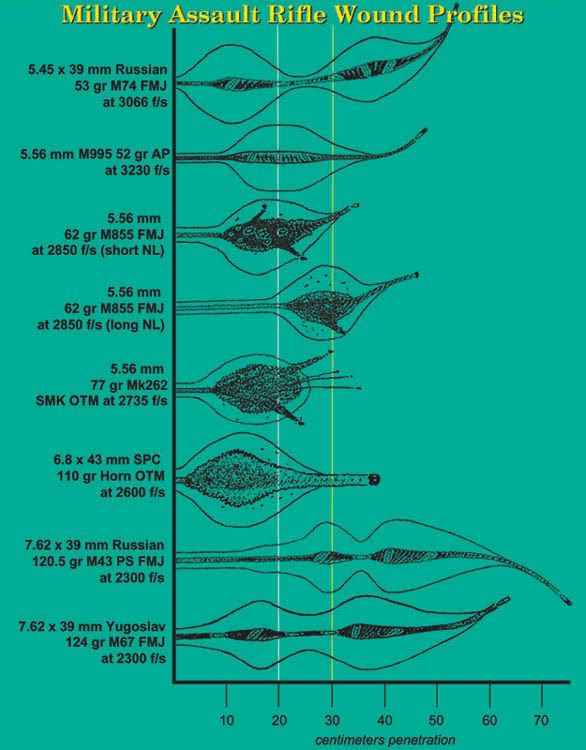
40052-MilitaryAssaultRifleWPcopy.jpg


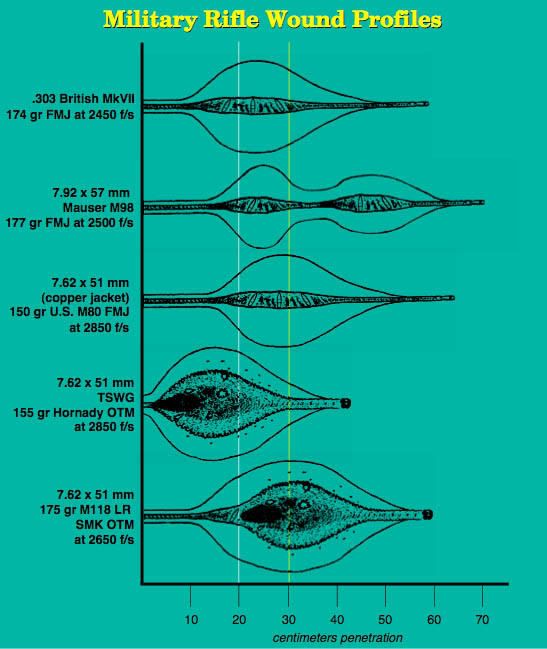
40053-MilitaryRifleWPcopy.jpg


870P - SOST or other newer ammuntions in 5.56mm will do a lot better than the best 7.62x39 out there.

7.62x39 is a pretty anemic round - we have many folks running around hit with it, that would not be around if it had been a 5.56mm round.

The key issue is bullet placement is more key than anything, however bullet design and impact velocity and angle of attack all have input into the wounding profile.
 
Hitting your target is the first step in shot placement.
Training is what makes hits possible.

People who have never shot an AK expousing them makes the internet possible.]
 
5.56 {and 5.45} might be better for going through metal sheets that are struck squarely but 7.62x39 will typically do much better on wood, masonry, brush, typical building materials and vehicle bodies, as well as complex cumulative barriers.

Also remember that the crusty old 7.62x39 surplus we get is hardly the last word in military ammo in that caliber.

Speaking of complex barriers.....Look at the Super Cavitating MEA rounds for the military calibers and their ranges thru water.
 
870P - SOST or other newer ammuntions in 5.56mm will do a lot better than the best 7.62x39 out there.

7.62x39 is a pretty anemic round - we have many folks running around hit with it, that would not be around if it had been a 5.56mm round.

The key issue is bullet placement is more key than anything, however bullet design and impact velocity and angle of attack all have input into the wounding profile.

I have no doubt that a 5.56 that yaws and fragments optimally will leave the target in worse shape medically, but short of maybe the original M43 spec 7.62x39 ammo, you don't really hear of that caliber being an inadequate fight stopper.

Some of those rounds in those slides, example the .303 Mk7, don't seem to be all that impressive in ballistic gel but DO NOT have a reputation for failing to put folks down and keep them down.

Anyway, the newer 7.62x39 ammo like the Ulyanovsk 8M3 and 7N23 are probably better technical comparisons to the newer 5.56 stuff.
 
Hitting your target is the first step in shot placement.
Training is what makes hits possible.

People who have never shot an AK expousing them makes the internet possible.]

I've shot AKs in 7.62x39, 5.45, 12 gauge and 5.56, with the last being select fire.

Basically, they're up to the task if you are.
 
I have no doubt that a 5.56 that yaws and fragments optimally will leave the target in worse shape medically, but short of maybe the original M43 spec 7.62x39 ammo, you don't really hear of that caliber being an inadequate fight stopper.

Some of those rounds in those slides, example the .303 Mk7, don't seem to be all that impressive in ballistic gel but DO NOT have a reputation for failing to put folks down and keep them down.

Anyway, the newer 7.62x39 ammo like the Ulyanovsk 8M3 and 7N23 are probably better technical comparisons to the newer 5.56 stuff.

I had a long response but it seems to be lost in the vastness of space.

Regarding Mk7 .303Brit - my guess is that folks could not get and post on the net from their couch.
 
303 Ball is not dissimilar to Mk118 308 LR Ball at 300-500m - it's within a couple of percentage points for energy. It's been a while since either was considered standard line infantry ammo, so kind of OT. Round development on the 303 concluded before the invention of the jet, so yeah, it's probably not optimum.
 
Last edited:
Older Slides

40052-MilitaryAssaultRifleWPcopy.jpg


40053-MilitaryRifleWPcopy.jpg


870P - SOST or other newer ammuntions in 5.56mm will do a lot better than the best 7.62x39 out there.

7.62x39 is a pretty anemic round - we have many folks running around hit with it, that would not be around if it had been a 5.56mm round.

The key issue is bullet placement is more key than anything, however bullet design and impact velocity and angle of attack all have input into the wounding profile.

My major takeaway from the slides: Being hit by any kind of military rifle bullet (or probably civilian sporting one, for that matter) is going to hurt like blazes and pretty much ruin your whole day. And if the shooter was either well-trained or lucky and placed the shot well, it will also have a highly deleterious effect on your future enjoyment of life.

Would that be a fair summary of these slides?
 
My major takeaway from the slides: Being hit by any kind of military rifle bullet (or probably civilian sporting one, for that matter) is going to hurt like blazes and pretty much ruin your whole day. And if the shooter was either well-trained or lucky and placed the shot well, it will also have a highly deleterious effect on your future enjoyment of life.

Would that be a fair summary of these slides?

No. The 5.56 is still not lethal by the sheer willpower of the internet.
 
I had a long response but it seems to be lost in the vastness of space.

Regarding Mk7 .303Brit - my guess is that folks could not get and post on the net from their couch.

Or it could be that not many of the folks who used that round {and its contemporaries} in combat are on the internet, or even around anymore?

My grandfather fought with the PPCLI in Korea, and while he would never talk about his combat experiences directly, he was pretty emphatic on its effectiveness.

Anyway, I mentioned the .303 to point out that there's sometimes a difference between real world and lab effectiveness, if the M855 worked as advertised, there would be little need for the SOST and M855A1.
 
I'm not an experienced shooter by any means but from what I've read 5.56X45 travels much faster and doesn't decelerate as quickly as 7.62X39 but being a lighter round, it doesn't have as much penetration as the latter at short to medium ranges. Shortening the barrel to less than 16 inches causes noticeable decreases in muzzle velocity and there's significant drop off when going shorter than the M4's 14.5 inches. This is why if you look at the kit of some of the SOF in Afghanistan they're often issued with both a standard 14.5 inch upper and a 10.3 inch MK18 upper they can switch it out with. I'm not sure what the difference in ballistic characteristics between the various types of 5.56 is though.
 
Back
Top Bottom