M1 Garand stock fit

D-BOMB

CGN Regular
Rating - 100%
59   0   0
Location
Calgary, Ab
Hey all,

So I have had my garand for a good amount of time now, havent shot it to much and definitely have never abused it. Today I noticed it has a very small amount of play of the receiver, about 1 - maybe 2mm of forward and rearward play. I understand these were war time finished rifle's (mine is a 1942) but is this normal? There is no lateral play at all. I tend to get a little OCD over things like this haha.

Thanks!

 
Sounds like the stock is very dry.

Try giving it a good few coats of BLO mixed 75% BLO mixed with 25% pure turpentine so that it is thinner and really soaks in. Apply it liberally and let soak in for 30-60 minutes then wipe off with paper towels and then really rub it dry with an old sock or something. Wait a few days between coats. Make sure you burn the paper towel in your wood stove or something as just leaving it wet with oil will allow it to smolder and self combust. Also make sure to leave the sock dry outside or something where it can dry without combusting. It worked for me with my slightly loose garand and M14 stocks.

Ian
 
Fore and aft play in the stock is caused by recoil forces compressing the 2 vertical wood surfaces behind the rear legs of the receiver. This happens to a lot of used Garand stocks over time. The best way to fix this is to cut a thin wooden shim to fit the 2 wood surfaces and then glue them in. Make sure that the vertical surfaces are free of oil so that the wood glue sticks. Use acetone on a Q tip to degrease these areas. You don't need to add much of a shim. I've fixed quite a few stocks by cutting shims from the thin wooden aromatic wrappers that used to come in the old aluminum cigar tubes. I don't smoke any more, but might need to smoke a couple see-gars just to replenish my shim stock.

There must be no fore/aft play in the stock for the rifle to shoot well. Another area that frequently requires shimming is the 2 surfaces on either side of the mag well where the 2 edges of the trigger housing sit. there must be discernible resistance when the trigger guard is swung up to lock in the trigger housing. Sometimes this can be fixed by finding a new trigger guard with full round/unworn locking lugs. Other times you need to glue a wooden shim to these 2 surfaces to tighten up the fit here. I cut pieces of the pre-glued, iron-on birch veneer edging for this. They stain well and will stay in place. Another, less intrusive, way of tightening up the fit is to cut strips from a piece of a magnetized pad and put them on the edges of the trigger housing before installing it.
 
Last edited:
I would use "RAW" linseed oil and not BLO, linseed oil dries with contact with air and BLO contains a chemical drier. The reason raw linseed oil was used is because the stock would stay "hydrated" longer, meaning the "RAW" linseed oil inside the wood dries very slowly, and BLO doesn't need contact with air to dry.

Try these shims or make your own if the linseed oil doesn't fix the problem.
(my M1 stock was loose and these shims tightened up my stock and stopped any movement)

M1 Garand Stock Shim Kit.

http://www.rcarms.com/15.html

NOTE: When a wooden canoe is finished it first gets many coats of raw linseed oil until the wood stops soaking up the raw linseed oil. The canoe then gets several coats of varnish to protect the surface of the wood and to seal the surface of the wood and thus prevent air contact with the linseed oil. This prevents wood shrinkage and the canoe from leaking.

BOILED linseed oil was never applied to military rifles and the manuals state to use raw linseed oil only.
Raw linseed oil is like the moisturizing oil your wife puts on her body to prevent the skin from drying out and prevent wrinkles.
 
Last edited:
Very interesting! Thanks. The RC arms shims look great but my trigger guard locks up tight. It seems to be the contact points where the action meets the forend that has shrunk.
 
Thanks for the tips so far guys! I also read that a guy soaked the channels where the action seats with water to swell the wood a bit. Thoughts?
Water will swell the wood fibers, but it will dry out and compress again. You are best to use a glue in wooden shims as I described. One could go a little further and hog out the entire area and glue in walnut blocks which could then be dressed down until the action fit tightly, but I find that the shims are a quick and easy fix.
 
"...linseed oil dries with contact with air..." Usually doesn't dry at all. Stays sticky forever. Raw linseed oil is a laxative for cows.
The M1 Rifle's normal field stripping sometimes led to stocks getting bash about a wee bit. So does being 70 years old. Assuming it has the original stock. A few coats of BLO might sort it out, but it's a battle rifle, not a target rifle. A bit of looseness is normal.
 
Alright guys so I tried some RLO and the stock is a little more snug, but does still have that very mild fore and aft play.

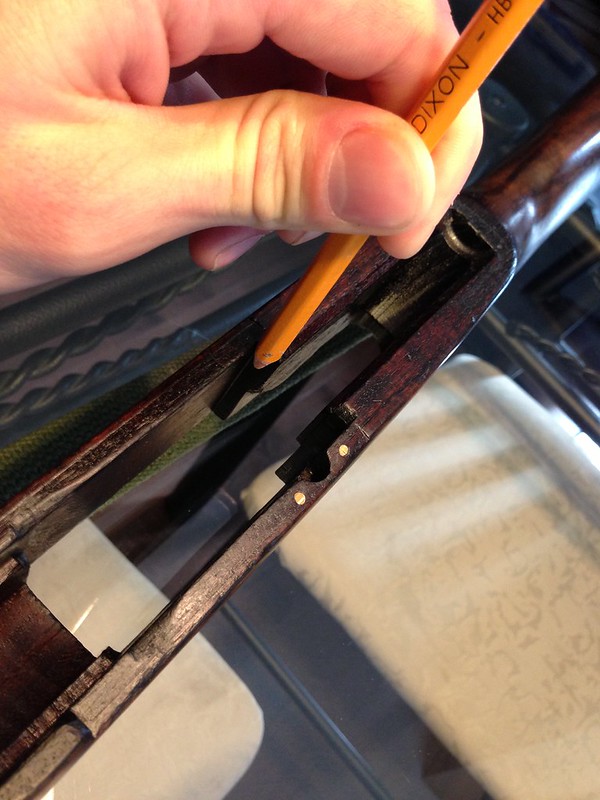
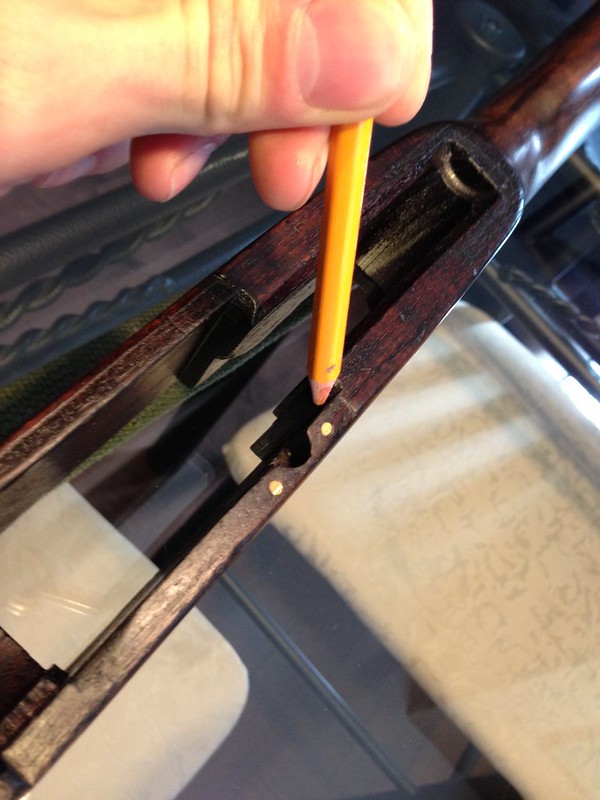
Just to be clear in the two photo's is where I should be shimming this stock? Also I would really rather not do anything permanent to the timber, I have been doing some reading and found that some have been using pieces cut from pop cans. Would it be acceptable to cut shims to fit using something like this? It seems like the trigger group would ensure that the shims could not move into the action, and it would not be a permanent alteration to the stock.

8741840782_ca56e8373e_c.jpg


8741840734_daeec0be12_c.jpg
 
Yes, those are the 2 areas that need to be shimmed. The linseed oil treatment is not a promising solution as these surfaces are already well compressed to the point where linseed will not really soak into them. The best use I've seen for linseed to improve wood/metal fit is with old, dried out wooden handgun grips. In this case the grips are removed and then soaked in a jar of linseed for a few days to permit the oil to soak in and expand the wood somewhat. This is not a compressed wood problem though. I'm wondering why you are reluctant to glue in 2 wooden shims as outlined? I can see that the stock has already been repaired by running in a couple of headless brass threaded pins around the cutout for the clip latch. You could use beer/pop can shims, but it will be tough to hold them in place while the stock is being installed every time that the rifle is stripped.

Glued in wooden shims are the best solution for this situation. If you decide to go this route you will need to degrease the 2 surfaces with acetone before gluing in the shims. Ordinary carpenters glue works well, provided that the surface of the wood has been well de-oiled first. You can also consider using pieces of a brown colored report cover for a shim. These fiber covers are already compressed when being made, so they will maintain their original thickness and won't compress too much, if at all. What works well is to stand the stock on end in a well padded vice in order to glue in the shims. Its a good idea to locate a piece of steel to add some weight to the shims while they dry. White glue won't adhere to the steel so it can be removed from the dried shim without any chance of removing the shim in the process.
 
Thanks for the tips Purple! I just may do it, I am just a little reluctant because I can't help but feel a little bit like bubba by doing permenant alterations to any milsurp.

Has anyone used a non permenant shim?
 
FWIW the military repaired Garand stocks in a number of ways incl;

-cutting out the rear bearing surfaces for the receiver lugs and gluing in walnut blocks which were then dressed down to tighten fore/aft stock fit
-using headless brass screws as repair pins to stop cracks in areas like the cut out for the clip latch, as seen in this stock
-cutting out the seats for the trigger housing at the bottom of the mag well and then gluing/pinning in walnut blocks which were then dressed down for a tighter fit
-cutting out and glass bedding this same area incl putting a glass pad on either side of the rear tang of the trigger housing
-filling gouges with wood dough or a mixture of shellac and sanding dust

The wooden shims that I've described are short of being a permanent GI repair, but they are very inconspicuous and do the job. I've used them on many Garand stocks, incl a stock on a pretty rare M1C sniper rifle. I've also used the brass repair pins to stop/repair cracks on a number of military Garand stocks, incl a couple with incipient cracks around the clip latch inletting. There are other things that can be done on MILSURPs to improve stock bedding and accuracy. For example, I recently re-barreled and assembled an 03A3 Springfield in a nice original 03A3 stock. The wood in this stock around the stock bushing had become compressed to the point where there was insufficient stock pressure on the barrel at the forend. The solution was to drill out and re-profile a metal Tee nut of suitable shape to shim the bearing surface around the rear stock bushing and "tilt" the barrel back into hard contact with the forend tip. This mimics the shims that the arsenals used on these rifles for the same purpose. No 4 Lee-Enfield often need shimming at the rear of the recoil lugs in order to improve stock fit for accuracy. If a person wants to set these rifles up for accurate shooting there are things that can be done short of towering bubba-type modifications.
 
Back
Top Bottom