reloading data record

guntarget

Member
Rating - 100%
1   0   0
Location
B.C. CANADA
Hey Everyone
Does anyone know of a sight that has blank reloading data record sheet.

I'm just starting to reload and has told a bout keeping a record of the different types of loads that I'm doing and their performance at the gun range.

If anyone knows a good sight for blank sheets that would be great or can give me ideas.

Thanks
 
Last edited:
This is what I use. I print them up on 5"x 8" card stock. (recipe cards)

250_110_Accubond.JPG
 
"...black reloading data record sheet..." That supposed to be 'blank'? Save yourself a lot of fuss, bother and expense(anything with the word 'gun' or 'firearm' on it will cost more) by just buying a note book in a dollar store.
I've only ever kept records of the load giving the best group. Don't care about the rest. Put the data right into my manual from a wee note book I used on the range.
 
I think I paid $7 or maybe $9 for a Lyman scribbler at WSS. To me having the pages bound together with the data spots already set up is worth the cost of a breakfast.
Just my 0.02
Clint
 
I looked at a bunch of examples online and just made my own in Microsoft Excel with all the fields I require. I also keep a second set of more detailed records (including weather conditions when shooting) in a hard cover notebook I got for $3-4.
 
I write all my load info in my hornady manual,,,the target I shoot with my best load hangs in my reloading room with all it's data,,but always double check and check again before you start charging your rounds,because just recently I had two rounds out of my 223 with extreme pressure sign's ,,and today I pulled my rounds just to discover I looked at my 40gr v-max target and load data and not my 50gr v_max target and load data. I was 4.0gr past max load,,I am lucky I still have all my body parts...
 
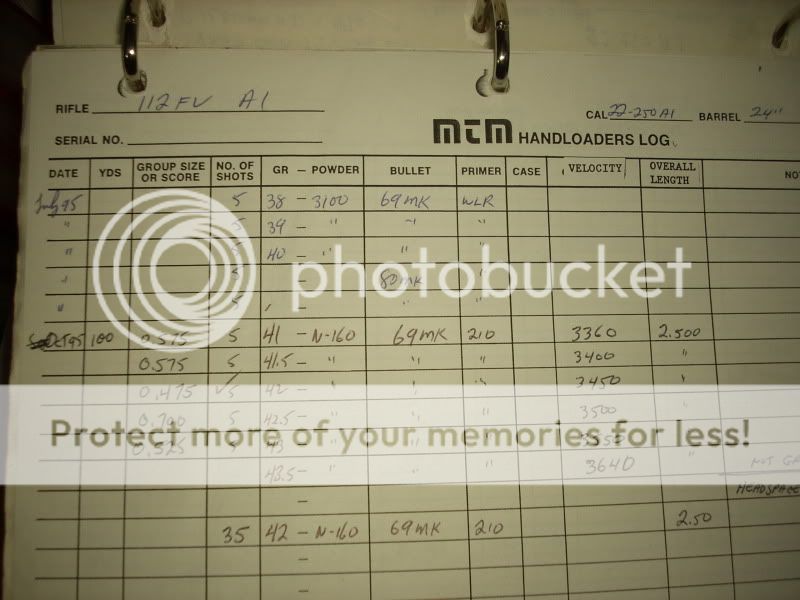
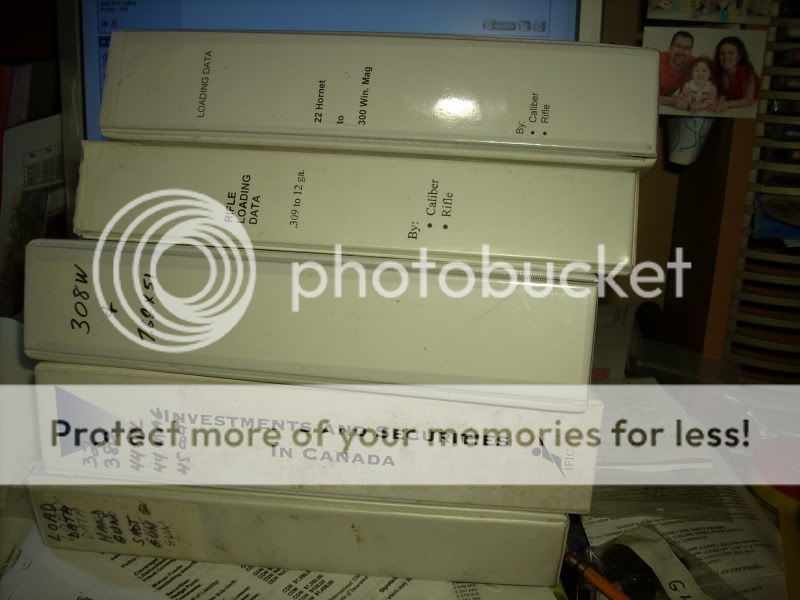
I use 3 ring binders with a tab for each gun (not for each caliber) Each gun has its own set of pages. The binders are 222 to 30 cal; 309 to 12 ga, Handgun and a dedicated binder for all the 308 rifles and all the 223 rifles.

It is easy to make an entry of how a load worked.

LOADLOG.jpg


LOADLOG2.jpg


LOADLOG1.jpg
 
I use a thin binder for each rifle, loading data and targets are included along with every load type every tried, good, bad, or failure.
 
I use graph paper that goes into a 3 ring binder for each calibre. On the graph paper I include:

Calibre/rifle - Date - Time - Weather - Location(Altitude)

Bullet - Powder/Charge - Primer - Seating Depth

Velocities - Results/Notes

This method is the easiest for me because I move the sheets of paper from my reloading book to my clipboard for the field then back to my book. I keep all of my results and make them as detailed as possible that way I don't waste my time trying something over and over, as well I know when a load may be worth revisiting. I also make scale diagrams of the groups while I shoot so that I don't have to go back to the target for reference, although I keep all of my targets during load development to refer to later if required.

I believe the Excel spreadsheet would be a great option for load data, you can customize it however you like.

In my binders I also have round count sheets for each rifle.
In each ammo box(I only use 50 rd boxes) I keep a small sheet that tells me where in the reloading process I am for brass sitting in a tray on the bench and a load count for the brass. This helps for info on brass life or tells me my pressures are up if I'm getting less loadings than expected. It also tells me which lot of brass I am using.

A lot of this is over kill but all of the information keeps me from scratching my head later on wondering about "what happened that day?" or "why is this not working now?'...
 
I use 3 ring binders with a tab for each gun (not for each caliber) Each gun has its own set of pages. The binders are 222 to 30 cal; 309 to 12 ga, Handgun and a dedicated binder for all the 308 rifles and all the 223 rifles.

It is easy to make an entry of how a load worked.

LOADLOG.jpg


LOADLOG2.jpg


LOADLOG1.jpg

Yep, just like my volume set ;-)
 
Lately (the last few years) I have used the reload bench reload data log. I like it and suggest you make a binder or binders as others have done. It makes it easy to go back and check what worked for you in a cartridge and what worked for you in a particular firearm.
 
I use graph paper that goes into a 3 ring binder for each calibre. On the graph paper I include:

Calibre/rifle - Date - Time - Weather - Location(Altitude)

Bullet - Powder/Charge - Primer - Seating Depth

Velocities - Results/Notes

This method is the easiest for me because I move the sheets of paper from my reloading book to my clipboard for the field then back to my book. I keep all of my results and make them as detailed as possible that way I don't waste my time trying something over and over, as well I know when a load may be worth revisiting. I also make scale diagrams of the groups while I shoot so that I don't have to go back to the target for reference, although I keep all of my targets during load development to refer to later if required.

I believe the Excel spreadsheet would be a great option for load data, you can customize it however you like.

In my binders I also have round count sheets for each rifle.
In each ammo box(I only use 50 rd boxes) I keep a small sheet that tells me where in the reloading process I am for brass sitting in a tray on the bench and a load count for the brass. This helps for info on brass life or tells me my pressures are up if I'm getting less loadings than expected. It also tells me which lot of brass I am using.

A lot of this is over kill but all of the information keeps me from scratching my head later on wondering about "what happened that day?" or "why is this not working now?'...

How about taking a photo of your groups with a cell phone or small camera.. I cleaned a lot of old targets out of my file cabinet this way..
 
Back
Top Bottom