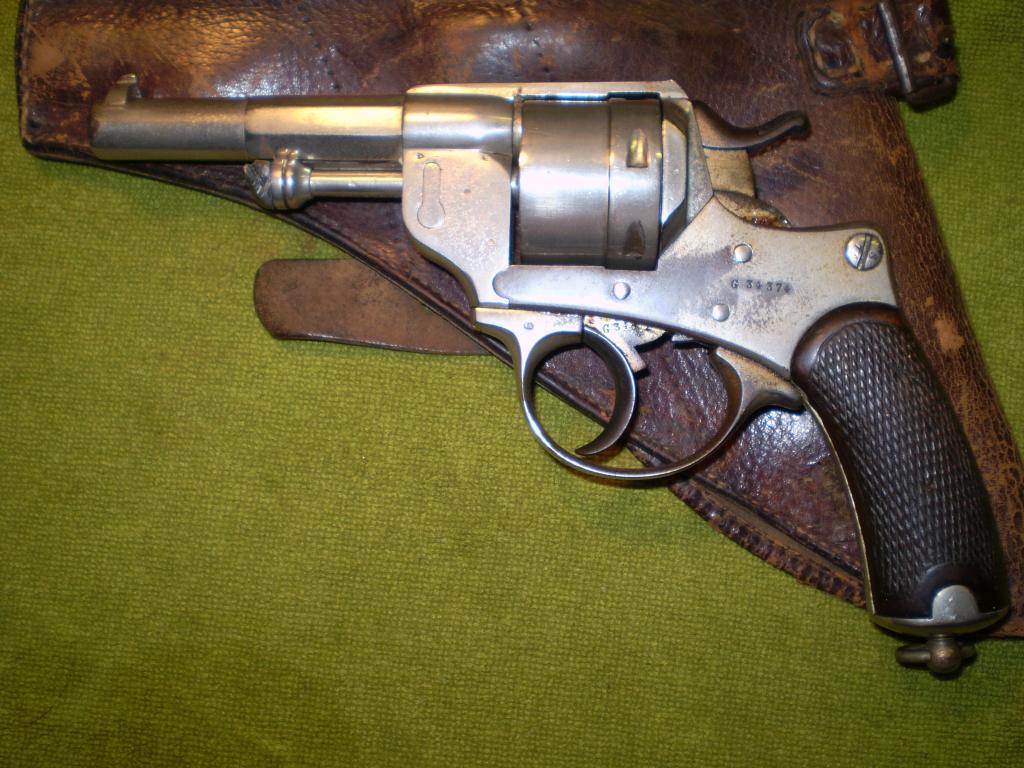
First Antique Gun- some newbie questions, French 1873 MAS

Status
Not open for further replies.

Thiopento

CGN Regular
Rating - 100%
64   0   0
Location
Toronto
Hi everyone,

I've recently bought my first antique firearm, an 1873 MAS Chamelot-Delvigne revolver (http://en.wikipedia.org/wiki/MAS_1873_revolver)- pic below, it's converted to .45 ACP. It's a REALLY heavy pistol and feel that it can take shooting .45 ACP no problem. I've been suggested to use lighter loads and SWC bullets which I've found and bought already.

I plan to shoot it quite a bit- My first question is can I shoot it on my property at my cottage up north? Its far away from anywhere and I'm making sure there's nothing behind where I'm shooting. Is this legal- anyone got proof ? Asyde: Can I do this with my non-restricted firearms as well?

Second question- how do I maintain my revolver? I don't have any gun supplies yet apart from gunlocks. What should I use to clean it, grease it and oil it? Any other tips for managing it apart from being safe with ACT-PROVING it before working on it.

As you can tell I'm a real newbie with owning a firearm so any help would be appreciate!

Cheers,

Thio

HInq9cd.jpg
 
Hi. Hope you enjoy your new hobby.

As for legally firng a restricted firearms just anywhere, hopefully somebody can weigh in for you. I don't feel qualified to answer that but (as for non-restricted) will observe that during hunting season or shooting varmits, most people just go wherever they have legal access and are prudent with every shot.

As for cleaning and maint; I recommend you get/assemble a cleaning kit containing a bore brush, jag, appropriate sized swabs and old tooth brush as a minimum. I'm not a fan of bore mops beyond drying out a barrel before firing. Essentially every surface that can be accessed, both inside and out gets a scrubbing/rub down to remove dirt/fouling.

I'm a fan of Hoppes #9 but any reputable solvent should do fine. If metal fouling in the barrel starts to distress you, there are products available to deal with it. In 35 years in the Army I never saw grease applied to small arms, even if the manual my have directed it. If you had issues, oil was removed or added as required. Any place that might benefit from grease would likely be difficult for you to access and would possibly stiffen things up in cold weather or hold dirt/grit. If you do go that way, a very light grease on surfaces that rub against each other.

My own rule for cleaning a bore is that if I can access from the breech, it's ok to use a rod. if I clean from the muzzle, a pull-through such as a Bore Snake can be drawn through from either direction although I prefer to pull it forward to minimize crap ending up in the chamber/action. My reasoning is that the crown will eventually wear from a rod and is the last point of contact for the bullet which might affect accuracy. Probably doesn't affect the Average Joe and may not have any validity in practice but that's my quiff.

Remember, rear sight and target should be blurred and front sight in focus. Twist some masking tape into a rope and burn that to blacken your sights.

Have you had it checked by a gunsmith? To be honest I don't and I'll bet most guys just take the used new toy to the range but it's a good idea, particularly with something as complicated as a revolver.

That's my 2 cents/2 minutes worth. Without checking, I'll bet there's lots of advice/instruction that can be Googled or found on YouTube.

Have fun.
 
Gorgeous piece. Sadly the way I understand it you can fire an antique firearm anywhere you can fire non restricted arm. But im pretty sure that since yours has been modified to 45acp it doesn't qualify as a antique any more and is classified as a restricted.
 
Handguns:

manufactured before 1898 that can discharge only rim-fire cartridges, other than .22 Calibre Short, .22 Calibre Long or .22 Calibre Long Rifle cartridges;
manufactured before 1898 that can discharge centre-fire cartridges, other than a handgun designed or adapted to#discharge .32 Short Colt, .32 Long Colt, .32 Smith and Wesson,
.32 Smith and Wesson Long, .32‑20#Winchester, .38#Smith and Wesson; .38 Short Colt,
.38 Long Colt, .38-40 Winchester, .44‑40 Winchester, or .45 Colt cartridges.

Licensing and Registration Requirements

Individuals who own only antique firearms do not need a firearms licence, nor do they need to register any of their antique firearms.

Straight from rcmp website, if its NOT on that list its an antique
 
Gorgeous piece. Sadly the way I understand it you can fire an antique firearm anywhere you can fire non restricted arm. But im pretty sure that since yours has been modified to 45acp it doesn't qualify as a antique any more and is classified as a restricted.

Stunningly mis-informed.

Please Sir, read just one of the many EE ads that clearly show many 45 ACP antiques for sale.

This is incredibly common knowledge and this post is spreading mis-information.

Sigh.
 
id like to say that not all factory .45 acp ammo is safe in this gun dingus recommends wolf factory .45 acp SWC ammo as it is lightly loaded or reload your own with light loads. it is antique don't worry
 
Shoot away anywhere it is legal to shoot a non restricted firearm. It must be transported in a locked opaque case. Otherwise, same rules as a rifle/shotgun apply. Don't fire +P ammunition in this ever. I had mine done to .455. Much safer.
 
So much mis information.... this gun is still antique status, discharge safely where you can legally discharge a non restricted firearm.

Keep the loads light, they are strong guns but they are old and you will damage them if you don't.
 
"...Straight from rcmp website, if its NOT on that list its an antique..." No it isn't. Read it again. There's no antique that fires a .45 ACP. No such thing as a .45 ACP before 1898.
"...discharge centre-fire cartridges, other than a handgun designed or adapted to discharge..."
"...one of the many EE ads..." Totally irrelevant. The EE has nothing to do with what is and what is not a legal antique.
 
"...Straight from rcmp website, if its NOT on that list its an antique..." No it isn't. Read it again. There's no antique that fires a .45 ACP. No such thing as a .45 ACP before 1898.
"...discharge centre-fire cartridges, other than a handgun designed or adapted to discharge..."
"...one of the many EE ads..." Totally irrelevant. The EE has nothing to do with what is and what is not a legal antique.


Huh that's really odd since the RCMP have given many members of the community antique status letters knowing that they currently fire said converted cartridges...
 
"...Straight from rcmp website, if its NOT on that list its an antique..." No it isn't. Read it again. There's no antique that fires a .45 ACP. No such thing as a .45 ACP before 1898.
"...discharge centre-fire cartridges, other than a handgun designed or adapted to discharge..."
"...one of the many EE ads..." Totally irrelevant. The EE has nothing to do with what is and what is not a legal antique.

Wow. Who knew it was possible to be wrong on so many levels?
 
Tyockell18 and Kewl both X2. I have an RCMP antique status letter for a 44 Special converted RR1883 and had a RCMP status letter for a 38 Special converted Colt that I used to own. I have RCMP antique status letters for two of my Webley MkIIs in 45acp. Counting only close friends I know of 6 other Webleys (MkI and MkIIs) converted to 45acp that have RCMP antique status letters issued for them. So I have no idea where Sunray gets his information from.
 
Sure it qualifies as an antique at the current time but I am pretty sure this wasn't the original intent of the law when they wrote it. Who can say that things won't change in the future? We could end up losing the freedom we enjoy with all antiques just because of the actions of a few. In France an 1873 MAS in the original caliber falls into their antique class. One converted to .45ACP does not.

There are other reasons why converting these is a bad idea and who better to ask then the French themselves?

During WW2 there were some that were converted to 45acp. This was done in DESPERATION. It wasn't like anyone thought it was a particularly good idea. They knew that it could only fire a few before it had a catastrophic failure. Still, a gun that can fire a couple of rounds was better than a gun that had no bullets at all. The strategy was to kill the German officer with the converted gun and then capture the Germans sidearm for future use, discarding the now damaged 45.

Years later when the 1873 MAS was plentiful the but 11mm French ordnance rounds were not; people started to ask about reloading. To begin with they knew a few things. First of all they knew that the .45acp round was much to powerful as it destroyed the guns. Second they knew that it was always the top strap that failed. The third thing they observed is that after firing a few of the more powerful rounds that the top strap would still eventually fail even if much lower power rounds were used after.

An engineer and some other folks got together to figure out what was safe and it is my understanding that they eventually published a series of articles about it in a French gun magazine. I was only ever able to find a translation of this one part but it has some very good information.

REVOLVER CHAMELOT DELVIGNE TYPE 1873

Computation of the forces transmitted to the top strap during firing:

At firing, pressure is transmitted to the cylinder frame through the case’s base.

Area of the chamber : 11.43mm X 11.43mm X 3.14/4 = 1.02 sqcm (0.1581 sqin)

Distribution of the force over the upper and lower surfaces of the frame, (distance of the application point of the force to the reaction points)

Distance from top of frame to barrel axis: 8.5 mm (.335”), top strap thickness: 3 mm (.118”).
Distance from top strap cross-section mid-point to barrel axis: 8.5 mm + 1.5 mm= 10 mm (.393”)
Distance from the bottom of the frame to the barrel’s axis: 37 mm (1.456”)
Lower frame thickness: 12 mm (.472”)
Distance from lower frame cross-section mid-point to barrel axis: 37 mm + 6 mm= 43 mm (1.69”)

Distance between mid-points of top and bottom frame cross-sections: 10 mm + 43 mm=53 mm (2.09”)

Force exerted on the rear of the frame, assuming an 800 bar [11,600 psi] loading:

800 x 1.02 = 824 kgf (1816 lbs)
Force acting on top strap:
824 x 43/53 = 669 kgf (1475 lbs)
Force acting on frame bottom:
824 x 10/53 = 155 kgf (342 lbs)

Case of a 48 kg/sqmm (34.136 ton/sqin) yield strength steel revolver frame :

Area of the top strap at its weakest point: 36 sqmm (.056 sqin)

HENCE: firing a 800 bar (11,600 psi) load exerts a force on the top strap of:
669/36 = 18.6 kg/sqmm (13.2 ton/sqin)

Without precisely knowing the tensile limit of a 48 kg/sqmm steel, which is somewhere between 70 and 80% of the minimum yield strength, an 18.6 kg/sqmm is only 39% of the yield strength and is well within the tensile limit of the steel.

Dangerous loads:
If the minimum tensile limit of a 48 kg/sqmm steel is 70% (or 33 kg/sqmm), the danger point for the top strap is therefore 36 x 33 = 1180 kgf; the force applied to the rear of the frame is therefore 1180 X 53/43 = 1464 kg/sqmm, which would require a 1464/1.02 – 1435 bar (20813 psi) load minimum to be dangerous.

These calculations do not take into consideration the friction between cylinder chamber and cartridge case which will reduce the rearward force by at least 10%.

The use of 800 bar (11,600 psi) loads in the Mle, 73 is quite reasonable IF the revolver has never fired loads that might have overstressed the top strap beyond its tensile limit (in which case top strap rupture would be inevitable as even weak loads induce stretching).


Note the last comment about an overstressed top strap. This is the reason that it fails even if low power loads are used. There isn't any obvious crack or anything I am told either. I imagine it might show up if you xrayed it like they do for aircraft parts. Also, 45acp is normally rated at 21000psi which fits with the statement that 20813psi is dangerous.

So this is the reason why you don't convert these to 45 and you don't buy one if it has been converted. You don't know what has been fired previously and a visual inspection isn't going to tell you if you are holding a sound piece or a dangerous one.
Besides, 11600 psi is a pretty anemic load so you are going to have to hand load for it anyway. It isn't that difficult to make brass for these and proper heeled bullets can be purchased and molds for them are available as well. Just be sure that you are using soft lead projectiles as 11600psi isn't much and jacketed or even hard (Wheel Weight) bullets will cause the pressure to spike quite a bit. I reload for my own 1873 MAS and I have made the brass as well as cast my own bullets. I shoot mostly black powder and it is great fun.

 
Last edited:
Sure it qualifies as an antique at the current time but I am pretty sure this wasn't the original intent of the law when they wrote it. Who can say that things won't change in the future? We could end up losing the freedom we enjoy with all antiques just because of the actions of a few. In France an 1873 MAS in the original caliber falls into their antique class. One converted to .45ACP does not.

We already know that the anti gun fanatics and their posse the "liberals and NDP" want to ban antique revolvers as they think its a disgusting loophole that must be plugged. We also know they want to ban modern handguns and semi automatic's of all shapes and sizes and most likely manual repeaters as well.

Why do you need more than 1 round for hunting anyways, you trying to hunt people or something?.

To think we are somehow going to be left alone for not converting over a few of these old girls is laughable at best, we have enemies everywhere and they want everything.
 
Common sense should tell you that giving them any reason to attack our freedoms is a bad idea then.

Common sense will tell you they already are going to regardless. When the CPC is out of power, we're 100% screwed, no contest. These guns will just be thrown in as an after thought while they go ban crazy on everything else that has a magazine.

Wendy and her friends have stated many times that antique firearms are a threat and must go. Doing something that "isn't illegal" won't change that.

Besides the cat is already out of the bag and has been for many years in regards to conversions.
 
Last edited:
OP - congrats on the great new revolver!

HOWEVER

You have to know that antiques are a very unique, poorly understood and obscure part of firearm law.

YOU are representing antique owners. If you screw up, all of us end up being held responsible, so please know the laws and don't do anything that can possibly bring concern on antiques

Also, be aware that most law enforcement have NO idea about antique law. That means you have to know the law inside and out, and be able to politely prove and show paperwork unless you want your gun confiscated and you to end up in the back of a police cruiser.
 
OP - congrats on the great new revolver!

HOWEVER

You have to know that antiques are a very unique, poorly understood and obscure part of firearm law.

YOU are representing antique owners. If you screw up, all of us end up being held responsible, so please know the laws and don't do anything that can possibly bring concern on antiques

Also, be aware that most law enforcement have NO idea about antique law. That means you have to know the law inside and out, and be able to politely prove and show paperwork unless you want your gun confiscated and you to end up in the back of a police cruiser.

What he said.
 
Status
Not open for further replies.
Back
Top Bottom